


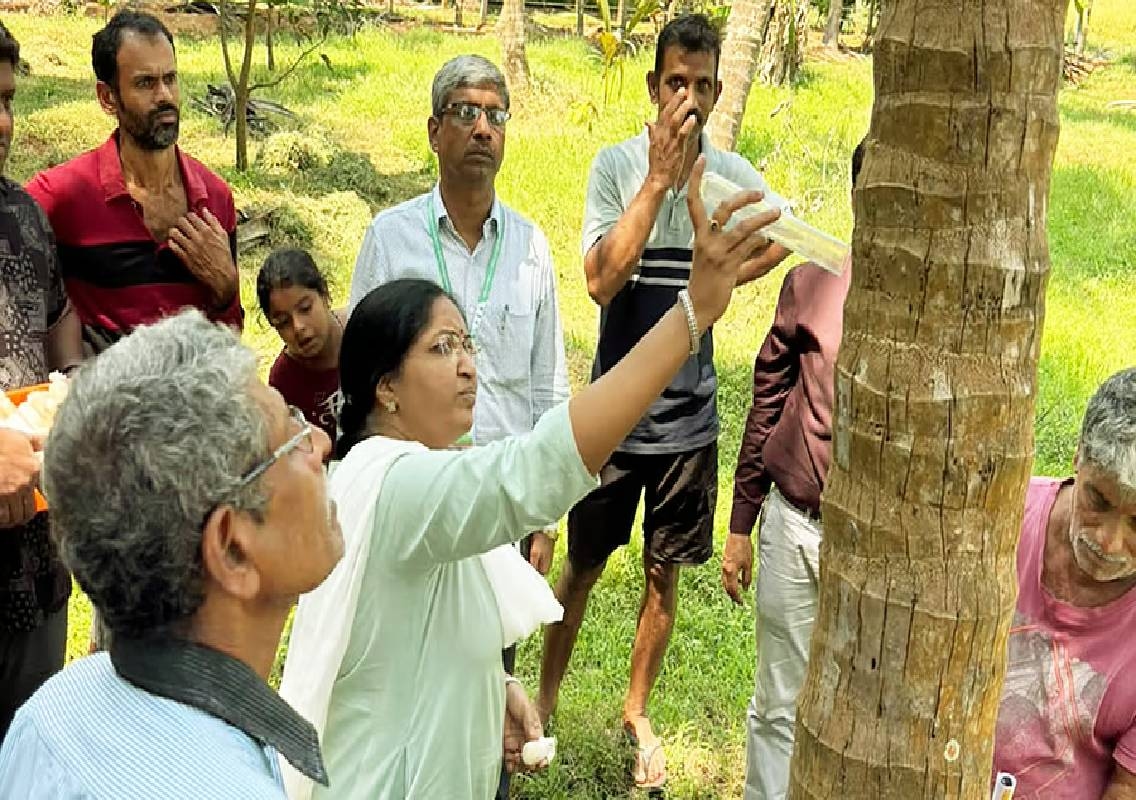


Udupi: Scientists from the ICAR–Central Plantation Crops Research Institute (ICAR-CPCRI), Kasaragod, have sensitised coconut growers in Udupi district on sustainable methods to manage the black-headed caterpillar, a pest that damages coconut leaves and threatens plantation health.
The farmer sensitisation programme was organised in collaboration with the Karnataka State Horticulture Department at Hadavu village in Kundapura taluk on October 13. Around 20 coconut growers participated in the initiative, which focused on identifying the pest, understanding the damage it causes and adopting biological control methods.
Scientists demonstrate biological pest management
The programme was attended by ICAR-CPCRI scientists Dr A. Josephrajkumar, Dr Rajkumar, Dr Mahendran B. and Dr Prathibha P. S. Kshama Patil, Deputy Director of Horticulture, and Praveen, Horticultural Officer in Kundapura, also participated.
The scientists explained how black-headed caterpillar infestations affect coconut palms. The pest feeds on leaf tissues, causing leaflets to dry and turn brown. In severely affected plantations, the leaves can develop a scorched appearance, indicating extensive damage.
Farmers were encouraged to monitor their plantations regularly and identify infestations at an early stage. Early detection and timely intervention can help farmers manage pest populations before the damage spreads across neighbouring coconut gardens.
Natural enemies released in affected plantation
A key component of the programme was the demonstration of biological control using two larval parasitoids: Goniozus nephantidis and Bracon brevicornis.
These natural enemies attack the larval stages of the black-headed caterpillar and can help suppress pest populations. During the programme, scientists released both parasitoids in an identified pest-infested area of Hadavu village.
The farmers also received practical training on parasitoid release techniques, their appropriate deployment in plantations and the importance of conserving beneficial organisms.
The scientists highlighted that biological control can form part of an eco-friendly approach to pest management, reducing dependence on chemical pesticides when implemented appropriately.
Community participation key to controlling the pest
The programme stressed the importance of collective action among coconut growers. Since pests can spread between neighbouring plantations, isolated efforts may not be sufficient to manage an infestation across an entire area.
Farmers were encouraged to coordinate monitoring and biological control activities with neighbouring growers. Such community-based interventions can help suppress pest populations over a wider area and reduce the risk of further spread.
ICAR-CPCRI has previously undertaken biological management initiatives against black-headed caterpillar outbreaks in coastal Karnataka. The institute reported successful management efforts in Thokkottu in 2017 and Mangaluru in 2023 through the sequential release of parasitoids suited to different stages of the pest. Similar demonstrations have also been conducted in Padukere in Udupi district and Arsikere in Tumakuru district.
Scientists assess chrysanthemum cultivation in Hemmady
Following the programme, the scientific team visited Hemmady village in Kundapura taluk to assess the traditional chrysanthemum variety known as Hemmady Sevanthige, or Hemmady Local, which is cultivated within coconut-based farming systems.
As the crop was still in its initial planting stage, no visible pest or disease incidence was observed during the visit. However, farmers raised concerns about managing pests and diseases, noting their reliance on chemical pesticides for crop protection.
The scientists emphasised regular crop monitoring, conservation of natural enemies and preventive, eco-friendly pest management practices. They also asked farmers to share details of any pest or disease symptoms that emerge as the crop develops so that appropriate recommendations can be provided.
The initiative highlighted the importance of collaboration between agricultural research institutions, horticulture officials and farmers in promoting sustainable pest management. By encouraging early detection, biological control and coordinated action, ICAR-CPCRI aims to support healthier coconut plantations and reduce unnecessary dependence on chemical pesticides in coastal Karnataka.