







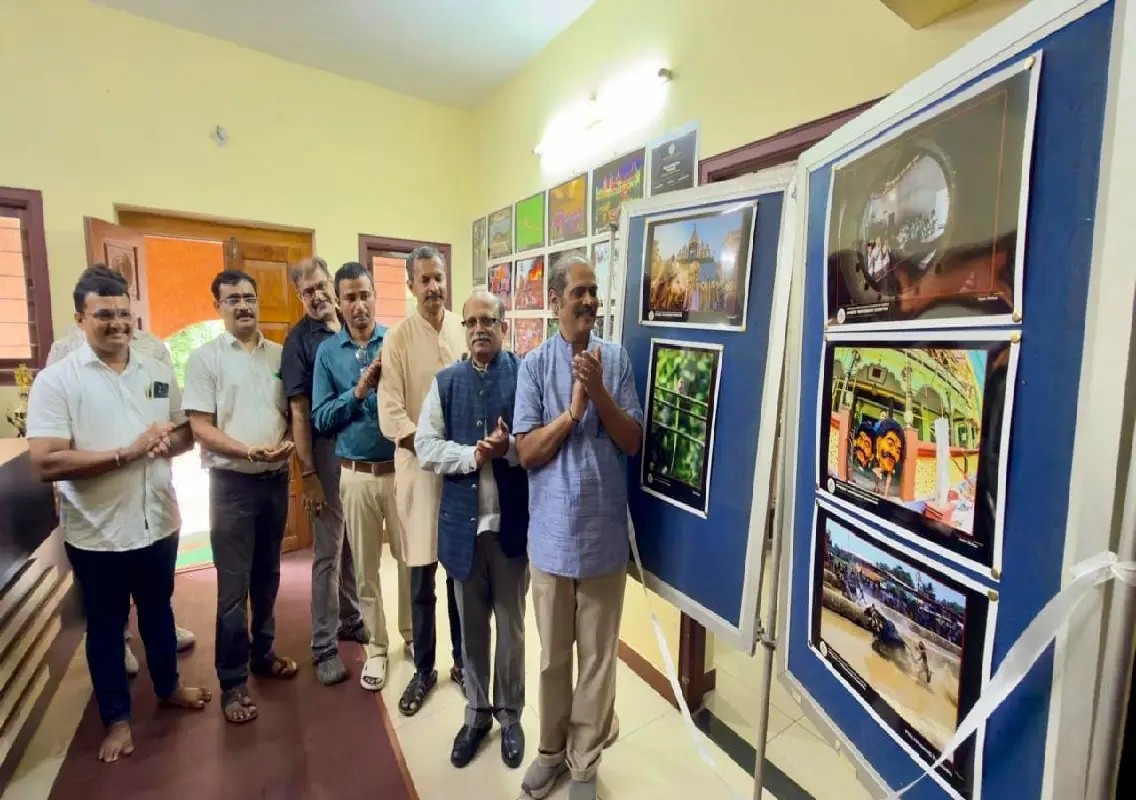


Udupi: The Udupi District Working Journalists’ Association (UDWJA), in association with the Udupi Press Club Committee, celebrated World Photography Day by organising a news photography exhibition at the Udupi Press Club on August 19.
The exhibition brought together news photographs highlighting the role of photography in journalism and provided a platform to discuss the changing nature of the profession in the age of digital technology and artificial intelligence (AI).
Satyabodha Joshi, professor of practice at Manipal Institute of Communication, inaugurated the news photography exhibition. Bharath Kumar, director of public relations, media and social media at Manipal Academy of Higher Education (MAHE), also inaugurated the programme.
The event focused on the importance of photography in documenting events and preserving moments while also examining the opportunities and challenges emerging technologies are creating for professional photographers.
AI presents both challenge and opportunity
Speaking at the programme, Satyabodha Joshi described AI as one of the most significant sources of knowledge in the present era.
He said the rapid development of AI was challenging photographers to acquire new skills and adapt to changing technologies. At the same time, he stressed that AI should not simply be viewed as a threat to photography.
According to Joshi, the limitations of AI could eventually be overcome, creating opportunities for photographers who learn to use the technology effectively.
He said emerging technologies in photography bring new responsibilities for professionals working in the field.
“If AI moves 10 steps ahead, we will have to move 100 steps ahead. This is the challenge before us. If AI is used appropriately, its advantages are numerous,” he said.
Joshi also pointed out that the technology and infrastructure supporting AI require significant investment and could become increasingly expensive as the technology develops.
Practice remains key to photography
Joshi emphasised that regardless of the technology being used, the way it is applied remains crucial.
He said skills acquired through consistent practice are more likely to remain strong and sustainable, making regular learning and practical experience essential for photographers.
“Regardless of what kind of technology emerges, what matters is how we use it. Only what we acquire through consistent practice can remain strong and sustainable. This applies particularly to the field of photography,” he said.
His observations highlighted the need for photographers to combine traditional skills with an understanding of new digital tools.
The discussion was particularly relevant to news photographers, whose work requires not only technical ability but also speed, accuracy, judgement and an understanding of the context in which an image is captured and published.
Photography preserves moments
Bharath Kumar, director of public relations, media and social media at MAHE, said photography plays a unique role in preserving moments in time.
Describing photography as the process of stopping the wheel of time for a moment and preserving it, he said the fundamental principle of photography had remained unchanged despite significant technological developments.
He said photography essentially involved bringing something from darkness into light, emphasising the basic purpose of the medium despite the changes in equipment and technology over the years.
From traditional cameras to digital photography and now AI-assisted technologies, the tools available to photographers have changed substantially. However, the fundamental purpose of recording and communicating a visual moment remains important to journalism.
Ethics remain central
Bharath Kumar also highlighted the importance of professional ethics in both photography and journalism.
He noted that professionals in these fields are governed by ethical principles that help determine what should and should not be done while gathering and publishing information.
“Human beings have the ability to think about what should and should not be done, machines do not possess this ability. Therefore, those who use technology must strictly adhere to professional ethics,” he said.
His remarks underlined the importance of human judgement even as AI-based tools become increasingly accessible to journalists and photographers.
The use of AI-generated or AI-assisted imagery has raised questions globally about authenticity, manipulation and transparency. Against this backdrop, the speakers stressed that technology should be used responsibly and within the framework of professional ethics.
Talk on photography and AI
Satyabodha Joshi also delivered a special talk titled ‘Photography amid digital technology and AI’.
The session explored the changing landscape of photography in an era when digital tools and artificial intelligence are becoming increasingly influential.
The discussion highlighted the need for photographers to remain adaptable while continuing to develop their fundamental skills. It also encouraged professionals to look at AI not merely as a technological challenge but as a tool that can potentially offer new possibilities when used appropriately.
The news photography exhibition provided a practical backdrop to the discussion by showcasing the continuing importance of photographs in journalism.
Office-bearers attend programme
UDWJA district president Subrahmanya G Kurya presided over the programme.
District general secretary Nazir Polya welcomed the gathering, while State Committee member Astro Mohan delivered the introductory remarks.
District Committee member Chetan Matapady compered the programme and District Association treasurer Harish Kundar proposed the vote of thanks.
Udupi Press Club Committee convener Ankit Shetty was also present.
The World Photography Day programme brought journalists, media professionals and representatives of the press community together to reflect on the evolving role of photography.
The discussions at the event stressed that while technology will continue to transform photography, professional judgement, ethical responsibility and consistent practice will remain essential.
As AI and digital technology become increasingly integrated into visual journalism, the programme highlighted the importance of ensuring that technological advancement complements rather than undermines the credibility and integrity of news photography.