







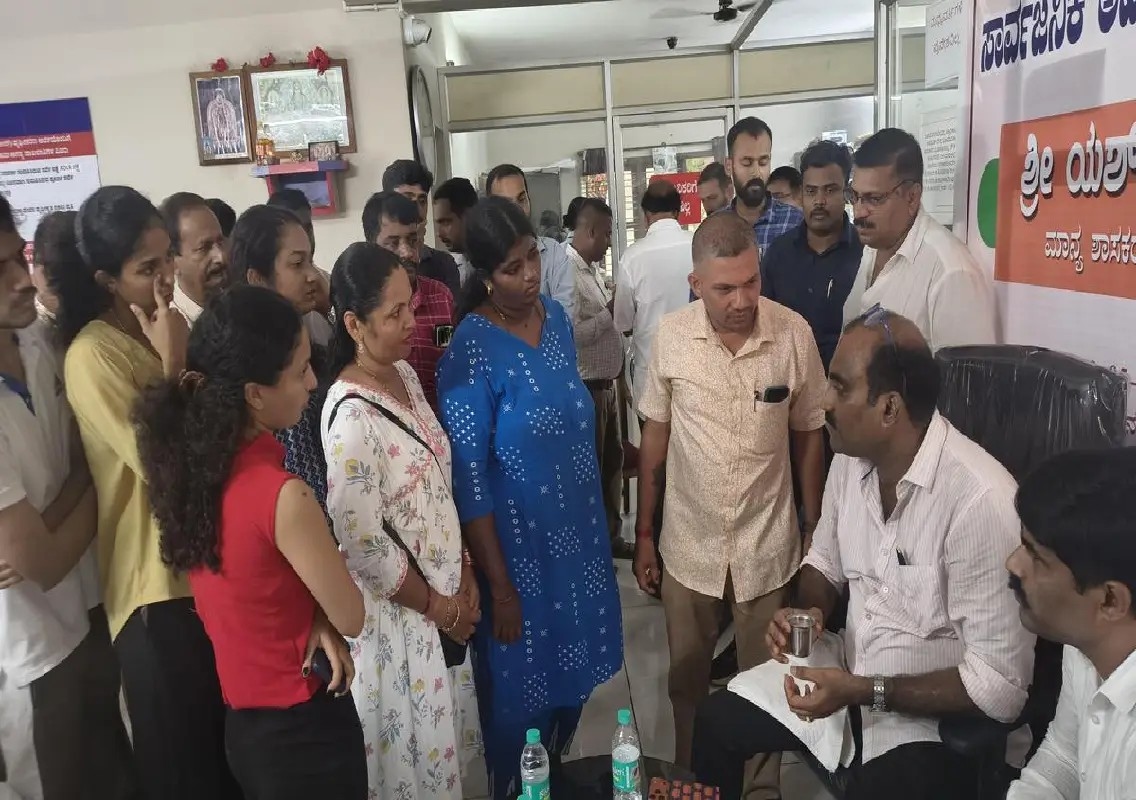


Udupi: MLA Yashpal Suvarna on Tuesday said the absence of a comprehensive master plan for Udupi city since 2008 has created several challenges for residents and urban development, and announced that consultations with stakeholders would be held within a fortnight to finalise the plan and secure government approval.
The MLA made the announcement after receiving petitions from citizens at the office of the Udupi Urban Development Authority (UUDA). He said that discussions with various departments and professional bodies would be conducted before moving ahead with the plan.
According to him, a comprehensive urban development strategy is necessary to address multiple issues affecting the city and provide long-term solutions for residents.
Stakeholder consultations to begin soon
Speaking on the matter, Yashpal Suvarna said that the proposed discussions would involve officials and representatives from different sectors connected with urban planning and development.
The consultation process is expected to include officials of the Udupi Urban Development Authority, representatives of the Udupi City Municipal Council, engineers’ associations, builders’ associations and urban planning experts.
The MLA said the purpose of the consultations is to gather inputs from stakeholders before finalising the master plan.
Urban master plans generally act as guiding frameworks for future development, covering aspects such as land use, infrastructure, road networks, housing and public amenities.
Officials believe that a structured development plan can help manage urban growth and address challenges arising from expanding residential and commercial activities.
Absence of updated plan affecting development
Yashpal Suvarna stated that the city has been functioning without a comprehensive master plan since 2008 and said this has led to various difficulties for residents.
He noted that an updated framework is important to ensure organised urban growth and prevent complications relating to planning and infrastructure.
According to him, the absence of a long-term plan has contributed to uncertainties in matters concerning land use, housing permissions and development activities.
He added that adopting a comprehensive plan could help resolve many concerns faced by people and create a clearer direction for future development projects.
Rapid urban expansion in many growing cities often increases the need for updated planning mechanisms to ensure balanced growth and efficient use of available land and infrastructure.
Exemption sought for certain property owners
The MLA also raised concerns regarding homeowners whose properties had been regularised decades ago under Section 94 (CC) of the Karnataka Land Reforms Act, 1964.
He stated that owners of such properties, typically ranging from three to five cents of land, had already received title deeds from the government and therefore should not face additional procedural difficulties while reconstructing their homes.
According to him, making such owners obtain single-site approval for reconstruction could significantly affect their property area due to road widening requirements.
He suggested that these property owners should be allowed to obtain licences for reconstructing houses without mandatory single-site approval procedures.
The MLA said mandatory approval requirements could instead be applied to newly developed layouts rather than older government-approved layouts.
Concerns raised over approval delays
Yashpal Suvarna also expressed concerns over the recently introduced two-stage approval system for house construction permissions.
He stated that the introduction of temporary and final approval stages for obtaining single-site approval had resulted in delays for people seeking to construct houses.
According to him, areas where no road widening proposals exist could be considered for direct final approval to avoid unnecessary delays.
He said the two-stage system may be appropriate only in locations where future road widening or infrastructure expansion has been planned.
The MLA argued that simplifying approval procedures in suitable cases could reduce inconvenience for residents and improve administrative efficiency.
UUDA Commissioner R. Manjunath and other officials were present during the programme.