







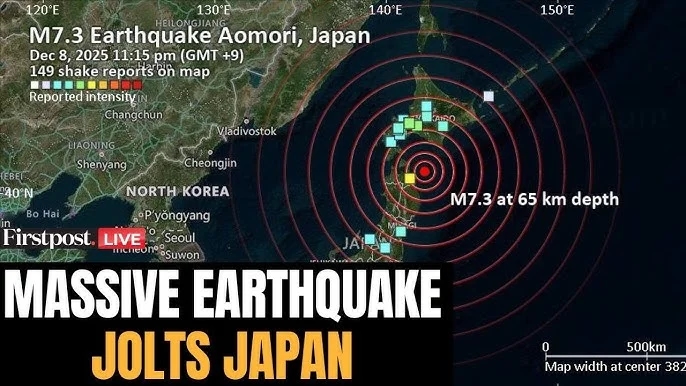


A powerful 7.6-magnitude earthquake struck off northern Japan late on Monday, triggering tsunami alerts, damaging roads and leaving at least 33 people injured. The Japan Meteorological Agency (JMA) said the quake occurred off the eastern coast of Aomori Prefecture near Hokkaido, with its epicentre about 50 km below the seabed.
Tsunami alerts and initial observations
Following the quake, the JMA issued tsunami warnings for Japan’s northeastern coastline, forecasting waves up to 10 feet in height. While no major tsunami was reported, smaller waves were recorded in several regions:
- 70 cm at Kuji Port in Iwate
- 50 cm in Urakawa Town, Hokkaido
- 40 cm at Mutsuogawara Port in Aomori
Authorities warned that further sea-level fluctuations remain possible.
Injuries and local damage reported
Prime Minister Sanae Takaichi said on Tuesday that there were reports of 30 injuries and a residential fire linked to the quake. Thousands of residents also experienced power outages in sub-zero temperatures.
The Japan Meteorological Agency later downgraded the magnitude from 7.6 to 7.5, while emphasising that the risk of strong aftershocks remains high.
“The government continues to gather information on the damage,” the Prime Minister said, noting that emergency teams have been deployed across affected prefectures.
‘Megaquake’ alert raises public concern
A day after the earthquake, Japan’s national broadcaster NHK reported that agencies have issued a warning for a potential ‘megaquake’ in the region. The alert indicates an increased probability of major tremors along the Pacific coast from Hokkaido to Chiba Prefecture.
Authorities have urged residents to stay vigilant, follow official advisories closely and prepare for additional seismic activity in the coming days.
Fukushima wastewater discharge halted as precaution
Following the tsunami alert, operations involving the discharge of treated wastewater at the Fukushima Daiichi Nuclear Power Plant were temporarily suspended. Officials confirmed that no abnormalities were detected at any nuclear facilities across the northeast.
The precautionary suspension follows routine safety protocols implemented after significant seismic events.
Infrastructure impact across northern Japan
Local authorities reported damaged roads, disrupted public services and renewed concerns about safety in coastal areas. While transportation systems remained largely operational, several communities faced overnight disruptions due to power outages and emergency inspections.
Residents in Aomori, Iwate and Hokkaido were advised to check evacuation routes and stay prepared for potential advisories.
Ongoing monitoring and public safety measures
The JMA said Monday’s late-night quake significantly increases the likelihood of similar or stronger earthquakes within the next few days. Officials have urged residents to avoid coastal zones, remain alert to evacuation orders and rely solely on verified government updates.
Emergency services continue to assess the full extent of the damage while strengthening disaster-response systems in quake-prone regions.