







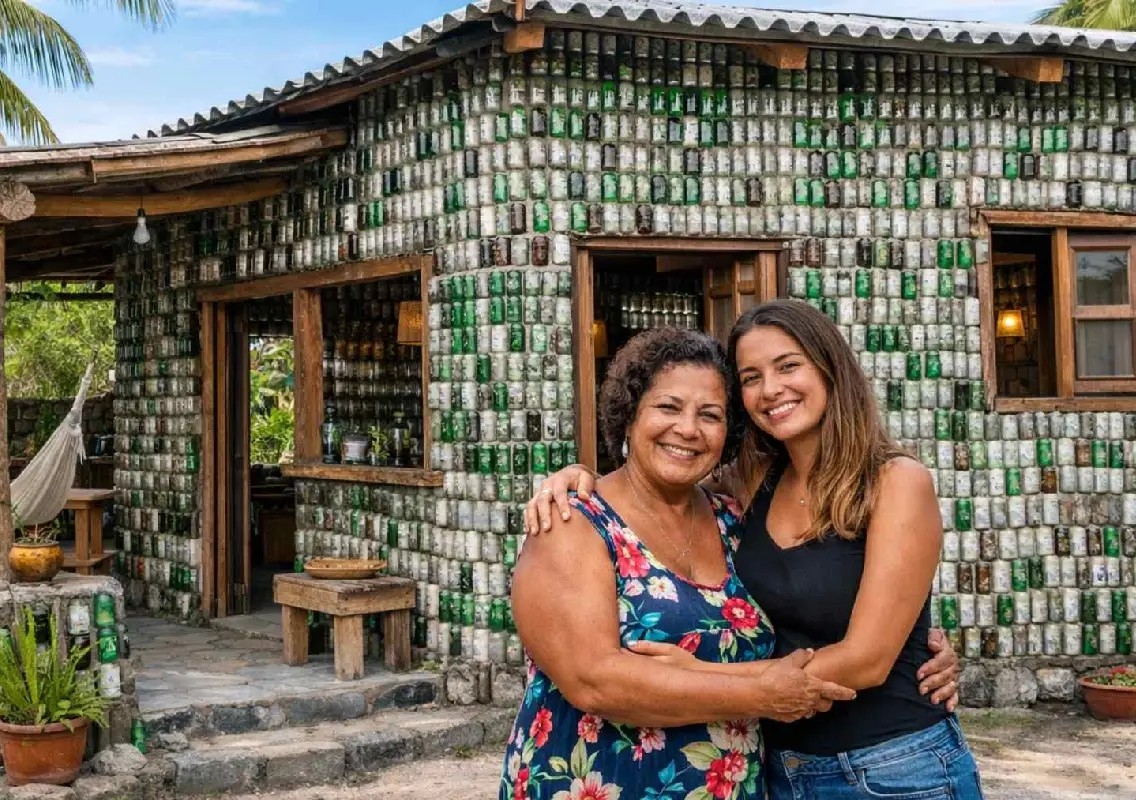


What began as a response to bottles piling up along a Brazilian beach has turned into an unusual seven-room home built from more than 8,000 discarded glass bottles, recycled wood, pallets and toothpaste tubes.
Called Casa de Sal, or The Salt House, the home on Brazil’s Itamaraca Island was created by mother-daughter duo Edna Dantas and Maria Gabreilly Dantas as an example of how waste can be transformed into something useful.
Beach waste becomes building material
Edna, 55, is a socio-environmental educator, while her 27-year-old daughter works in sustainable fashion. The pair spent two years collecting materials for the project.
They used glass bottles to create walls, recycled pallets for partitions and toothpaste tubes for roofing. The first completed room, measuring around 215 square feet, was used as a sewing workshop while construction continued.
According to the information shared by the family, they have collected more than 13,000 bottles since beginning the project, with around 8,000 incorporated into the house.
A home built through creativity and persistence
Edna grew up in a family where reusing materials was part of everyday life. She recalled making toys from bamboo and other discarded materials during childhood, describing reuse as a way of living rather than environmental activism.
The project also presented challenges beyond construction. Maria said workers brought in for specific tasks sometimes tried to correct or underestimate the women instead of simply helping them.
Their experience challenged the idea that construction is traditionally a male domain and highlighted the skills, planning and determination required to complete an unconventional building project.
More than an environmental project
The Dantas family views Casa de Sal as part of a wider response to waste, housing needs and environmental inequality.
Glass bottles can remain in the environment for long periods when they are discarded rather than recycled. In coastal communities, abandoned bottles can become an additional burden for residents dealing with tourism-related waste.
The family also connects the project to their Afro-Brazilian Quilombola heritage and their tradition of respecting and reusing natural resources.
From home to community initiative
Casa de Sal is now listed as a destination on Airbnb, while Edna and Maria conduct workshops to share their sustainable construction methods.
They have also developed an upcycled accessories brand, creating hand-sewn tote bags using other recovered materials.
For the mother and daughter, the house represents more than an unusual construction project. It is a reminder that material often dismissed as waste can be given a second life through creativity, skill and determination.