







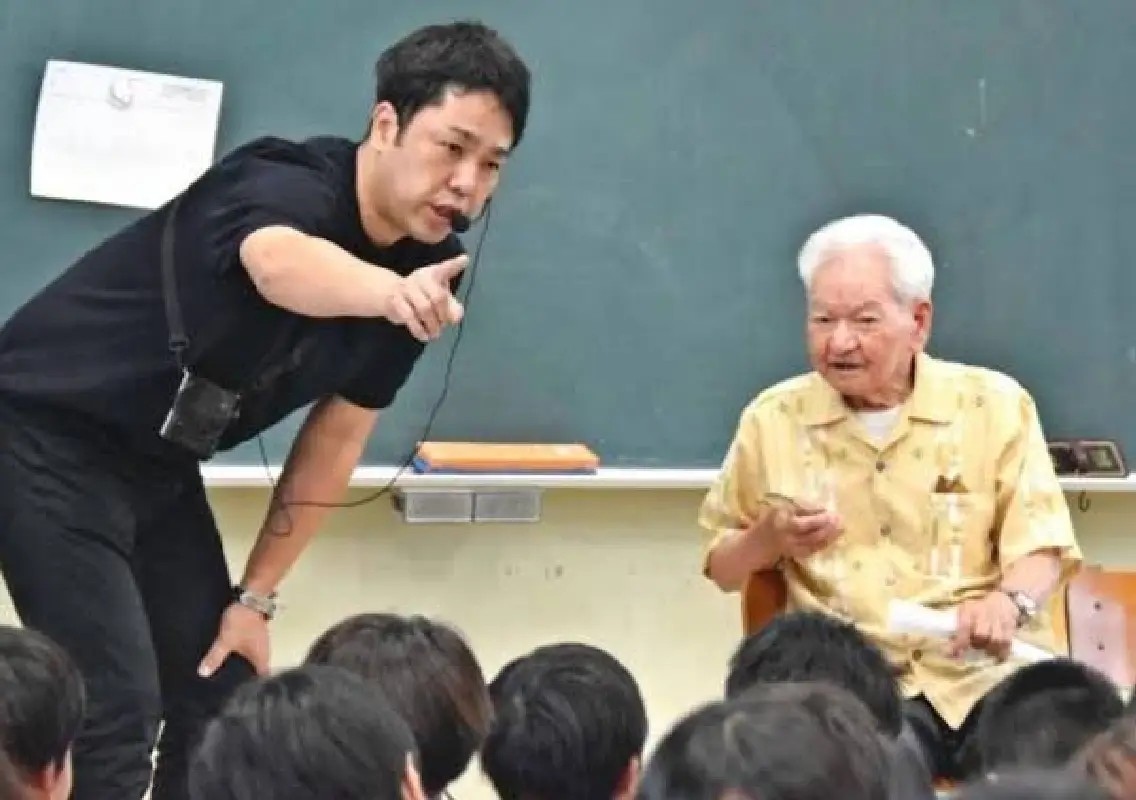


Haebaru, Okinawa: Eighty-one years after the Battle of Okinawa, 95-year-old Kohei Nohara returned to his hometown to share memories of war with a new generation of children.
Nohara was only 14 when he fled Haebaru with relatives in May 1945 as US forces advanced across Okinawa. His journey south was marked by shelling, destroyed villages, dead bodies and the loss of family members.
A childhood marked by fear
Speaking to around 90 fifth-grade students at Shonan Elementary School, Nohara recalled hiding in caves before his family was forced to flee.
Near Mabuni in present-day Itoman, tragedy followed them. An aunt was badly wounded by shell fragments and had to be left behind. Days later, a cousin was killed by shrapnel when a shell exploded near the family.
Nohara and his relatives eventually surrendered to American soldiers in June 1945. He vividly remembered fearing that the soldiers would shoot him, only to discover that one of them had lit a cigarette for his uncle.
“That was when I realised I had survived,” he recalled.
Passing memories to a new generation
Teacher Naoya Arakaki used Google Maps and wartime photographs to trace Nohara’s escape route for the children. The lesson focused not only on what happened during the battle but also on why remembering such experiences matters.
Nohara continues to visit the Cornerstone of Peace memorial in Itoman each year to pray for those who died.
“War is a terrible thing,” he told the students.
Arakaki said firsthand accounts are especially valuable as the generation that experienced the war grows older. He hopes children will learn about history without being consumed by hatred, while respecting their own country and other nations.
The Battle of Okinawa remains one of the most devastating campaigns of World War II, with enormous civilian and military losses.
Nohara’s testimony carries a simple message across generations: remembering the suffering of war can help build a stronger commitment to peace.