







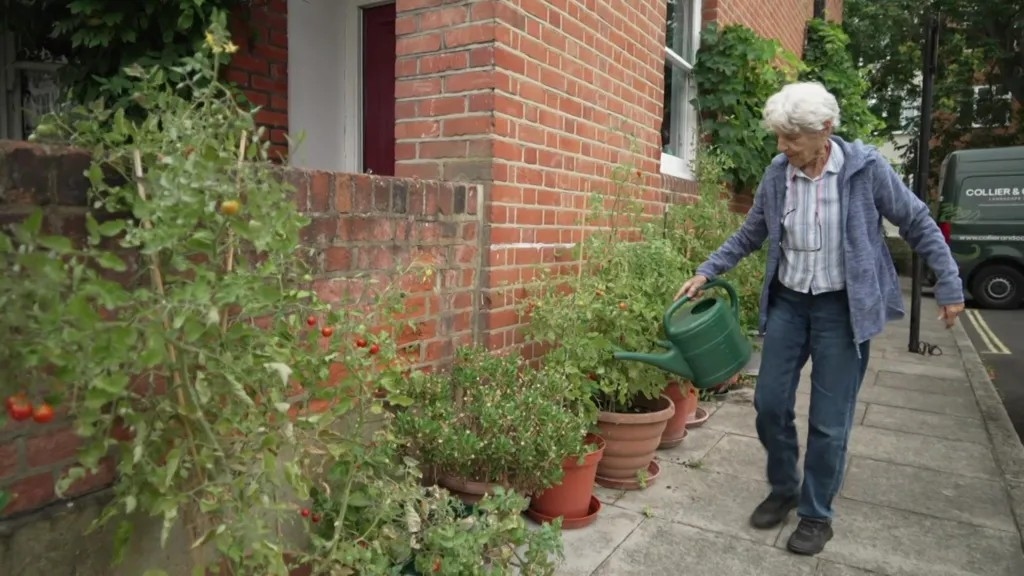


London : An 89-year-old retired teacher who has spent more than 25 years tending a small street garden outside her home in St John’s Wood, central London, has been told by Westminster City Council to remove it following complaints.
Katharine Hoskyns has filled the pavement outside her home with more than 20 plant pots, growing geraniums, tomatoes and herbs with support from neighbours. She was issued a removal notice by Westminster City Council in July, asking her to remove the pots and a bench from the pavement.
The notice has sparked concern among neighbours, who say the garden has become an important part of the local community and has transformed what could otherwise be an ordinary concrete corner.
Garden became part of her retirement
Hoskyns, who has lived in the area since the 1960s, said the garden began after parking spaces were introduced on the street. Over the years, caring for the plants became an important part of her daily routine.
She said gardening gives her a reason to get outside and provides her with an occupation in retirement.
“This space is important to me because I love gardening and it gives me plenty to do,” she said.
The garden has also helped Hoskyns maintain social connections with people living nearby. She said passers-by often stop to speak to her while she tends the plants, giving her an opportunity to interact with others.
“People come up and talk to me while I’m doing it, so it gives me a bit of a social life as well,” she said.
The issue therefore goes beyond the plants themselves for Hoskyns. The garden has become a source of routine, purpose and community interaction during her later years.
Council raises concerns over bench
Westminster City Council said unauthorised plant pots on pavements can be subject to enforcement where they cause an obstruction or when complaints are received.
The council has specifically asked for the bench to be moved, saying it has attracted anti-social behaviour.
Hoskyns, however, said she was upset and angry when she initially received the notice. She disputed concerns that the plants obstructed the pavement and said she had never witnessed anti-social behaviour at the site.
She also uses a walking frame and said she could move past the pots without difficulty, suggesting that the garden did not prevent pedestrians from using the pavement.
The disagreement highlights the challenge faced by councils in balancing public access and safety with residents’ efforts to improve and maintain shared spaces.
Neighbours rally behind the garden
Hoskyns’s family responded to the removal notice by writing to the council and launching a petition in support of the garden.
The petition, started by her son, has attracted more than 190 signatures.
Neighbours have also spoken about the importance of the space to the local community.
Holly Bell-Stevens, who lives nearby, said the garden had given the area a distinctive character and created a place where residents could interact.
She described the corner as a “quiet oasis” within Westminster and warned that removing the plants would leave it looking like another concrete corner.
Bell-Stevens said the space had become familiar to local families over the years. Her children learned to ride their bicycles there, while residents use the area when walking their dogs.
She said the plants had helped cultivate a sense of community and that the garden had an impact on people beyond its immediate appearance.
Deadline passes without removal
The deadline mentioned in the council’s notice has now passed, but the garden remains in place.
Hoskyns said she expected to hear from Westminster City Council again about the matter.
For now, the pots remain outside her home, continuing to provide flowers, herbs and vegetables while neighbours rally around their elderly caretaker.
The dispute has also raised a broader question about the role of informal community spaces in urban neighbourhoods. What began as one resident’s effort to create a small garden has, over more than two decades, become part of the character of the street and a place associated with everyday interactions among residents.
For Hoskyns, however, the garden is about more than beautifying the pavement. It gives her something meaningful to do, brings people to her doorstep and provides a reason to remain connected with the neighbourhood she has called home for decades.