







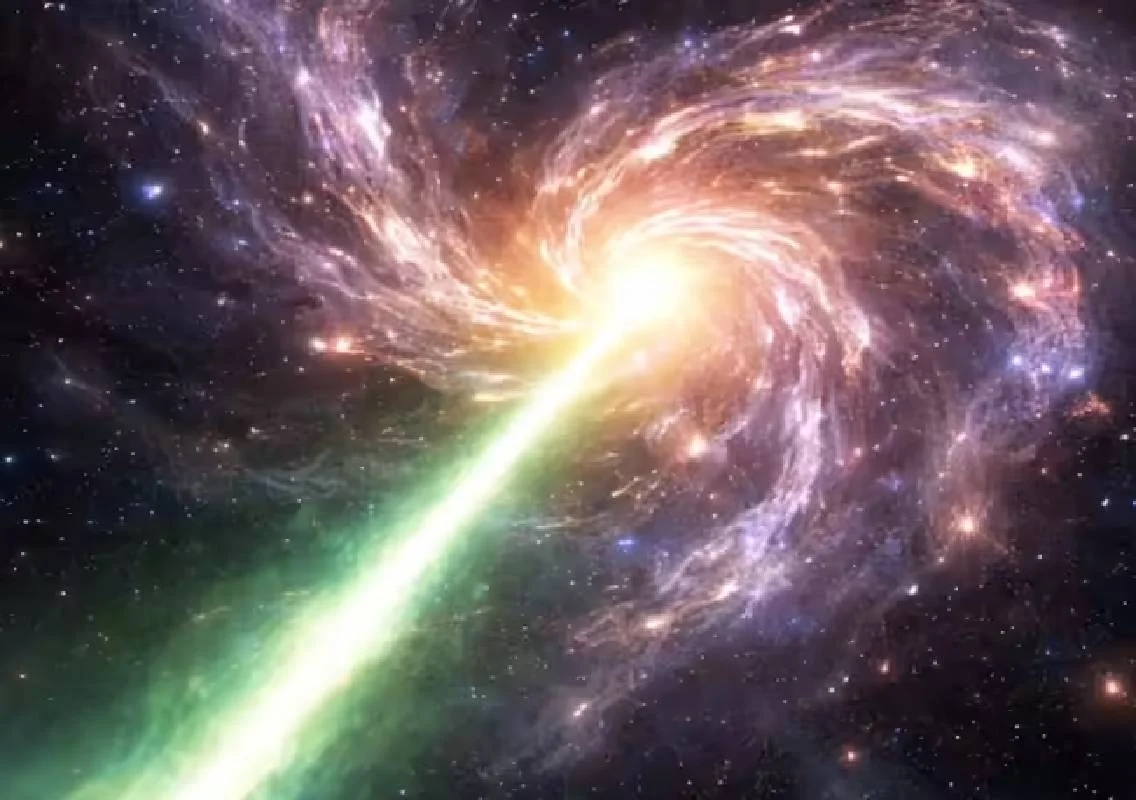


Cape Town: Astronomers have detected the most distant and brightest “space laser” ever observed, originating from a galactic collision around 8 billion light-years away. The discovery offers fresh insights into extreme cosmic environments and how powerful signals travel across vast distances in the universe.
The signal was captured using the MeerKAT radio telescope, one of the world’s most advanced radio astronomy instruments. Scientists identified the phenomenon as a hydroxyl megamaser — a natural amplifier of microwave radiation formed during galaxy mergers.
What is a ‘space laser’?
Unlike traditional lasers that emit visible light, a megamaser produces intense radiation in microwave or radio wavelengths. In this case, the signal originated from hydroxyl molecules made of oxygen and hydrogen present in dense gas clouds within merging galaxies.
The source of the signal is a distant galaxy system known as HATLAS J142935.3–002836. The light detected today began its journey roughly 8 billion years ago, meaning astronomers are observing the system as it existed when the universe was about half its current age.
Role of gravitational lensing
The discovery was made possible due to a phenomenon called gravitational lensing, first predicted by Albert Einstein in his theory of general relativity.
Gravitational lensing occurs when light from a distant object passes through warped spacetime created by massive objects like galaxy clusters. This bending effect magnifies the light, making faint and distant objects appear brighter and easier to detect.
In this case, gravitational lensing amplified the megamaser signal, allowing astronomers to observe a system that would otherwise have remained too faint to study.
Why this discovery is significant
According to researchers, including discovery team leader Thato Manamela from the University of Pretoria, the megamaser is remarkable for both its distance and intensity.
“This megamaser is unusual because it is located at a very large distance. That means we are observing it from a much earlier time in the universe,” Manamela said.
The signal also indicates the presence of dense molecular gas and highly energetic activity within the merging galaxies. Such conditions are ideal for producing megamasers, but detecting them at such extreme distances is rare.
Insights into the early universe
The finding helps astronomers better understand how galaxies evolve and interact over billions of years. It also sheds light on the physical processes that amplify cosmic radiation, offering clues about star formation, black hole activity and gas dynamics in the early universe.
The research has been accepted for publication in the Monthly Notices of the Royal Astronomical Society Letters and is currently available as a preprint on arXiv.
Conclusion
The detection of this record-breaking megamaser marks a major step forward in deep-space observation. By combining advanced telescopes with natural cosmic magnification, scientists are now able to study distant and ancient phenomena with unprecedented clarity, opening new windows into the universe’s past.