







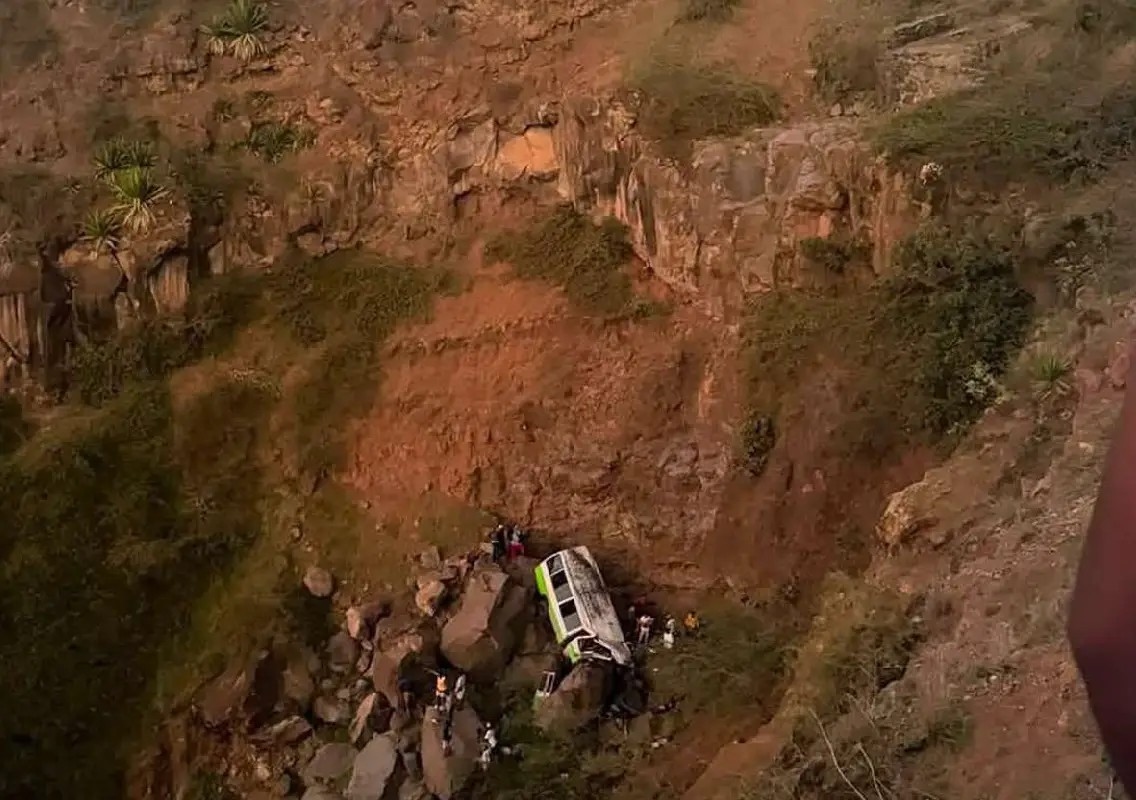


Fogo : At least 25 people, many of them schoolchildren and teenagers, have died after a passenger bus plunged into a steep ravine on the island of Fogo in Cape Verde, in a tragedy that has prompted two days of mourning across the country.
The bus crashed late on Saturday, September 5, after veering off a mountainous road in northern Fogo. It fell approximately 30 metres into a ravine along the Campanas de Cima route, according to reports citing Cape Verde’s national news agency Inforpress.
The victims included a large number of young people, with reports saying many passengers were primary and secondary school students. The bus driver was also among those killed.
Bus was returning from an excursion
The group had travelled to Chã das Caldeiras, a settlement located within the volcanic crater area of Fogo, before beginning the journey back towards São Filipe.
According to reports, the trip was not formally organised by local schools. Instead, it was privately arranged by the bus driver, who was said to organise a similar excursion annually.
The bus was carrying dozens of passengers when it left the mountain road. Reports indicate that the vehicle had a capacity of about 32 people.
The exact reason why the bus veered off the road has not yet been established. Authorities are expected to investigate the circumstances surrounding the crash, including the condition of the vehicle, the road and other possible factors.
Difficult rescue operation
Emergency teams faced challenging conditions while attempting to reach the crash site.
The bus landed in a steep and rocky ravine after falling roughly 30 metres, making access difficult for rescuers. Some victims were trapped inside the vehicle, while others were reportedly thrown from it during the fall.
Several survivors were taken to the São Francisco de Assis Regional Hospital on Fogo for treatment. Reports said some of the injured were in serious condition.
The difficult terrain complicated rescue and recovery efforts, with emergency workers having to operate in an area that could not be easily reached by ordinary vehicles.
The scale of the tragedy also placed pressure on local medical and emergency services as authorities worked to treat survivors and identify the victims.
President calls crash a ‘great catastrophe’
Cape Verdean President José Maria Pereira Neves described the incident as a “great catastrophe” and expressed condolences to the families and communities affected by the tragedy.
The deaths have caused widespread grief on the Atlantic island nation, where such a large loss of young lives has deeply affected the local community.
Officials have been involved in supporting the victims’ families and coordinating the response to the disaster. Authorities have also moved to honour those who died as the country mourns.
Cape Verde declared two days of national mourning following the crash.
Young victims leave communities in mourning
The fact that many of those killed were teenagers and schoolchildren has made the tragedy particularly painful for families in the affected communities.
Reports indicate that many passengers came from the communities of Curral Grande and Ponta Verde. The annual excursion had been an anticipated outing for young people, making the sudden loss particularly devastating for families who had expected their children to return home safely.
The tragedy has also affected the wider island community, where relatives, friends, teachers and neighbours have gathered to mourn the victims.
The loss of so many young lives has transformed what was intended to be a recreational trip into one of the country’s worst recent road tragedies.
Religious celebrations cancelled
The accident occurred at a time when communities on Fogo were preparing for religious celebrations.
Reports said planned festivities connected with the Our Lady of Light celebration were cancelled following the crash as communities turned their attention towards mourning and supporting affected families.
The decision reflected the scale of the tragedy and the grief felt across the island.
For many residents, the days following the crash have become a period of prayer, remembrance and solidarity rather than celebration.
Investigation into cause begins
Authorities have yet to determine why the bus left the road.
The crash occurred on a mountainous route with steep terrain, but officials have not attributed responsibility to any particular factor. Investigators will need to establish whether mechanical problems, road conditions, driver-related factors or other circumstances contributed to the accident.
The investigation will also examine the organisation of the excursion and the condition of the bus.
With the death toll already at 25 and several people injured, establishing the cause will be important not only for the families seeking answers but also for preventing similar tragedies in the future.
A nation mourns
Cape Verde, an Atlantic island nation off the west coast of Africa, has been left mourning after the devastating crash on Fogo.
For the families who lost loved ones, the national mourning period cannot lessen the pain of losing children and relatives in such sudden circumstances. The injured survivors also face a difficult period of physical and emotional recovery.
The tragedy has drawn attention to the risks associated with travel on mountainous roads and the importance of ensuring the safety of passengers, particularly children and young people travelling as part of organised excursions.
As authorities continue their investigation, families and communities are coming to terms with a loss that has touched much of the island.
The immediate priority remains caring for survivors, supporting bereaved families and establishing how the bus came to leave the road. For Cape Verde, the two days of mourning provide an opportunity for the nation to stand together in grief and remember the 25 people whose lives were lost in the Fogo tragedy.