







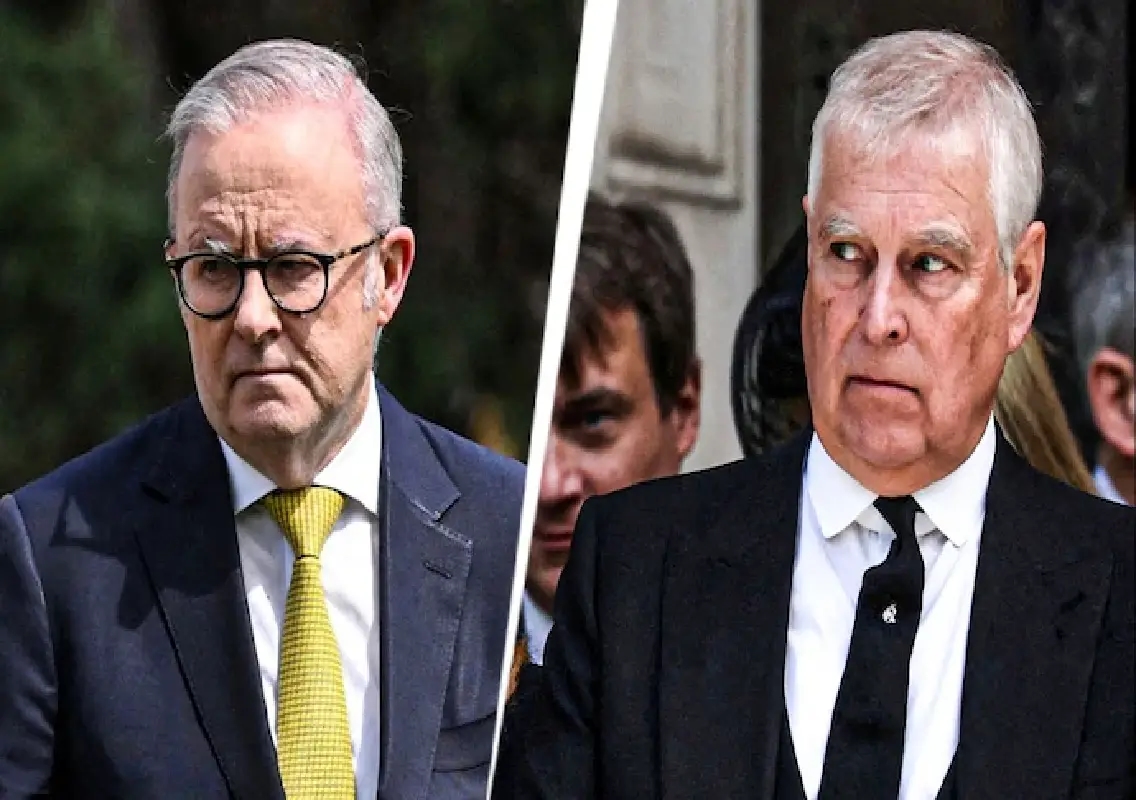


Australia’s Prime Minister Anthony Albanese has formally told his British counterpart Keir Starmer that his government would support any proposal to remove Prince Andrew — legally known as Andrew Mountbatten-Windsor — from the royal line of succession.
In a letter addressed to the UK Prime Minister, Albanese wrote that in light of recent developments concerning Prince Andrew, Australia would agree to legislative measures required to remove him from the order of succession to the British throne.
“In light of recent events concerning Andrew Mountbatten-Windsor, I am writing to confirm that my Government would agree to any proposal to remove him from the line of royal succession,” Albanese stated.
He added that he agreed with Charles III that the law must take its full course and that there must be a “full, fair and proper investigation”, describing the allegations as grave and taken seriously by Australians.
Arrest and ongoing investigation
Prince Andrew was arrested on 19 February by Thames Valley Police at his residence on the Sandringham estate on suspicion of misconduct in public office. The allegation reportedly relates to claims that he shared confidential information with convicted sex offender Jeffrey Epstein during official overseas visits more than a decade ago.
Officers also searched properties connected to him in Norfolk and Windsor as part of the inquiry.
He was released after approximately 11 hours of questioning but remains under investigation. Authorities have not filed charges, and prosecutors are yet to determine whether the evidence meets the threshold for prosecution. Prince Andrew has consistently denied any criminal wrongdoing.
In an interview with Sky News Australia, Albanese described the arrest as an “extraordinary fall from grace”, noting that the allegations would be pursued through proper legal channels.
“These are very serious allegations and they will be pursued quite clearly, so I’m not going to go into any of the legal matters,” he said. “It is extraordinary that someone who all of us have seen as part of the royal family has now been bustled off into a legal process.”
Status in the line of succession
Despite losing several royal titles and patronages in October 2025 amid mounting scrutiny over his links to Epstein, Prince Andrew remains eighth in line to the British throne.
Removing him from the line of succession would require primary legislation passed by the UK Parliament. This means approval by both the House of Commons and the House of Lords, followed by royal assent from King Charles III.
However, the process does not end there.
Commonwealth consent required
Under the principles established by the Statute of Westminster 1931 and reaffirmed during the 2013 succession reforms, any change to the rules of royal succession must receive the consent of all Commonwealth realms where the British monarch serves as head of state.
At present, the monarch is head of state in 14 other countries, including Australia, Canada and New Zealand. Conventionally, these nations must indicate their agreement before such legislative changes can take effect.
Albanese’s letter is therefore a significant diplomatic step, signalling that Australia would not stand in the way of a coordinated move to amend succession laws should the UK government introduce a bill in Parliament.
Political observers note that while the legal threshold for removal is high, public pressure and reputational considerations surrounding the monarchy have intensified in recent years, particularly following controversies linked to Epstein.
Wider implications
The issue comes at a sensitive time for the British monarchy, which has faced growing scrutiny over transparency and accountability. In Australia, debates over republicanism have periodically resurfaced, with Albanese previously expressing support for a future Australian republic, though he has said constitutional change is not an immediate priority.
For now, the Australian government has framed its position as one of legal and constitutional cooperation rather than political intervention.
The UK government is reportedly weighing legislative options, though no formal bill has yet been introduced. Any move to remove Prince Andrew from the line of succession would likely trigger extensive debate in Parliament and across the Commonwealth.
As investigations continue and prosecutors assess whether charges will be brought, the matter remains both a legal and constitutional question. Albanese’s public backing, however, makes clear that Australia would support coordinated action if Britain decides to proceed.