







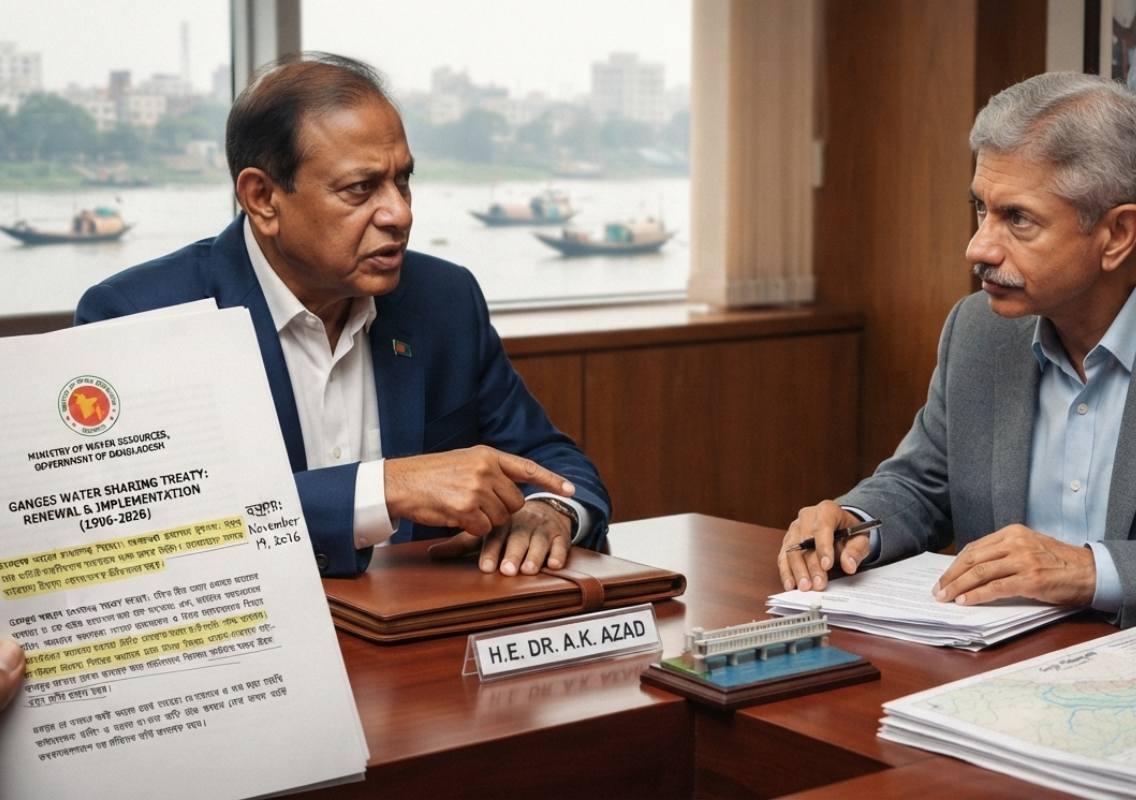


Dhaka: Bangladesh has appeared to soften its position on the renewal of the 1996 Ganga Water Sharing Treaty with India, shifting away from its earlier demand for a fresh agreement and expressing hope that New Delhi will initiate formal negotiations before the pact expires on December 12.
Dhaka is now seeking steps from India’s political leadership to facilitate negotiations on renewing the existing treaty, while continuing to press for equitable water-sharing arrangements, particularly during the dry season.
Bangladesh Prime Minister’s adviser on finance and planning Rashed Titumir, who heads the country’s 10-member technical committee on the treaty, said Dhaka had completed preparations related to the agreement and was waiting for India to take effective steps.
“We hope India will take effective measures to ensure the equitable and fair sharing of the waters of the international river Ganga,” Titumir told reporters, according to the report.
The development comes amid ongoing diplomatic discussions between the two countries over water-sharing arrangements involving their transboundary rivers.
Bangladesh hopes India initiates formal negotiations
Titumir said Bangladesh hopes India will take the necessary steps before the current treaty expires to pave the way for formal negotiations on its renewal.
His remarks followed the 91st meeting of the Bangladesh-India Joint Committee on the implementation of the Ganga Water Sharing Treaty, held in Dhaka on Sunday.
The four-member Indian delegation was led by India’s Joint Rivers Commission chief Sharad Chandra, while Anwar Kadir headed the six-member Bangladeshi delegation.
Titumir said both sides finalised the annual report on the implementation of the treaty for 2026 during the meeting.
Bangladesh has been pushing for discussions on the treaty’s renewal, with its government seeking safeguards to ensure a fair share of water during the dry season. Dhaka had earlier sought a new agreement with provisions guaranteeing its water share and proposed the formation of technical teams on both sides to discuss the arrangements.
Dhaka formed technical committee, sought India’s response
Bangladesh established a high-level technical committee in June 2026 to prepare for discussions on the Ganga treaty and subsequently informed India about the initiative, requesting New Delhi to notify Dhaka about the formation of its own technical committee.
Bangladesh’s Water Resources Minister Shahiduddin Chowdhury Anee had also sent a letter to his Indian counterpart through diplomatic channels, urging an early start to negotiations.
The latest shift in Dhaka’s position indicates that it is now seeking a formal process to renew the existing agreement rather than insisting outright on a completely new treaty.
Sources cited in the report suggested that decisions on renewal, interim extension or the terms of a future agreement would ultimately require political leadership from both countries.
India maintains Joint Rivers Commission is the established mechanism
India has maintained that the Joint Rivers Commission (JRC) is the established mechanism for discussing water-related and cross-border river issues between the two countries, including matters concerning the Ganga treaty.
The treaty, signed on December 12, 1996, by then Prime Ministers Sheikh Hasina and H D Deve Gowda, provides a framework for sharing Ganga water during the dry season, particularly between January and May, when river flows decline.
The agreement is based on a formula for distributing available water between India and Bangladesh, with allocations calculated over 10-day periods during the dry season.
The absence of a minimum guaranteed water-sharing clause has remained a point of concern for Bangladesh, which has sought greater assurance about the availability of water during periods of low river flow.
Ganga treaty remains the only water-sharing agreement between India and Bangladesh
India and Bangladesh share 54 transboundary rivers, but the Ganga Water Sharing Treaty remains the only bilateral agreement specifically governing water-sharing arrangements between the two countries.
The upcoming renewal discussions are expected to have implications for water management, agriculture, irrigation and livelihoods in areas dependent on the river on both sides of the border.
With the treaty approaching its expiry, Dhaka is hoping that negotiations will begin in time to establish a renewed framework for water-sharing cooperation with India.