







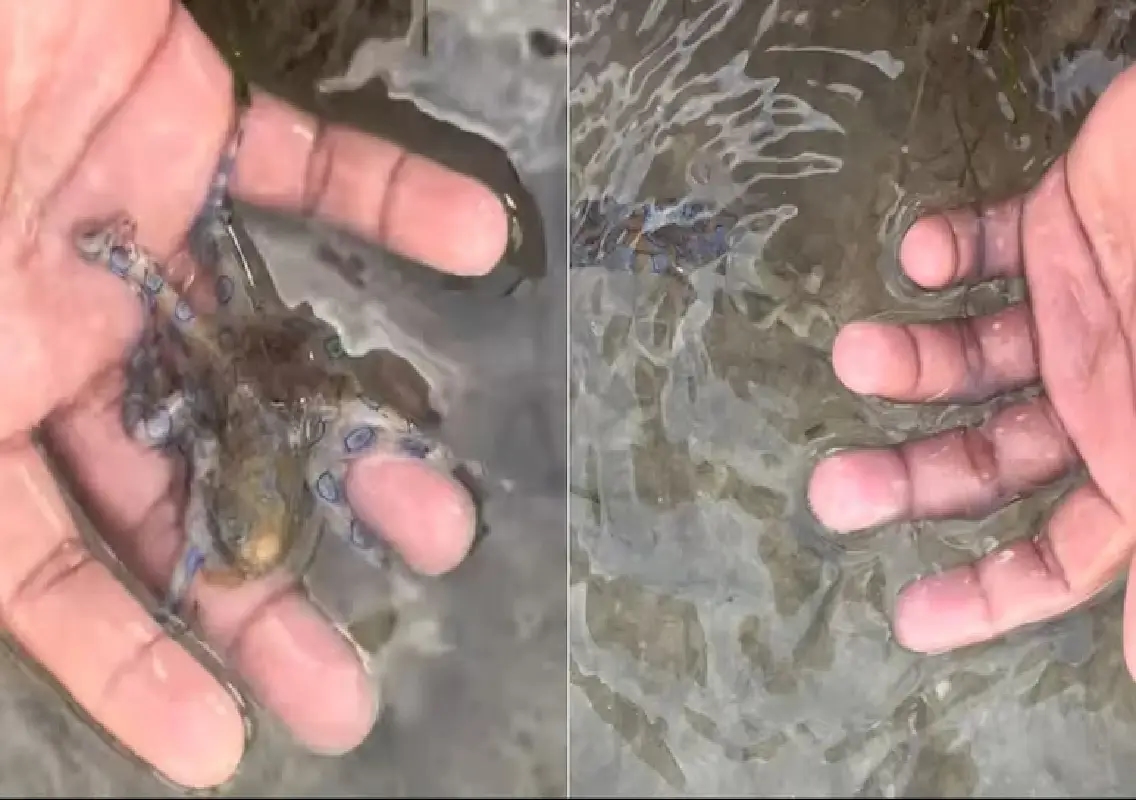


A British tourist had a narrow escape from a potentially fatal incident after unknowingly handling one of the most venomous marine creatures in the world while swimming in shallow waters in the Philippines. The incident has since drawn global attention, serving as a stark reminder of the dangers posed by misidentifying wildlife during seaside holidays.
Andy McConnell, who was vacationing in the island nation, encountered what he believed was a harmless small octopus while swimming near the shore. Unaware of the danger, he picked up the creature and later shared photographs of the encounter on Instagram. According to McConnell, the octopus had already been handled by local children on the beach, which further reassured him that it posed no threat.
However, shortly after the images were posted online, social media users and wildlife experts identified the animal as a blue-ringed octopus — one of the most dangerous marine species known to science.
Deadly species mistaken for harmless sea life
The blue-ringed octopus, despite its small and visually appealing appearance, is considered among the most venomous animals in the ocean. According to BBC Wildlife Magazine, the species is commonly found in the waters stretching from Australia to Japan, including parts of Southeast Asia such as the Philippines.
When threatened, the octopus displays a vivid warning signal: its skin turns bright yellow and flashes iridescent blue and black rings. This phenomenon, known as aposematic colouration, is nature’s way of signalling extreme danger to predators and humans alike.
In McConnell’s case, the octopus reportedly did not display its warning colours at the time, making it appear docile and safe to handle.
Venom more lethal than cyanide
Medical research cited by the National Library of Medicine highlights the extreme danger posed by the blue-ringed octopus. Its venom contains tetrodotoxin (TTX), a powerful neurotoxin believed to be nearly 1,000 times more deadly than cyanide.
Even a single bite can lead to rapid paralysis, respiratory failure and death within minutes. One of the most alarming aspects of blue-ringed octopus envenomation is that the bite is often painless, meaning victims may not immediately realise they have been bitten until severe symptoms begin to appear.
There is currently no known antivenom for tetrodotoxin poisoning. Survival depends largely on immediate medical intervention, including artificial respiration, until the toxin wears off.
Viral post sparks warnings from experts
McConnell later admitted that he had no knowledge of the creature’s deadly nature at the time of the encounter. Only after his post went viral did he understand how close he had come to serious injury or death. Reflecting on the experience, he described it as “my close encounter with death”.
Wildlife experts and marine biologists have since used the incident to warn tourists against touching or handling marine animals, regardless of how harmless they may appear. Experts stress that many dangerous sea creatures rely on camouflage and subtle warning signs, making them easy to misidentify.
A reminder for coastal travellers
The incident has reignited discussions around the need for greater awareness and education about marine biodiversity, particularly in popular tourist destinations. Coastal regions across Southeast Asia attract lakhs of visitors annually, many of whom are unfamiliar with local marine life.
Authorities and conservationists emphasise that respecting wildlife from a safe distance is crucial — not only for human safety but also for the protection of delicate marine ecosystems.
Conclusion
While Andy McConnell escaped unharmed, experts say the outcome could easily have been tragic. The episode stands as a cautionary tale for travellers worldwide, highlighting the hidden dangers that can lurk beneath calm waters. As tourism continues to grow in tropical regions, awareness and caution remain the most effective tools to prevent such near-fatal encounters.