









Beijing: China has completed and tested a massive 582-tonne superconducting magnet designed for its next-generation nuclear fusion programme, marking a major engineering milestone in the country’s push to generate electricity using the same basic process that powers the Sun. The development supports China’s ambition to demonstrate fusion-generated electricity by around 2030.
The magnet, developed by the Institute of Plasma Physics under the Chinese Academy of Sciences (ASIPP) in Hefei, is a key component of China’s planned fusion reactor programme. Measuring about 21 metres in length, the toroidal-field magnet is described as the largest of its kind built for a controlled fusion reactor.
What is China’s ‘Artificial Sun’?
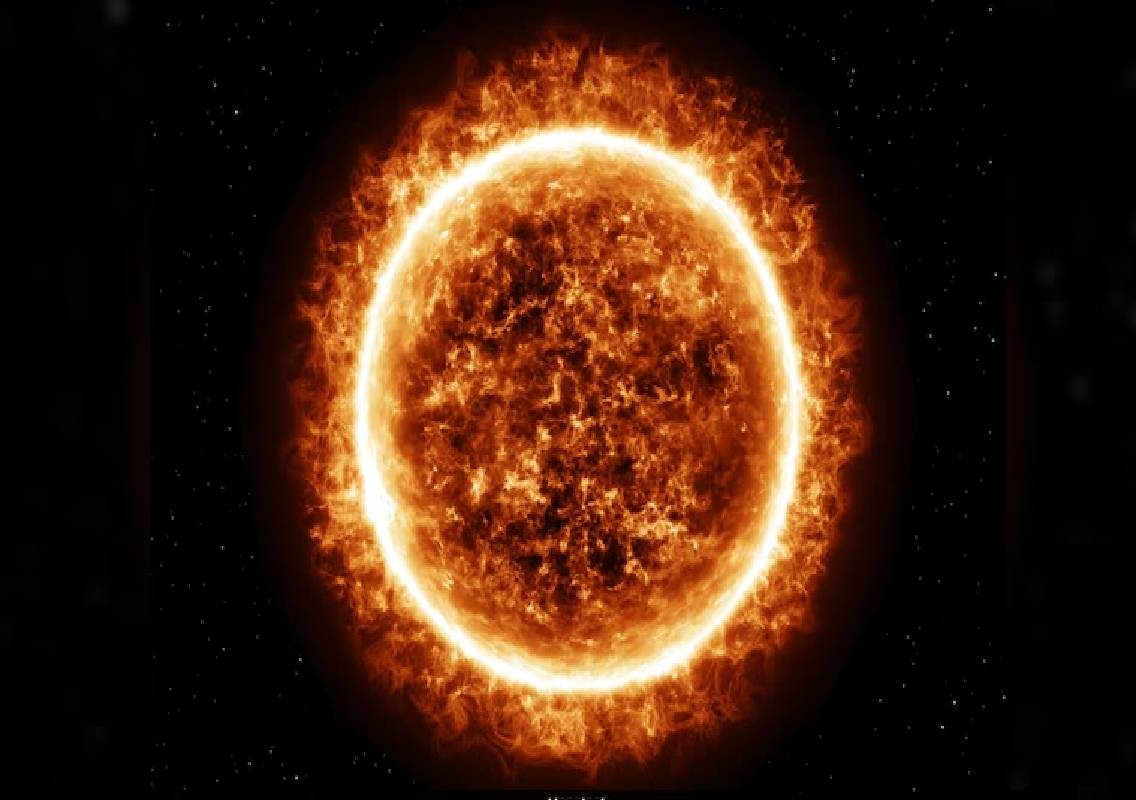
China’s ‘Artificial Sun’ is a popular description for its efforts to recreate the nuclear fusion process that occurs inside the Sun.
Unlike conventional nuclear power plants, which generate energy through nuclear fission, fusion attempts to combine light atomic nuclei under extremely high temperatures and pressures. When hydrogen isotopes fuse, they release a large amount of energy.
Fusion reactors such as tokamaks use powerful magnetic fields to confine the extremely hot plasma inside a chamber without allowing it to come into direct contact with the reactor walls.
The plasma in these experiments must reach temperatures exceeding 100 million°C, considerably hotter than the core of the Sun.
Why the 582-tonne magnet matters
The newly completed magnet is not the reactor itself. Instead, it is a crucial component of the magnetic confinement system.
The toroidal-field magnet creates a powerful magnetic field around the doughnut-shaped fusion chamber. This field helps keep the superheated plasma confined and stable.
This is particularly important because no conventional material can simply contain plasma at temperatures of more than 100 million°C.
The magnet therefore performs one of the fundamental jobs required to make a magnetic-confinement fusion reactor work.
One of the world’s largest fusion magnets
The scale of China’s new magnet is extraordinary.
The structure weighs approximately 582 tonnes and measures around 21 metres long and 12 metres wide. It has been developed domestically by Chinese researchers and engineers under the Chinese Academy of Sciences.
According to reports, the magnet has about 1.3 times the volume and three times the stored energy of comparable superconducting magnets developed for the International Thermonuclear Experimental Reactor (ITER), the multinational fusion project being built in France.
The achievement is therefore not simply about the physical size of the equipment. Building a superconducting magnet capable of operating reliably under the demanding conditions of a fusion reactor is a major engineering challenge.
How does a fusion reactor work?
A tokamak uses a combination of magnetic fields to confine plasma inside a toroidal, or doughnut-shaped, chamber.
Hydrogen isotopes are heated until they become plasma. At sufficiently high temperatures, the atomic nuclei can overcome their electrical repulsion and fuse.
The fusion reaction releases energy, which scientists ultimately hope to convert into electricity.
The difficulty is maintaining the required plasma conditions for long enough while ensuring that the reactor components can withstand the extreme environment.
China’s roadmap targets electricity generation by 2030
China’s latest magnet milestone is linked to a broader roadmap for developing commercial fusion technology.
The country aims to move through several stages, eventually demonstrating electricity generation from controlled nuclear fusion around 2030. The milestone does not mean China will have a commercial fusion power station supplying electricity to homes by that year.
Instead, the target is to demonstrate that fusion energy can be converted into usable electrical power — an important step towards future commercial reactors.
Several additional engineering and scientific challenges remain before fusion can become a practical source of grid electricity.
The magnet will support China’s next-generation programme
China has been developing a number of fusion facilities as part of its long-term programme.
Its Experimental Advanced Superconducting Tokamak (EAST) in Hefei has already been used for experiments involving extremely hot plasma and long-duration confinement.
The next generation of facilities is intended to move beyond experimental plasma research towards conditions that more closely resemble those required for an eventual fusion power plant.
The newly completed superconducting magnet is part of that broader transition.
Fusion promises low-carbon energy
Scientists have long considered fusion a potentially transformative energy source.
Fusion fuel can be derived from hydrogen isotopes, while the reaction itself does not produce carbon dioxide in the same way that fossil-fuel combustion does.
Fusion also differs fundamentally from fission in the way the reaction is sustained. A fusion plasma must remain under carefully controlled conditions; if those conditions are lost, the fusion reaction stops.
However, calling fusion an immediately available source of unlimited clean energy would be premature. Scientists still have to solve major challenges involving sustained plasma confinement, materials, fuel cycles, heat management and the economics of large-scale reactors.
China joins a global fusion race
China is not the only country investing heavily in fusion technology.
The ITER project in France brings together China, India, the European Union, Japan, South Korea, Russia and the United States in one of the world’s largest international fusion programmes.
At the same time, private companies in the US and elsewhere are pursuing alternative fusion reactor designs.
China’s advantage lies in its ability to combine large-scale state investment, domestic manufacturing capabilities and a long-term national research programme.
The completion of the 582-tonne magnet adds another significant achievement to that effort.
Bigger than simply building a giant magnet
The significance of the project goes beyond the headline-grabbing weight of the equipment.
Superconducting magnets are among the most technically demanding parts of a magnetic-confinement fusion reactor. They must generate strong and stable magnetic fields while operating under cryogenic conditions.
China’s ability to design, manufacture and test such a large component domestically could help it develop the industrial capabilities required for future fusion facilities.
The successful completion and testing of the magnet therefore represents both a scientific and manufacturing milestone.
Major challenges still remain
Despite the progress, commercial fusion power remains a long-term goal.
Generating fusion reactions is only one part of the challenge. A practical power plant must produce enough energy to operate the facility and deliver a useful surplus to the electricity grid.
Researchers must also develop materials capable of surviving intense neutron bombardment and extreme heat, establish reliable fuel cycles and develop systems for removing heat from the reactor.
The economics of fusion power will also ultimately determine whether it can compete with other forms of low-carbon electricity.
What China’s 2030 goal really means
China’s target of demonstrating fusion electricity by 2030 should therefore be viewed as a research and engineering milestone, rather than a promise of widespread commercial fusion power.
If successful, however, it could represent an important proof of concept for the country’s longer-term fusion programme.
The ultimate objective is to move from experimental machines to reactors capable of producing electricity reliably and economically.
Conclusion
China’s completion of a 582-tonne superconducting magnet marks an important step in its ambitious nuclear fusion programme. The 21-metre-long component is designed to generate the magnetic fields needed to confine plasma at temperatures exceeding 100 million°C.
China now aims to demonstrate electricity generation from controlled nuclear fusion around 2030. While that target is still several major engineering challenges away from commercial reality, the successful completion and testing of the giant magnet strengthens the country’s position in the global race to harness fusion energy.
If China and other research programmes eventually overcome the remaining technical and economic barriers, fusion could become an important source of low-carbon electricity in the decades ahead.