







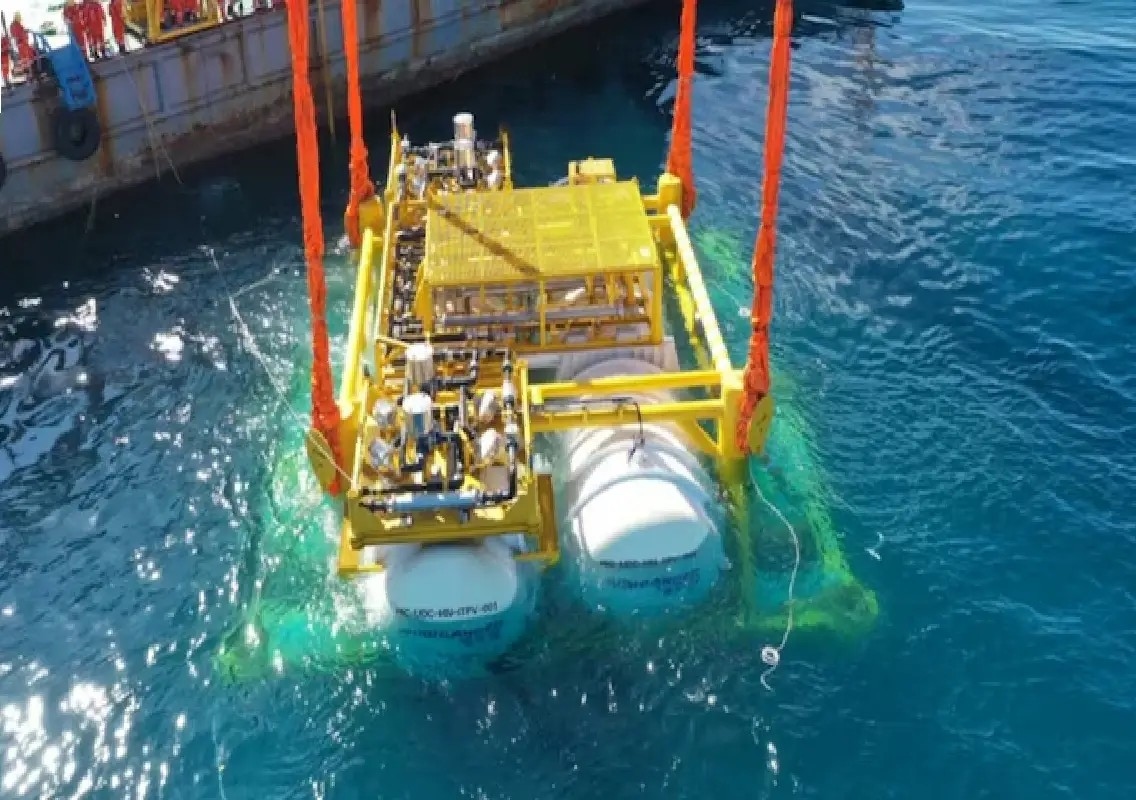


Shanghai: China’s underwater datacentre initiative has attracted global attention following the successful operation of the Shanghai Lingang Undersea Datacentre Demonstration Project, a facility designed to reduce energy and water consumption while supporting growing computing demands.
Located near Lingang, a high-tech free-trade zone in eastern Shanghai, the datacentre sits approximately 10 metres below the sea surface and began operations in May as a joint venture between HiCloud Technology, also known as Shanghai Hailanyun Technology, and the state-owned China Communications Construction Company.
The facility has a computing capacity of 24 megawatts and represents one of the world’s most advanced commercial underwater datacentre projects.
₹1,900 crore project completed last year
The Lingang Undersea Datacentre Demonstration Project was completed in October 2025 at an estimated cost of around 225 million US dollars, equivalent to approximately ₹1,900 crore.
Although relatively small compared to the gigawatt-scale datacentres being developed globally to support artificial intelligence and cloud computing, the project is viewed as an important proof-of-concept for future infrastructure development.
Officials have described the facility as a demonstration project aimed at evaluating the long-term viability of underwater computing infrastructure.
Reduced power and water consumption
According to Chinese authorities, the underwater facility consumes approximately 22 per cent less electricity than conventional land-based datacentres.
The project is also powered largely by renewable energy, with around 95 per cent of its electricity supplied by a nearby offshore wind farm.
One of the most significant claimed benefits is water conservation. Traditional datacentres require substantial amounts of clean water to cool servers and maintain operating temperatures.
China says the Lingang facility uses more than 90 per cent less water than comparable land-based facilities because the surrounding seawater provides natural cooling.
By taking advantage of the ocean’s stable temperatures, the datacentre reduces the need for energy-intensive cooling systems and freshwater consumption.
Growing concern over datacentre water use
The development comes at a time when water consumption by datacentres is becoming a major global concern.
As artificial intelligence, cloud computing and digital services expand, datacentres are consuming increasing quantities of water and electricity.
According to studies cited by international researchers, the global water footprint of datacentres could reach 9.3 trillion litres annually by 2030. Such consumption would be sufficient to meet the yearly domestic water requirements of the entire population of sub-Saharan Africa.
Supporters of underwater facilities argue that the technology could help reduce environmental pressures associated with conventional datacentres.
Environmental concerns remain
Despite the potential benefits, environmental experts have raised concerns about underwater datacentre deployment.
Some researchers have warned that large-scale underwater installations could disturb seabed ecosystems, affect marine habitats and contribute to localised warming of surrounding seawater.
Questions have also been raised about the long-term ecological impact of placing major computing infrastructure in marine environments.
Authorities and developers have stated that environmental monitoring and impact assessments are being conducted to evaluate potential risks.
China leads commercial deployment
While several countries have experimented with underwater datacentre concepts, China is currently considered the first nation to operate such facilities on a commercial basis.
HiCloud previously launched a commercial underwater datacentre in Hainan province in 2023. The Shanghai facility is notable for being the first such project powered by offshore wind energy.
Microsoft also tested underwater datacentre technology through its Project Natick initiative near Scotland’s Orkney Islands in 2018. The company later reported encouraging results, although the project has not seen large-scale commercial expansion.
Global race for next-generation datacentres
Interest in alternative datacentre designs is growing worldwide as demand for computing power continues to rise.
In the United States, ocean technology startup Panthalassa has secured major funding to develop floating, wave-powered datacentre platforms that would remain largely underwater and utilise seawater cooling.
Meanwhile, SpaceX is reportedly exploring the possibility of space-based datacentres, while India is also investigating orbital computing infrastructure. Indian AI company Sarvam has partnered with space technology firm Pixxel to explore the development of the country’s first orbital datacentre, aimed at supporting AI model training and data processing in space.
Conclusion
China’s Shanghai Lingang Undersea Datacentre Demonstration Project represents a significant step in the search for more sustainable computing infrastructure. By leveraging natural ocean cooling and renewable energy, the project aims to reduce power and water consumption associated with traditional datacentres. While environmental concerns remain under scrutiny, the facility highlights how nations and technology companies are exploring innovative solutions to meet the rapidly growing demand for digital computing capacity.