







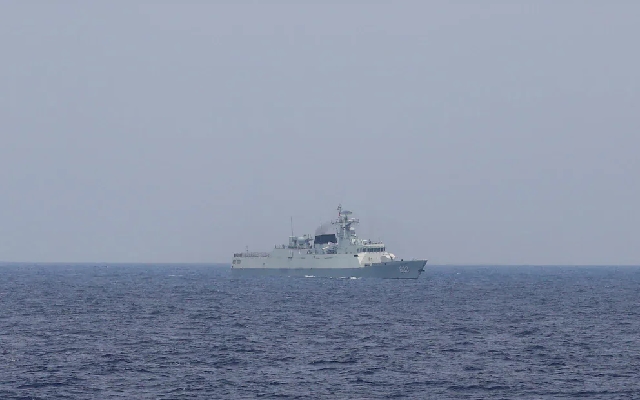


Fresh images emerging from a Shanghai shipyard have triggered intense discussion among defence analysts after a Chinese civilian cargo vessel was seen fitted with advanced drone launch infrastructure, underscoring Beijing’s growing focus on dual-use maritime capabilities.
The medium cargo ship Zhong Da 79, photographed at the Hudong-Zhonghua Shipyard in December 2025, was initially spotted with containerised vertical missile launch systems, radars and close-in weapon systems. At the time, analysts believed the vessel may have been temporarily configured as an “arsenal ship” under China’s civil-military fusion strategy.
Mobile EMALS points to drone carrier role
Subsequent images, however, have shifted that assessment. The latest photographs show the cargo ship equipped with a road-mobile electromagnetic aircraft launch system (EMALS), mounted on heavy trucks arranged in a modular “train” configuration on the deck. Defence watchers now believe Zhong Da 79 is being tested as a light drone carrier rather than a missile platform.
Compared to earlier images, most of the missile launch cells appear to have been removed to make space for drone operations. The ship reportedly retains sensors, communications systems and a 30mm close-in weapon system, suggesting a defensive posture while enabling unmanned aircraft launches.
Capable of launching heavy combat drones
Analysts note that the EMALS system could launch large, fixed-wing unmanned aerial vehicles, including “loyal wingman”-type platforms similar to collaborative combat aircraft. Some images appear to show a CH-4 drone on deck, a well-known reconnaissance and strike UAV in the People’s Liberation Army inventory.
While there is no evidence yet of a recovery system on board, experts suggest such drones could be used for one-way strike missions or potentially recovered later using parachutes or flotation devices.
Part of wider civil-military fusion push
The development is being viewed in the context of China’s long-standing policy of integrating civilian assets into military planning. By adapting commercial vessels, Beijing could rapidly expand its operational footprint without relying solely on conventional warships.
Such capabilities could prove significant in potential flashpoints like the South China Sea or the Taiwan Strait, where flexibility and numbers may shape early stages of any conflict.
Strategic implications
Defence experts caution that technical challenges remain, including power stability, deck space constraints and the impact of ship movement on launch reliability. Nevertheless, the concept reflects China’s emphasis on adaptable, high-tech solutions for future warfare.
If refined, converting merchant ships into drone launch platforms could allow China to leverage its vast commercial fleet for military purposes, blurring traditional distinctions between civilian and combat vessels.