







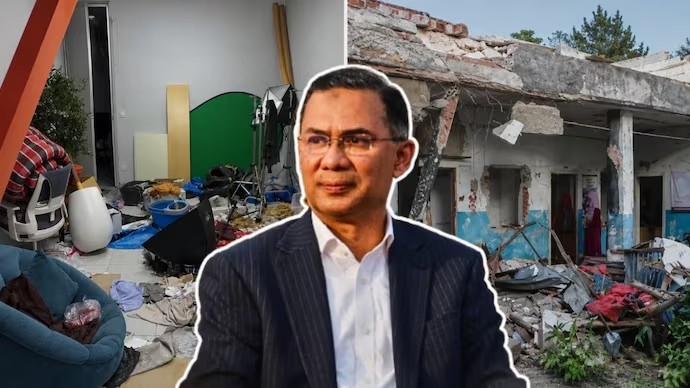


Dhaka: Two high-profile attacks in the Bangladeshi capital — the demolition of a healthcare centre serving disadvantaged families and the vandalism of YouTuber Salman Muqtadir’s BrownFish Studio — have intensified scrutiny of Prime Minister Tarique Rahman’s BNP-led government.
The incidents occurred within days of each other in late September and have generated political controversy after allegations emerged of links between some local BNP figures and the attack on the Radda MCH-FP Centre in Mirpur.
The studio attack, however, has a different preliminary explanation. Police have said the BrownFish Studio incident was connected to a land dispute involving New Gini Properties and a retired major general, while Muqtadir has alleged that the attack was connected to extortion. Several people have been arrested in that case.
The two incidents have nevertheless become politically linked in public debate because both have raised questions about law and order, political influence and the ability of the new government to prevent criminal activity involving politically connected individuals.
Radda health centre demolished in midnight attack
The Radda MCH-FP Centre in Mirpur-1 was attacked around midnight on September 24–25.
The facility, which began operating in 1974, provides maternal and child healthcare, reproductive healthcare, family planning and vaccination services, particularly to disadvantaged and low-income families.
According to reports, between 200 and 250 masked people entered the premises carrying locally made weapons and demolition equipment. Two security guards were reportedly held hostage while the attackers looted medicines, vaccines, medical equipment, cash and other belongings.
An excavator was subsequently used to demolish one permanent and three semi-permanent structures at the centre. A signboard and banners bearing the name of the Somomona Dokandar Samabaya Samiti Limited were placed at the site after the demolition. The centre estimated that the damage exceeded Tk 1 crore.
The attack also disrupted healthcare and vaccination services. Staff continued providing limited services from the damaged premises even after the buildings were destroyed.
The incident attracted particular concern because the centre had been providing services to vulnerable families for decades and was involved in child vaccination programmes.
BNP links emerge during investigation
The Radda case became politically sensitive when local sources and investigative reporting identified several people allegedly associated with BNP politics as being involved in organising the attack.
Prothom Alo reported that local BNP figures were allegedly involved in gathering the attackers, arranging locally made weapons and equipment and securing the excavator used in the demolition. The newspaper also reported that several of the figures were known associates of BNP reserved-seat lawmaker Ferdousi Ahmed Mishti.
Ferdousi Ahmed has denied involvement in the attack.
Police have since arrested several people in connection with the incident. Prothom Alo reported that 15 people had been arrested and that investigators had identified people suspected of ordering the attack, although police had not initially disclosed their identities because the investigation was continuing.
The police investigation has also examined allegations of inaction during the attack. Shah Ali Police Station officer-in-charge Jahangir Alam was withdrawn from his post after the incident, although the official order cited administrative reasons rather than explicitly linking the withdrawal to the Radda case.
Tarique Rahman orders MP Ferdousi Ahmed to resign
The political consequences became more significant after Prime Minister and BNP chairman Tarique Rahman instructed Ferdousi Ahmed to resign from Parliament.
Ahmed, a BNP lawmaker from a reserved women’s seat, subsequently submitted her resignation to Speaker Hafiz Uddin Ahmad on October 1. The Speaker confirmed that the resignation took effect immediately and that the seat became vacant.
The move followed scrutiny over her alleged links to the Radda incident. Ahmed has denied responsibility.
Home Minister Salahuddin Ahmed said an investigation would determine whether there was sufficient evidence for legal action. He also said political identity would not protect anyone found to have participated in the attack.
The resignation therefore represents political action by the ruling party, rather than a judicial finding that Ahmed was responsible for the attack.
Opposition parties have nevertheless argued that organisational action alone is insufficient and have called for those responsible for the violence and destruction to face criminal proceedings.
Salman Muqtadir’s BrownFish Studio attacked
A second major incident took place on the night of September 26 at the New Gini Properties compound near ECB Chattar.
YouTuber Salman Muqtadir’s BrownFish Studio operated from the compound. A large group entered the property and vandalised the developer’s office and other structures before damaging the studio.
Furniture, televisions, CCTV cameras and other equipment were damaged, while cash, phones and other items were reportedly looted.
Muqtadir said shortly after the attack that his studio had been caught in an attack apparently aimed at the property owner. He initially raised the possibility that an extortion dispute was behind the incident.
The New Gini Properties chairman separately alleged that the attack was part of an organised attempt to grab the land and said assets worth around Tk 50 crore had been looted from the housing project.
Police point to land dispute
Police have not confirmed Muqtadir’s allegation that BNP activists attacked the studio over extortion.
The Cantonment Police Station officer-in-charge told The Daily Star that the attack stemmed from a dispute between New Gini Properties and retired Major General Golam Mohiuddin Chowdhury over land.
According to the preliminary police account, people associated with the retired officer allegedly carried out the attack after a dispute over possession of the property. Muqtadir had rented a floor of the building from New Gini Properties, which was where his studio was located.
Police arrested several people in connection with the incident. Investigators identified Shahriar as the alleged main planner, while other suspects were also detained.
A fifth arrest involved Shah Alam Anik, a joint convener of the Muktijoddha Projonmo League. Police said the investigation was continuing.
A case was filed over alleged illegal entry, vandalism and looting, with police seeking further remand of some of the accused.
Muqtadir continues to challenge the official account
Muqtadir has continued to question the explanation offered by the authorities.
He has alleged that local BNP activists were behind the attack and connected it to an extortion dispute involving the landowner. At the same time, he acknowledged that nobody had personally demanded money from him.
He also criticised the government’s handling of the case and said he had remained at Cantonment Police Station for hours following the attack to pursue a complaint.
Home Minister Salahuddin Ahmed rejected the broader BNP-extortion allegation, saying the preliminary police investigation pointed instead to the land dispute.
The competing accounts have left the motive for the attack contested, even as police investigations and arrests continue.
Government says perpetrators will face action
The government has sought to distance itself from the violence and promised legal action against anyone found responsible.
Prime Minister’s Information and Broadcasting Adviser Zahed Ur Rahman said the government was regretful and embarrassed by the attacks on the Radda centre and Muqtadir’s studio. He said anyone found to have been involved through investigation would be brought to justice.
The government’s response has also included action against officials and political figures connected to the Radda controversy.
In the healthcare-centre case, investigators have continued to pursue alleged organisers and participants, while the withdrawal of the Shah Ali police station chief has raised questions about the police response during the attack.
Political pressure grows over law and order
The incidents have become a broader test for the BNP government because allegations of political involvement have emerged at a time when the administration is under scrutiny over law and order and governance.
The Radda case has produced the clearest documented political fallout so far, with a sitting BNP MP resigning after the Prime Minister directed her to step down.
The studio case is more complicated. Although Muqtadir has alleged BNP involvement and opposition figures have used the incident to criticise the government, police have publicly linked the attack to a land dispute rather than confirming an extortion operation by BNP activists.
That distinction is important as investigations continue.
The Radda attack has also raised concerns beyond politics because the destruction affected a healthcare facility used by disadvantaged families. The centre’s vaccination services continued despite the damage, highlighting the immediate public impact of the incident.
Investigations remain central to the controversy
The two Dhaka incidents have now moved beyond isolated cases of vandalism and become politically significant tests for the BNP government.
In the Radda case, police have made numerous arrests and investigators have identified alleged organisers. Several people linked to BNP organisations have also faced scrutiny, while Ferdousi Ahmed has resigned from Parliament after Tarique Rahman’s directive.
In the BrownFish Studio case, police have arrested several suspects and continue to investigate the land dispute identified as the preliminary cause. Muqtadir’s separate allegation of an extortion motive remains disputed.
For Tarique Rahman’s government, the central issue now is whether the investigations result in transparent criminal proceedings against those responsible, irrespective of political affiliation.
The coming legal and investigative findings will determine whether the allegations of political involvement are substantiated and how far the government’s response goes beyond organisational action.