







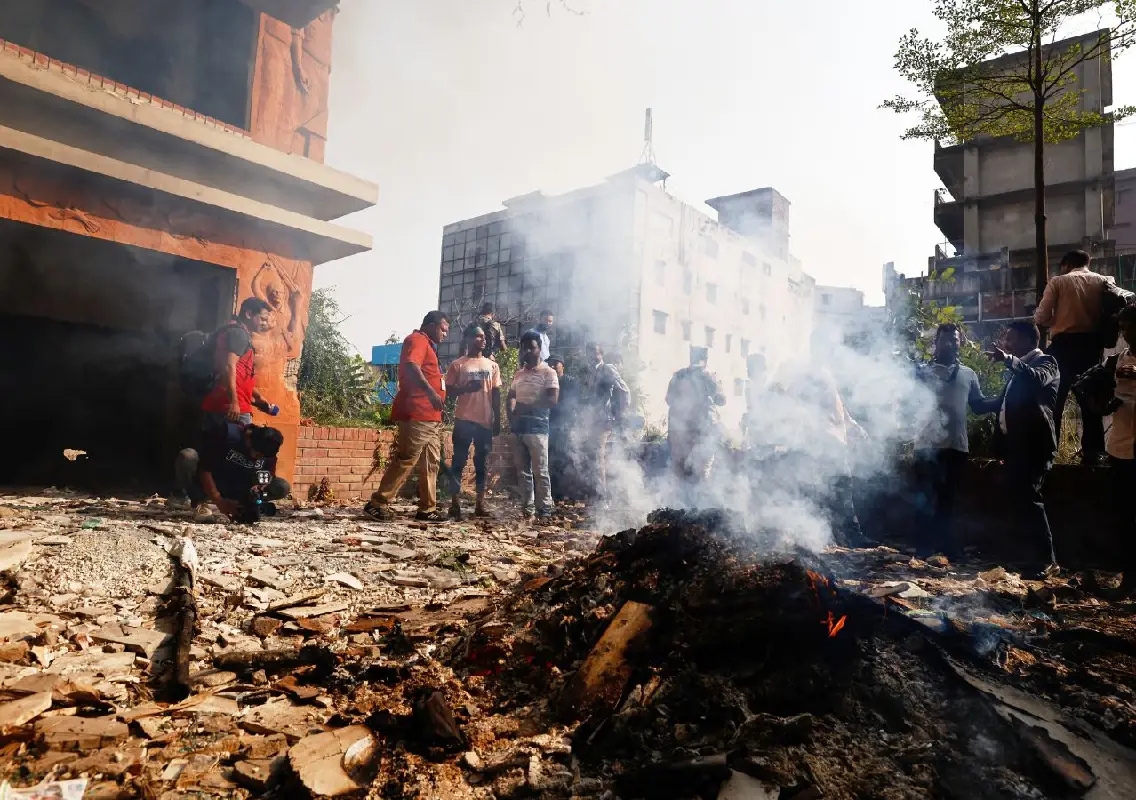


Bangladesh witnessed a night of explosions, arson, and growing political unrest on Sunday as authorities braced for a crucial verdict by the International Crimes Tribunal (ICT) against ousted prime minister Sheikh Hasina. The tribunal is set to pronounce its judgment on charges of crimes against humanity linked to last year’s deadly July Uprising — a ruling that could carry the death penalty. Hasina, who has been living in India since her ouster in August 2024, was tried in absentia along with former home minister Asaduzzaman Khan Kamal.
The unrest has amplified tensions across the country, prompting heavy deployment of security forces, expanded surveillance, and a “shoot-at-sight” order against those involved in violent acts. With major political stakeholders escalating rhetoric ahead of Monday’s nationwide shutdown, Bangladesh finds itself on a knife’s edge.
Hasina urges supporters to defy protest ban
In a late-night audio message uploaded to the Awami League’s official Facebook page, the 78-year-old former prime minister urged her supporters to continue demonstrations despite a government ban on gatherings.
“There is nothing to be afraid of. I am alive. I will live. I will support the people of the country,” she said, calling for protests that show what she described as the “strength of the people.”
She praised party cadres for earlier mobilisations and accused the interim administration of attempting to destroy the Awami League. “This Awami League was built from the soil of the people. Its roots are very deep,” she said.
Ahead of the verdict, the party announced a nationwide shutdown on Monday, alleging that the trial was politically motivated and aimed at eliminating Hasina from the political landscape.
Hasina calls trial ‘illegal’, lashes out at interim government
Hasina has repeatedly labelled the charges against her as fabricated, alleging “political revenge” by Nobel laureate Muhammad Yunus, who leads the interim government. She claims the administration engineered her ouster and continues to persecute her party workers.
“You know that all the charges brought by the Chief Prosecutor are false,” Hasina said, further accusing the tribunal of violating the 1973 war-crimes law. She described the ICT as a “kangaroo court” that denied her the right to fair representation after she refused to accept a state-appointed lawyer.
She also denied ordering violence during the July Uprising, alleging that forces loyal to Yunus were behind the killings and attacks. “I did not order anyone to be killed. The orders came from Dr Muhammad Yunus,” she claimed.
Under ICT-BD rules, Hasina may appeal the verdict only if she is arrested or voluntarily surrenders within 30 days — a condition that may influence her political and legal strategy in the coming weeks.
Explosions and arson intensify across Dhaka
Dhaka and other cities have been rocked by a series of explosions since 10 November. On Sunday night, two crude bombs detonated outside the residence of interim government adviser Syeda Rizwana Hasan around 9 pm. Another blast rattled the busy Karwan Bazar area shortly after.
No injuries were reported, but police registered cases of arson targeting buses, public vehicles, and a waste-dumping site inside a police station complex. The capital has witnessed multiple predawn explosions over the past week, including attacks on Grameen Bank headquarters and its branches in Mirpur.
Dhaka Metropolitan Police Commissioner SM Sazzat Ali authorised officers to fire on violent protesters. “Anyone who sets a bus on fire or throws crude bombs with intent to kill should be shot,” he said, citing provisions under national law.
Authorities have sealed major intersections, restricted movement in sensitive zones, and placed Dhaka under an extensive security lockdown.
Political future at stake as nation awaits verdict
Hasina’s ouster last year after weeks of violent student-led protests ended her 15-year rule. The interim government has promised parliamentary elections in February 2026, though conditions remain volatile. The Awami League claims thousands of its supporters have been arrested nationwide and that the election will lack legitimacy if the party remains barred.
Hasina’s son and adviser, Sajeeb Wazed, has warned that the party’s exclusion could destabilise the polls, calling for international scrutiny.
According to a United Nations report published in February, up to 1,400 people may have been killed during the July unrest. The interim government’s health adviser put the figure at over 800 deaths and approximately 14,000 injuries. Hasina disputes all official and UN estimates, demanding an independent investigation.
As Bangladesh waits for the tribunal verdict, the political climate remains charged, with analysts warning that fresh violence could erupt regardless of the outcome.
Conclusion
With explosions, protests and a deeply polarised political atmosphere, Bangladesh stands at a critical juncture. The ICT verdict against Sheikh Hasina — one of the most consequential in the nation’s recent history — may reshape the political landscape, influence upcoming elections, and determine the trajectory of a country already battling deep divisions and instability.