







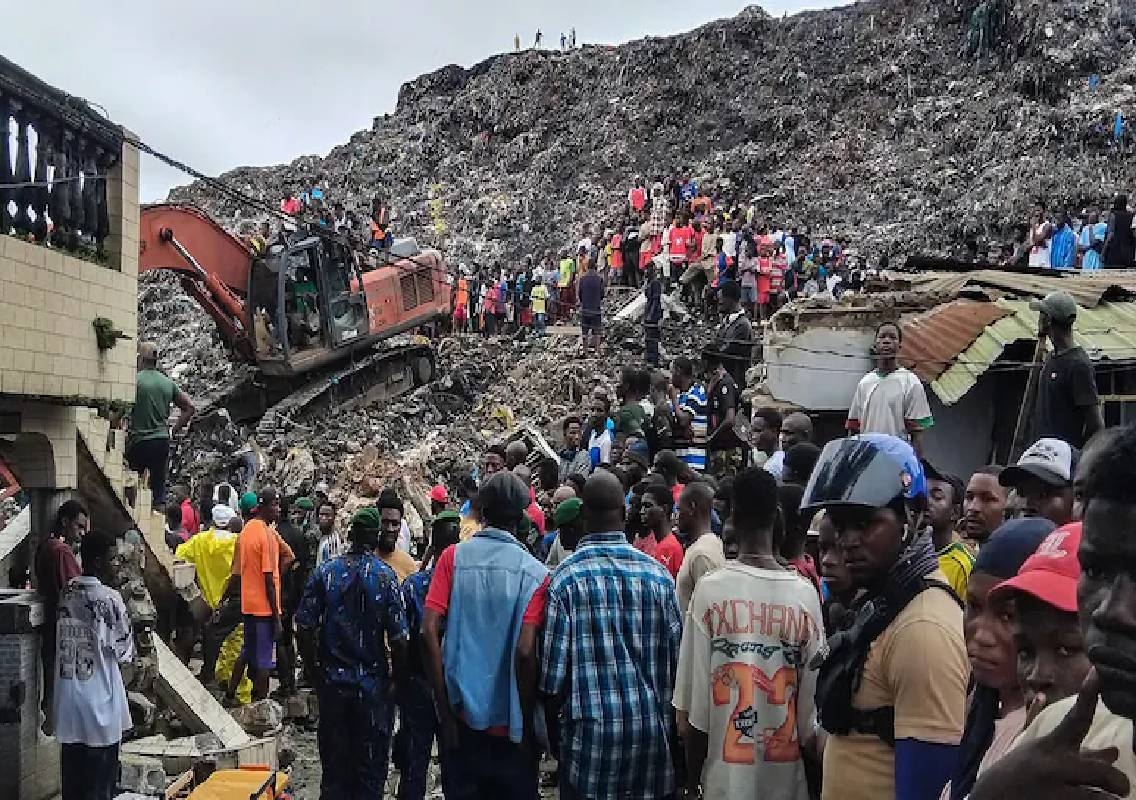


Conakry: At least 30 people were killed after a massive mound of rubbish collapsed at a landfill in Guinea’s capital, Conakry, following heavy overnight rain. The collapse buried nearby homes in the Dar-es-Salam neighbourhood, while six people were seriously injured, according to the Guinean government.
The disaster struck at around 2 am local time on Sunday in the Gbessia area, where the Dar Es Salam landfill is located. Rescue teams, including excavator operators, were deployed to search through the debris for survivors and recover bodies.
Heavy rain triggered landfill collapse
Authorities said heavy rainfall caused the huge waste mound to become unstable before it collapsed onto nearby residential areas.
The landfill is the largest in Conakry and has long been a concern because of its proximity to homes and informal settlements. The collapse destroyed or buried several structures, leaving residents trapped beneath tonnes of waste and debris.
Emergency workers continued clearing the site with excavators as authorities searched for people who may still have been buried.
The government said significant human and material resources had been deployed to support the rescue operation, treat the injured and recover the bodies of those who died.
Six people seriously injured
Along with the 30 fatalities, six people suffered serious injuries and were taken for medical treatment.
The government said arrangements were being made to provide medical care to the wounded and assistance to families affected by the disaster.
The scale of the collapse raised fears that the number of victims could change as rescue teams continued searching through the debris.
Witnesses and local officials described a chaotic scene as residents gathered near the landfill while heavy machinery worked to clear the collapsed waste.
Landfill was due to close
The tragedy occurred just as authorities were preparing to close the landfill.
Guinea’s government had announced plans to shut the site because of safety concerns, particularly during the rainy season. The waste was expected to be relocated to another location outside Conakry.
The closure had reportedly been scheduled for August 23, the same day the collapse occurred.
In the days before the disaster, authorities had ordered people living close to the landfill to leave the area because of fears that the waste mound could collapse. However, many people remained nearby when the disaster struck.
The timing has raised questions about whether the planned closure and evacuation measures were implemented quickly enough to prevent the loss of lives.
Rescue operation underway
Prime Minister Amadou Oury Bah visited the site after the collapse to assess the situation and oversee the government’s response.
Excavators were seen working through the huge pile of waste as rescue teams searched for survivors.
Authorities have urged residents to remain calm and cooperate with emergency services while rescue and recovery efforts continue.
The government has also said that families still living around the landfill will be relocated to safer areas.
Residents had received eviction notices
Officials had previously warned residents about the dangers of living near the landfill.
Eviction notices were issued to people in the surrounding area as authorities prepared to shut down the site. Some families left, but others continued to live or work in the vicinity.
The disaster has renewed concerns about the risks faced by people living close to poorly managed waste disposal sites in densely populated areas.
For many low-income residents, however, such areas can become places to live or earn a livelihood despite the environmental and safety risks.
Questions over landfill safety
The collapse has also brought renewed attention to waste management and urban planning in Conakry.
The Dar Es Salam site is an open-air landfill serving a rapidly growing capital. Large accumulations of waste can become unstable, particularly when heavy rainfall saturates the material and weakens the underlying ground.
The incident highlights the dangers that can arise when waste disposal infrastructure is located close to residential communities.
Guinea experiences heavy seasonal rainfall, and landslides and flooding have previously caused deaths in parts of the country.
Similar disaster occurred in the past
The latest tragedy is not the first deadly incident involving a landfill in Conakry.
A similar collapse at a rubbish dump in the capital in 2017 killed several people and injured dozens after heavy rain triggered a landslide.
The recurrence of such incidents has increased pressure on authorities to improve waste management systems and prevent residential settlements from developing around dangerous landfill sites.
Guinea faces wider infrastructure challenges
Guinea is rich in natural resources, including some of the world’s largest reserves of bauxite, as well as significant deposits of iron ore, gold and diamonds.
Despite its mineral wealth, the country continues to face major infrastructure and development challenges.
The latest landfill disaster has brought these challenges into sharp focus, particularly in Conakry, where rapid urban growth has placed pressure on housing, waste management and public services.
Reuters reported that millions of people in Guinea live below the national poverty line, making relocation and access to safer housing a major challenge for vulnerable communities.
Government promises support for affected families
Authorities have promised assistance to families affected by the collapse.
The government said medical care would be provided to injured people and that support would be offered to those who lost their homes or family members.
Officials are also expected to assess the condition of nearby structures and determine how many residents need to be relocated permanently.
The priority, however, remains the search for survivors and the recovery of victims from beneath the debris.
Investigation expected into the disaster
The circumstances surrounding the collapse are expected to come under scrutiny.
Authorities had already identified the landfill as unsafe and planned to close it. The fact that the collapse happened before the closure could prompt questions about the implementation of safety measures and the evacuation of nearby residents.
An investigation could examine the condition of the waste mound, the impact of heavy rainfall and whether adequate warnings and evacuation measures were in place.
Conclusion
At least 30 people have died in Conakry, Guinea, after a massive landfill collapsed onto nearby homes following heavy rain. Six others were seriously injured, while rescue teams continued searching the debris for survivors and recovering bodies.
The disaster occurred at the Dar Es Salam landfill, which authorities had already deemed unsafe and planned to close. Residents living nearby had received eviction notices because of concerns over the landfill’s stability, particularly during the rainy season.
The tragedy has highlighted the dangers posed by inadequate waste management and vulnerable settlements around landfill sites. With the government now promising to relocate affected families, attention will turn to the rescue operation, the investigation into the collapse and measures to prevent another such disaster in Conakry.