


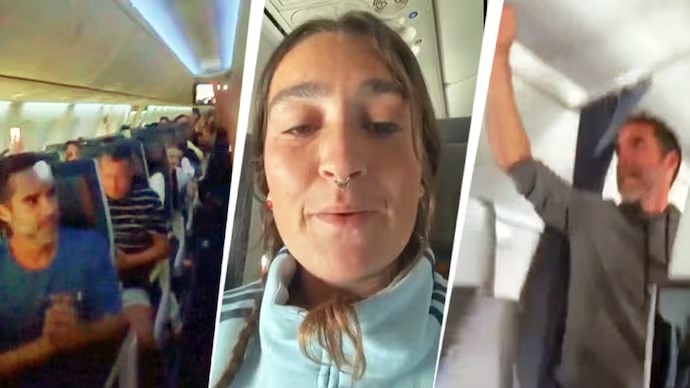


Dubai: Screams filled Flydubai flight FZ1073 as passengers feared the aircraft was about to crash after an alleged cockpit attack left Indian Captain Smit Machchhar seriously injured and sent the Boeing 737 into a steep descent.
The Dubai-to-Tel Aviv flight was carrying 174 people when the Omani co-pilot allegedly attacked Machchhar inside the cockpit on September 30. Despite his injuries, the captain managed to open the cockpit door, allowing passengers to enter and overpower the attacker. A reserve crew then helped take control of the aircraft before it was diverted to Tabuk in Saudi Arabia.
Passenger accounts and newly released footage have provided a clearer picture of the panic inside the cabin and the sequence of events that followed the attack.
What began as a terrifying cockpit assault eventually turned into a desperate collective effort by passengers, the injured captain and fellow pilots to prevent a potentially catastrophic outcome.
‘I’m not going to die. I’m going to see my mom’
Passenger Miriam Ohayon captured some of the frightening moments on her phone as the aircraft descended rapidly.
In the footage, she can be heard reassuring herself that she would survive and see her mother, reflecting the fear among passengers who were unaware of exactly what was happening inside the cockpit.
The aircraft had suffered a dramatic loss of altitude during the confrontation. Reuters reported that FZ1073 plunged nearly 14,000 feet in less than 30 seconds, based on flight-tracking data.
Passengers were initially confronted with a combination of confusion and fear. The aircraft was still airborne, the cockpit had become the centre of an emergency and many people did not know whether the pilots remained in control.
Then passengers began moving towards the cockpit.
‘He’s stabbing him’
For Tzvika Manes and his wife Tali, the danger became clear when they were near the cockpit with their six-year-old daughter.
Tali reportedly shouted that the co-pilot was stabbing the captain. Their daughter then began crying and told her father that she did not want to die.
Manes responded by rushing towards the cockpit.
He was joined by passengers Asaf Rajuan and Yaniv Hayun and an off-duty pilot who was travelling on the aircraft.
Inside, they found Machchhar badly injured and the cockpit in chaos.
The captain had nevertheless managed to unlock the cockpit door, giving those outside an opportunity to intervene.
The passengers entered, pulled the injured captain away from the attacker and restrained the co-pilot.
The precise weapon used in the attack has been described differently in early accounts. Reports have referred to a cockpit fire axe, while other accounts have described the attack as a stabbing. The investigation is continuing to establish the exact sequence and circumstances.
Passengers rush to save the captain
The intervention happened while the aircraft was still in a dangerous descent.
The passengers’ immediate priority was to separate Machchhar from the attacker and prevent further violence.
Hayun was among those who entered the cockpit. Accounts of the incident say he helped restrain the co-pilot and assisted in stabilising the aircraft.
The reserve crew then became critical to the emergency response.
Reuters reported that Machchhar’s actions in opening the cockpit door enabled passengers and crew to subdue the attacker, after which a backup pilot team helped land the aircraft safely in Tabuk.
The aircraft eventually reached the Saudi airport without a mass-casualty disaster.
‘You just go and do it’
For the passengers who entered the cockpit, there was little time to consider the danger they were facing.
Rajuan later described the instinctive nature of the response.
He said passengers did not have time to think about the scale of what was happening or how many lives were at stake. They simply moved towards the cockpit and acted.
Only afterwards, he said, did they begin to understand that their actions may have saved many lives.
The account illustrates how the passengers’ intervention developed from an immediate response to an unfolding emergency rather than a planned attempt to take control of the aircraft.
Machchhar opened the door despite his injuries
One of the most significant moments in the incident came when Machchhar managed to open the cockpit door.
According to accounts from the captain and investigators, he was already seriously injured but still managed to release the door.
In a video call with Prime Minister Narendra Modi on Friday, Machchhar described the crisis and said he opened the cockpit door during the attack. Modi praised the pilot for his courage and presence of mind.
Opening the door changed the situation inside the aircraft.
Passengers who had previously been separated from the cockpit could now reach the injured captain and the attacker.
That allowed them to restrain the co-pilot and helped create the conditions for another pilot team to take over the flight.
Reserve pilots help land the aircraft
The presence of additional aviation professionals among the passengers proved important after the cockpit confrontation.
A reserve crew helped take control of the aircraft and divert it to Tabuk.
The aircraft had experienced a rapid and substantial descent during the struggle. Reuters reported that it lost nearly 14,000 feet in less than 30 seconds.
After landing, Machchhar was taken to hospital for treatment.
The passengers were subsequently able to continue their journey after the emergency response was completed.
Captain Smit Machchhar recovering in UAE
Machchhar was seriously injured during the attack but survived.
After receiving treatment in Saudi Arabia, he was transferred to the UAE. The Indian Embassy said the captain was in good health and recovering well, while Indian officials continued coordinating with local authorities over his treatment and safety.
Machchhar has since spoken about the incident, including his conversation with Modi.
His account has provided investigators and the public with additional information about what happened inside the cockpit.
The captain has also received praise from Indian and Israeli officials for his actions during the emergency.
What happened to the co-pilot?
The co-pilot has been identified by Israeli authorities as an Omani national, although his name has not been publicly disclosed.
Israeli Prime Minister Benjamin Netanyahu said the co-pilot had undergone what he described as “Islamist radical indoctrination” and appeared to be suicidal. Netanyahu also said it was too early to draw final conclusions about the motive.
Israeli security officials told Reuters that their initial assessment was that the co-pilot was likely acting alone. At the same time, the wider investigation remains open and authorities are examining whether there was any advance planning, terrorist connection or outside direction.
Netanyahu has also said it was too early to determine whether Iran had any connection to the incident.
There is therefore a distinction between the claims made by Israeli officials about the co-pilot’s background and the findings that investigators have formally established.
UAE launches investigation
The UAE has launched an investigation into the incident, including its circumstances and motive.
Authorities are examining whether the attack was connected to terrorist activity, involved prior planning or was directed by another party. Saudi and Israeli authorities are also involved in examining different aspects of the incident.
The investigation is particularly significant because the incident occurred aboard a UAE-based airline on a flight travelling to Israel.
Questions have also emerged over how the co-pilot was able to operate the flight and whether existing security and vetting procedures were sufficient. Those questions are now being examined alongside the investigation into the attack itself.
From terror to survival
The events aboard FZ1073 unfolded within minutes but involved several critical turning points.
An alleged attack inside a locked cockpit left the captain seriously injured and the aircraft in a steep descent. Machchhar then managed to open the cockpit door. Passengers entered, restrained the attacker and helped move the wounded captain away from further danger.
A reserve crew subsequently helped stabilise the aircraft and land it safely in Saudi Arabia.
For the passengers, the experience began with uncertainty, screams and fear that the aircraft might crash. It ended with cheers and relief after the immediate danger had passed.
The investigation into the attack and its motive is continuing. But the sequence of events is already clear in broad outline: an injured captain managed to open the cockpit door, passengers intervened at enormous personal risk, and fellow aviation professionals helped bring the aircraft safely to the ground.
For the 174 people aboard FZ1073, those actions turned a potentially catastrophic mid-air emergency into a safe landing.