







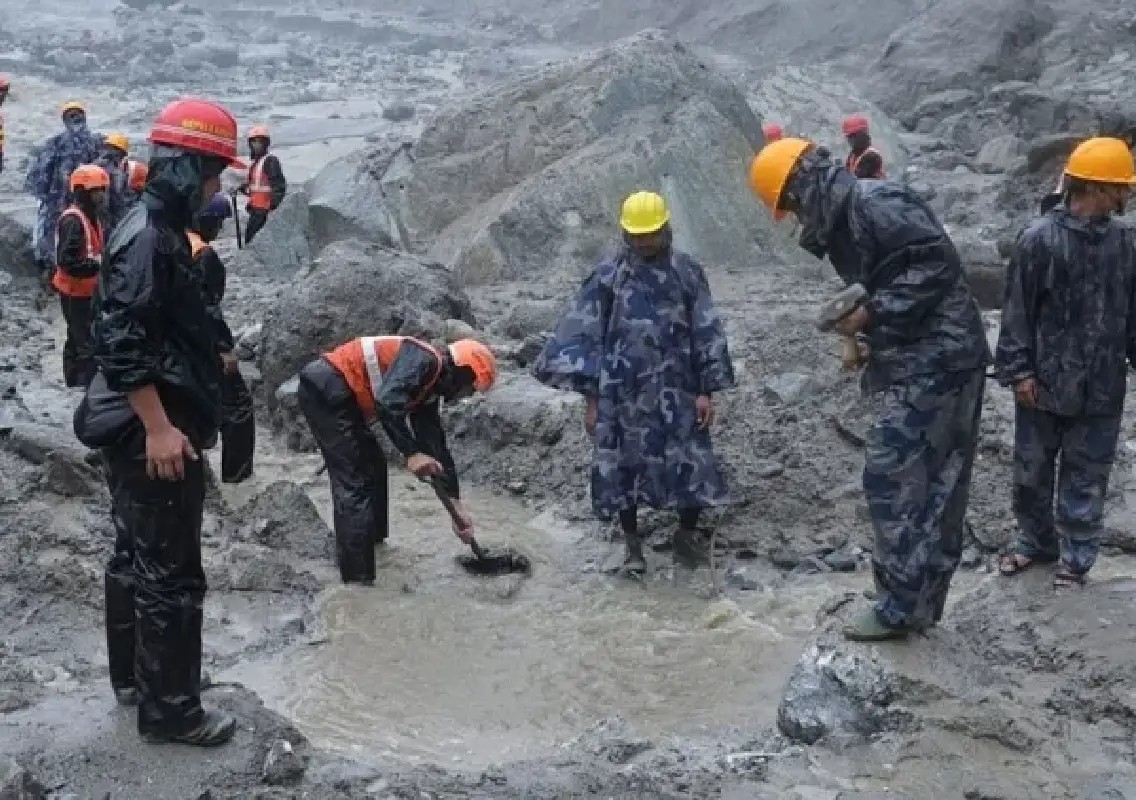


Kathmandu: Hundreds of hydropower workers remain missing in northern Nepal after devastating floods and landslides swept through the Trishuli and Bhote Koshi river corridors, leaving rescue teams facing a race against time to reach workers who may be trapped inside underground tunnels.
Nepal’s National Disaster Risk Reduction and Management Authority (NDRRMA) said 903 people have died and 4,247 remain missing following the disaster. The missing include 933 hydropower workers and 592 foreign nationals.
The disaster followed a glacial collapse near the Nepal-Tibet border on August 26, sending huge volumes of water, ice and rock down the mountain valleys. Roads, bridges, settlements and several hydropower projects were severely damaged.
Mud and debris have sealed tunnel entrances
Rescuers face major challenges in reaching workers who may be trapped underground. Tunnel entrances at several hydropower projects have been buried beneath mud and debris, while roads and bridges needed to reach the sites have also been damaged or washed away.
At the Upper Trishuli-3A project, Nepal Army rescuers drilled into the upper section of a mud-filled tunnel, pumped air inside and sent a camera through the opening to assess conditions underground.
Nepal Army spokesperson Raja Ram Basnet said the large quantity of debris deposited inside the tunnels was posing a major challenge, with the immediate focus on opening the passages.
Finding workers remains a major challenge
Hydropower projects have extensive underground tunnel networks and multiple access points. Floodwaters and debris have blocked these passages, making it difficult for rescuers to determine how far the flooding has spread and where missing workers could be located.
The use of cameras through narrow openings is therefore helping teams assess the situation before attempting to create larger passages.
Rescuers are also pumping air into some tunnels to maintain ventilation and determine whether workers could still be alive inside.
Heavy equipment difficult to reach affected sites
Clearing the blocked tunnels requires excavators, drilling equipment, pumps and other heavy machinery. However, the destruction of roads and bridges has made transporting equipment to remote hydropower projects extremely difficult.
The steep Himalayan terrain has added to the logistical challenge, forcing security personnel to assist with moving equipment and supplies.
Nearly 21,000 security personnel have been deployed across Nepal, while specialised teams from India and China are also assisting with search and rescue operations.
Rescuers face the risk of further collapse
Removing large quantities of mud and rock from underground structures carries its own risks. Flooding and the weight of debris may have weakened tunnel structures, raising concerns about further collapse.
Rescue teams must therefore assess the stability of the tunnels before sending personnel deeper inside. Drilling and debris removal have to be carried out cautiously, potentially slowing the operation.
Rain and rising rivers add to the danger
Continuing rainfall is making conditions even more unpredictable. Fresh rain can raise river levels, trigger landslides and damage routes that rescuers have already cleared.
At Trishuli-3A, overnight rain and rising river levels reportedly disrupted rescue operations. Poor weather can also affect helicopter operations used to reach remote locations and transport rescue personnel and equipment.
Officials believe some workers could potentially have access to oxygen and water inside certain facilities, but the condition and exact location of many missing workers remain unknown.
Rescue teams spread across multiple projects
The search is not limited to a single hydropower facility. Hundreds of workers and employees have been reported missing across several projects in the affected regions.
This has forced rescue agencies to divide personnel and equipment among multiple sites, adding to the complexity of an already difficult operation.
Specialised teams from Nepal, India, China and South Korea have been brought in to assist with the technically demanding underground rescue efforts.
For the families of the missing workers, however, the technical challenges offer little comfort as they continue to wait for news from the disaster-hit Himalayan valleys.