







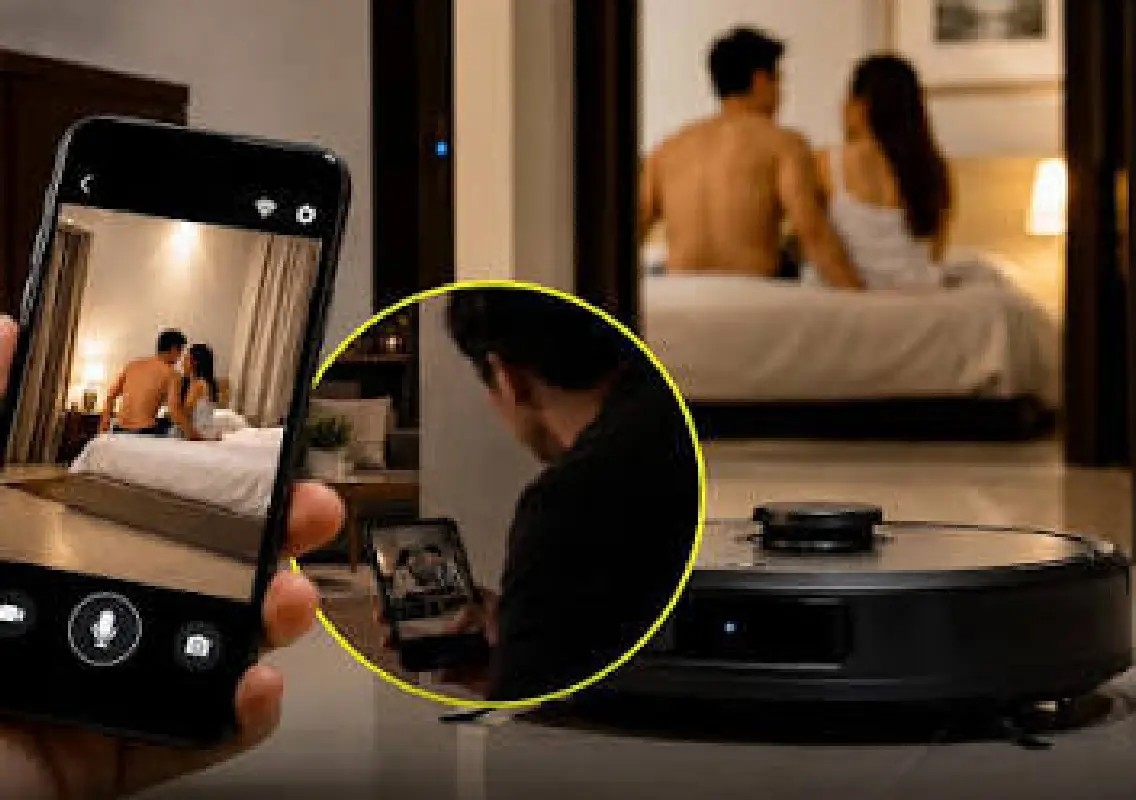


Taoyuan : A Taiwanese man who used the camera on a robot vacuum cleaner to secretly record his wife during an alleged affair has been sentenced to five months in prison for violating her privacy, despite successfully using the footage in a separate civil case.
The unusual case unfolded after the man became suspicious that his wife was having an extramarital relationship. He eventually used the smart vacuum cleaner’s camera to obtain footage of his wife and another man at the couple’s holiday home.
The recording helped him establish his claim in a civil lawsuit concerning the breakdown of the marriage. However, the same evidence later became the basis of a criminal complaint filed by his wife, who argued that she had been recorded without her knowledge or consent.
The court ultimately ruled that the husband’s marital relationship did not give him the right to secretly record his wife in a private setting.
Suspicion began with a toothbrush
According to reports on the case, the couple married in 2021 and generally lived with the man’s parents. They occasionally travelled to a holiday property owned by the family.
In September 2023, the husband reportedly discovered a used toothbrush at the holiday home that he did not recognise. The discovery increased his suspicions that his wife was seeing another man.
He subsequently examined surveillance footage from the property’s parking area. The footage reportedly showed an unfamiliar man visiting the location.
The husband then turned to a rather unconventional piece of technology for further evidence — a robot vacuum cleaner equipped with a camera and remote-access features.
Robot vacuum becomes an unlikely spy
The husband used a mobile application to remotely access the robot vacuum and its camera.
The device’s live-feed function allowed him to see what was happening inside the property. He eventually captured footage showing his wife in an intimate situation with another man.
The recording subsequently became part of the husband’s legal case against his wife and the alleged lover.
What began as an ordinary household appliance therefore became an unexpected source of evidence in a marital dispute.
However, the husband’s decision to record the encounter without his wife’s consent would ultimately create a second legal battle — this time with him as the defendant.
Husband wins civil claim
The footage helped the husband pursue a civil claim concerning the alleged affair and the violation of marital rights.
A court awarded him NT$500,000 in damages, equivalent to roughly ₹17 lakh or US$19,000, according to reports. The compensation was connected to the harm he claimed to have suffered as a result of his wife’s relationship with the other man.
The civil ruling appeared to vindicate the husband’s allegations about the affair.
But the legal consequences did not end there.
His wife subsequently filed a criminal complaint, arguing that the secret recording itself was an unlawful invasion of her privacy.
The case therefore took an unusual turn: the same husband who had obtained compensation over the alleged affair found himself facing criminal punishment for how he gathered the evidence.
Court rules privacy cannot be ignored
The Taoyuan District Court considered whether the husband’s actions were justified by his suspicions of infidelity and his desire to obtain evidence.
The court ruled against him.
According to reports, the judges found that the recording was intentionally made without the woman’s consent in a private setting. The fact that the two people were married did not remove the wife’s right to privacy.
The court therefore sentenced the man to five months in prison.
He was also ordered to pay a fine of NT$150,000, according to reports.
The decision underlines an important distinction in privacy law: evidence that may assist someone in a civil dispute does not necessarily mean the method used to obtain that evidence is lawful.
Marriage did not override privacy rights
The case has attracted attention because of the apparent contradiction in the legal outcome.
The husband was able to use evidence of the alleged affair to obtain compensation, yet he was separately punished for secretly obtaining that evidence.
The court’s reasoning emphasised that being someone’s spouse does not automatically grant permission to monitor or record their private activities.
Taiwanese law places significant restrictions on the unauthorised recording of private or intimate activities. Reports indicate that violations can carry serious criminal penalties.
The ruling consequently serves as a warning that people involved in personal or family disputes cannot necessarily bypass privacy protections simply because they believe they are gathering evidence of wrongdoing.
The unusual role of smart-home technology
The case also highlights the changing nature of privacy in homes filled with connected devices.
Robot vacuum cleaners, smart cameras, home assistants and other internet-connected appliances can contain microphones, cameras or sensors capable of collecting information about people inside a property.
These technologies are normally designed to provide convenience. A robot vacuum, for example, may use cameras and sensors to navigate rooms and avoid obstacles.
In this case, however, the same technology became a remotely accessible observation tool.
The incident raises questions about how people understand the privacy implications of smart devices — particularly when more household appliances can transmit images and other data through mobile applications.
Evidence and privacy can collide
The case demonstrates the complicated relationship between evidence gathering and privacy rights.
A person who suspects wrongdoing may want to document what is happening, particularly during a legal dispute. But secretly recording someone in a private environment can itself constitute a separate offence.
The Taiwanese ruling shows that courts can distinguish between the underlying allegation and the way evidence is obtained.
In this case, the husband’s civil claim and the wife’s privacy complaint were considered in different legal contexts.
The outcome means that success in one proceeding did not shield him from liability in another.
Social media fuels interest in the case
The unusual circumstances have attracted considerable attention online, with many people debating whether the husband should be viewed primarily as a victim of infidelity or as someone who crossed a legal boundary by secretly recording his wife.
The case has generated contrasting reactions because both issues involve competing ideas of fairness.
Some observers have focused on the alleged affair and the husband’s discovery of it, while others have pointed to the importance of privacy protections and consent.
The court’s decision, however, centres on the latter issue: regardless of the marital dispute, the recording itself was found to have violated the wife’s privacy.
A caution for smart-home users
The case is also a reminder that connected household devices can have capabilities far beyond their primary purpose.
Owners should understand what cameras and microphones their devices contain, how remote access works and who can access recorded or live footage.
At the same time, people involved in personal disputes should be aware that secretly using such devices to monitor another person may have legal consequences.
Technology can make it easier to obtain information, but easier access does not necessarily make an action lawful.
An unusual legal lesson
The Taiwanese husband’s experience has produced a striking legal paradox.
His investigation into his wife’s alleged affair resulted in a successful civil claim and compensation. Yet the method he used to document the relationship resulted in his own criminal conviction.
The five-month prison sentence demonstrates the seriousness with which authorities can treat unauthorised recordings of private activities.
The case ultimately sends a broader message about privacy in the digital age: suspecting someone of wrongdoing does not automatically provide the right to secretly record them.
As smart devices become increasingly common in homes, the boundary between convenience and surveillance is becoming more important. The Taiwanese case shows how quickly that boundary can become a legal issue — even inside a marriage.