







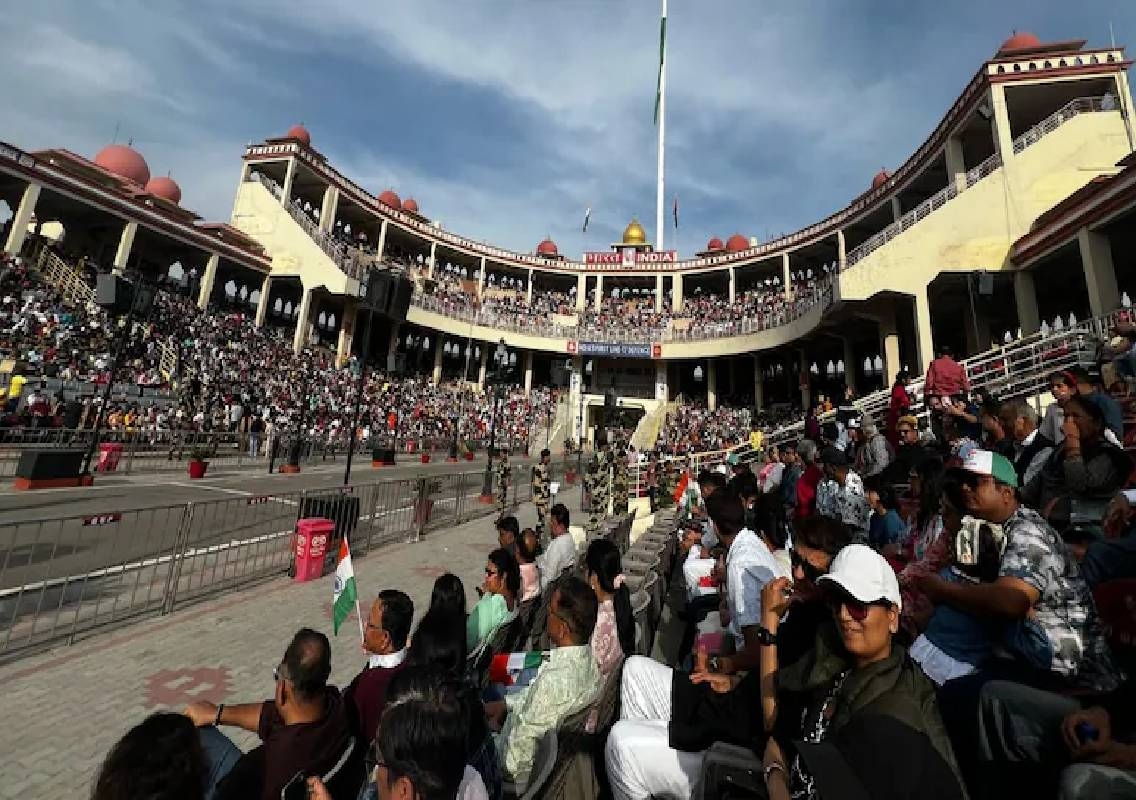


New Delhi: India has expanded its e-visa entry network by adding 11 international ports, including the Attari (Road) land port on the India-Pakistan border in Punjab. The move allows eligible foreign nationals holding Indian e-visas to use the newly notified locations for entering the country.
The latest expansion includes nine land ports and two airports, taking the total number of international entry points authorised for e-visa holders to 88. The network now comprises 37 airports, 38 seaports and 13 land ports, according to the Ministry of Home Affairs.
The inclusion of Attari is particularly notable because it is located on the India-Pakistan border and is one of India’s key land gateways in Punjab. However, the expansion does not mean Pakistani passport holders can use the e-visa facility. India currently does not grant e-visas to Pakistani nationals or people of Pakistani origin, who must apply for a regular visa through an Indian Mission.
Attari border joins India’s e-visa network
Attari (Road) in Punjab has been added to the list of land ports through which eligible foreign nationals can enter India using an e-visa.
The border point is located in Punjab’s Amritsar district and is part of the important India-Pakistan border crossing infrastructure. Its addition to the e-visa network expands the options available to international travellers entering India by land.
The change is also significant because land-based entry points have traditionally formed a smaller part of India’s e-visa network compared with airports and seaports.
With Attari now included, travellers who meet India’s e-visa eligibility requirements can use the notified land port instead of being restricted to designated airports or seaports.
However, the facility is subject to the conditions of the particular e-visa category and the traveller’s nationality.
11 new international ports added
The Centre has notified a total of 11 new international ports.
The nine newly added land ports are:
- Attari (Road), Punjab
- Darranga, Assam
- Gede, West Bengal
- Ghojadanga, West Bengal
- Haridaspur, West Bengal
- Jaigaon, West Bengal
- Dawki, Meghalaya
- Moreh, Manipur
- Agartala, Tripura
The two newly added airports are Bhopal and Tirupati.
The additions expand the geographical reach of India’s e-visa system, particularly for travellers arriving through land borders with neighbouring countries.
Total e-visa entry points rise to 88
Following the latest notification, India now has 88 international ports authorised for entry by eligible e-visa holders.
The network consists of:
| Type of entry point | Number |
|---|---|
| Airports | 37 |
| Seaports | 38 |
| Land ports | 13 |
| Total | 88 |
The government has been progressively expanding the number of entry points available under the e-visa programme to make the facility more accessible to international travellers.
The latest expansion is particularly relevant for visitors who may prefer to enter India by road rather than flying into one of the designated international airports.
Pakistani nationals cannot use the e-visa facility
The inclusion of Attari could raise questions about whether Pakistani citizens can now travel to India through the border using an e-visa.
The answer is no.
India does not currently grant e-visas to travellers holding Pakistani passports or to people of Pakistani origin. Such applicants are required to apply for a regular Indian visa through an Indian Mission.
Therefore, adding Attari to the e-visa entry list should not be interpreted as a relaxation of India’s e-visa policy for Pakistani citizens.
The new provision applies to foreign nationals who are otherwise eligible for an Indian e-visa.
Why Attari’s inclusion is significant
Attari is one of India’s most prominent land gateways towards Pakistan.
The border crossing is closely associated with the Wagah-Attari border and has long been an important point for cross-border movement, although access and travel arrangements between India and Pakistan are governed by the prevailing rules and bilateral circumstances.
By adding Attari (Road) to the e-visa network, the government has expanded the range of land-based options available to eligible international visitors.
The move could also make travel more convenient for tourists and other foreign nationals travelling across India’s western land border from countries and routes where such entry is permitted.
More land routes added across India
Attari is not the only border location included in the latest notification.
The government has also added land ports such as Moreh, which connects India with Myanmar, and Dawki, a major border point in Meghalaya.
Other additions include Darranga in Assam, Agartala in Tripura and several land ports in West Bengal.
The expansion therefore covers India’s borders with multiple neighbouring countries rather than focusing on a single frontier.
This broader approach increases the geographical coverage of the e-visa system and provides additional options for international travellers entering India by land.
Bhopal and Tirupati airports added
Along with the nine land ports, the government has added two airports to the e-visa entry network.
They are Bhopal airport in Madhya Pradesh and Tirupati airport in Andhra Pradesh.
Their inclusion gives eligible e-visa holders additional domestic regional gateways for entering India directly by air.
The move could also support tourism and business travel to destinations that may previously have required travellers to enter through another designated airport before continuing their journey.
What is an Indian e-visa?
India introduced its e-visa facility in 2014 to simplify the visa process for eligible foreign nationals.
The programme initially covered citizens of 43 countries. It has since expanded considerably and is now available to citizens of 172 countries, subject to the applicable eligibility rules and visa categories.
The e-visa system allows eligible travellers to complete much of the application process online before travelling to India.
Instead of visiting an Indian diplomatic mission for every application, eligible applicants can submit their details electronically and receive an electronic travel authorisation if their application is approved.
The system has become an important part of India’s efforts to facilitate international tourism and business travel.
Several categories covered by e-visas
India’s e-visa system is not limited to tourists.
According to the latest information cited by NDTV, the facility covers 17 sub-categories of travellers.
These include categories such as tourism, medical travel, student travel, mountaineering, cruise travel, transit, group travel and business, among others.
The applicable conditions can differ depending on the visa category.
Travellers should therefore check the requirements attached to their particular e-visa before selecting an entry point.
Possessing an e-visa does not automatically mean that a traveller can enter through any border crossing in India.
Entry must take place through an authorised immigration checkpoint.
Most applications processed within 72 hours
The government has also highlighted the speed of the e-visa application process.
According to the information published by NDTV, around 95 per cent of e-visa applications are processed within 72 hours.
The relatively quick processing time is intended to make international travel planning easier.
However, travellers should not assume that every application will be processed within the same timeframe. Applicants must still meet the eligibility requirements and provide the necessary information and documentation.
Applying sufficiently ahead of the intended travel date remains important.
How the expansion could help international travellers
The increase in authorised entry points provides greater flexibility for visitors.
Travellers arriving by air now have additional options with Bhopal and Tirupati joining the network. Those travelling by road have more choices through the nine newly notified land ports.
For tourists, this could reduce the need to take connecting flights solely to reach a destination.
For business travellers and other visitors, the expanded network could make travel planning more convenient.
The government has described the expansion as a step towards making India’s e-visa facility more accessible and useful to international travellers.
What the Attari addition does not change
The latest notification should not be confused with a general reopening or relaxation of India-Pakistan travel arrangements.
The e-visa expansion concerns eligible foreign nationals who already qualify for India’s electronic visa system.
It does not grant Pakistani passport holders access to an Indian e-visa.
Travellers must also comply with all other immigration, security and border-entry requirements applicable at the time of travel.
Therefore, the significance of Attari’s addition lies primarily in expanding the list of authorised entry points rather than changing the underlying eligibility rules for India’s e-visa programme.
Other land ports already on the list
Before the latest expansion, India already permitted e-visa entry through several land ports.
The Ministry of Home Affairs’ latest notification brings the number of authorised land ports to 13.
The previously notified land borders include Raxaul, Rupaidiha and Jogbani, while the latest additions have expanded the network to include Attari and eight other land ports.
This gradual expansion indicates that the government is increasingly incorporating land-based international travel into the e-visa framework.
Implications for tourism
The expansion could support India’s tourism sector by making travel more convenient for eligible foreign visitors.
India has a large and geographically diverse tourism market, with popular destinations located far from the country’s biggest international airports.
Additional airports and land ports can help distribute international arrivals more widely.
For states such as Madhya Pradesh, Andhra Pradesh and border regions in the north-east and east, additional e-visa entry points could make it easier for international visitors to travel directly to or closer to their intended destinations.
The move could therefore have benefits beyond immigration convenience, particularly for regional tourism.
Importance for business travel
The expansion also applies to eligible business travellers.
India’s growing trade, manufacturing, technology and services sectors attract visitors from across the world.
Additional entry points can make short business trips more convenient, particularly when travellers are heading to regions outside the country’s largest metropolitan centres.
However, business travellers must ensure that their e-visa category permits the intended activities and that the selected port is authorised for that category.
India continues to expand its e-visa system
The latest notification is part of a broader expansion of India’s electronic visa infrastructure.
The e-visa programme has grown substantially since its launch in 2014, both in terms of the number of eligible nationalities and the number of entry points.
The latest addition takes the number of authorised entry points to 88, comprising airports, seaports and land ports.
This provides a much wider network than the system offered when it was first introduced.
What foreign travellers should check
Foreign nationals planning to travel to India on an e-visa should verify several details before beginning their journey.
First, they should confirm that their nationality is eligible for an Indian e-visa.
Second, they should ensure that the visa category matches the purpose of their visit.
Third, they should check that their intended airport, seaport or land port is on India’s authorised list.
Finally, travellers should check the latest immigration requirements before departure because visa and border policies can change.
The addition of Attari does not remove these requirements.
Conclusion
India has added 11 international ports to its e-visa entry network, including Attari (Road) in Punjab, taking the total number of authorised entry points to 88. The expansion consists of nine land ports and two airports — Bhopal and Tirupati.
The move gives eligible foreign nationals more options to enter India using electronic visas and expands the country’s land-based e-visa network. The other newly added land ports include Moreh, Dawki, Agartala, Darranga, Gede, Ghojadanga, Haridaspur and Jaigaon.
The addition of Attari is notable because it lies on the India-Pakistan border. However, the change does not allow Pakistani passport holders to enter India using an e-visa. India currently does not issue e-visas to Pakistani nationals or people of Pakistani origin, who must apply for a regular visa through an Indian Mission.
With the latest expansion, India’s e-visa network now covers 37 airports, 38 seaports and 13 land ports. The facility is available across multiple categories, including tourism, business, medical, student, transit and other eligible travel purposes.
The government’s decision is aimed at making India’s electronic visa system more accessible and convenient for international travellers. For eligible visitors, the addition of more airports and land borders could simplify travel planning and improve connectivity to destinations across the country.