


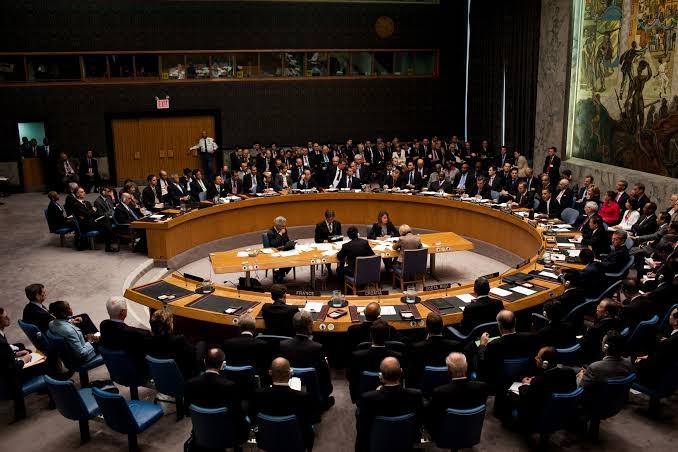


New York: India has called for comprehensive reforms of the United Nations Security Council, warning that creating new permanent seats without veto powers would leave their occupants with “second-class” status and fail to address the existing concentration of decision-making power.
India’s Permanent Representative to the UN, Ambassador Harish Parvathaneni, made the remarks during an Inter-Governmental Negotiations (IGN) plenary debate on the veto in the UN General Assembly on Monday. He said the veto must be exercised with restraint, particularly on issues concerning international peace and security, and should not become an instrument of narrow political expediency.
Parvathaneni argued that reform cannot focus on the veto alone. Changes must also address the Council’s membership categories, regional representation, size and working methods. He called for negotiations based on a clear text, with defined timelines and milestones, to move the long-running reform process forward.
India reiterated its position that if veto powers continue to exist, all permanent members of a reformed Security Council should enjoy the same rights and responsibilities.
India questions the use of the veto
The Security Council is the UN body responsible for maintaining international peace and security. It has 15 members, comprising five permanent members and 10 non-permanent members elected by the General Assembly for two-year terms.
The permanent members, commonly known as the P5, are China, France, Russia, the United Kingdom and the United States. Each has veto power over substantive resolutions, allowing any one of them to block a proposal even when the remaining Council members support it.
Addressing the General Assembly debate, Parvathaneni said the veto was not merely a privilege but a responsibility that should be exercised with great restraint.
“India has always maintained that the veto, which is right now a prerogative only of the five permanent members of the Security Council, is a responsibility that must be exercised with great restraint, especially on matters bearing upon the maintenance of international peace and security. It should not be an instrument of narrow political expediency,” he said.
The envoy cited the historical record of veto use to underline India’s concerns. According to his remarks, the veto had been exercised 331 times on around 200 resolutions during the UN’s existence.
He also noted that two of the five permanent members had not exercised a veto for more than three and a half decades, while most vetoes or threats to use them had come from the other three.
The figures, he argued, highlighted the need to examine how the veto affects the Council’s ability to respond to international crises and how its use should be addressed as part of wider institutional reform.
India says 2022 veto initiative has limitations
Parvathaneni also referred to a UN General Assembly initiative adopted in 2022 to increase scrutiny of the veto.
Under General Assembly Resolution 76/262, a debate is mandated in the General Assembly whenever a permanent member exercises its veto in the Security Council. The mechanism was intended to encourage accountability and provide a forum for member states to discuss the use of the power.
However, the Indian envoy said the experience since the initiative’s adoption had not produced the change many had anticipated.
“The veto initiative of 2022 was seen as a harbinger of change by mandating a General Assembly debate every time a veto is cast. However, the actual record of the large number of vetoes cast since Resolution 76-262 was adopted tells a contrary story,” he said.
While acknowledging the intent behind the initiative and efforts to address vetoes in situations involving mass atrocities, Parvathaneni argued that incremental steps could not resolve the deeper structural problems affecting the Council.
He said restricting the veto without addressing the Council’s composition and functioning would leave its fundamental decision-making dynamics largely unchanged.
“The lived experience shows that piecemeal approaches, however well-intentioned, are bound to fail. Limiting the veto cannot be separated from the questions of categories of membership, regional representation, size, and working methods. We need to move forward on all five clusters together,” he said.
India’s position is that reform should be negotiated as a comprehensive package rather than through isolated changes that leave other areas of disagreement unresolved.
New permanent members without veto powers would face inequality
A central element of India’s position is that any expansion of permanent membership must provide new permanent members with the same rights as the existing P5.
Parvathaneni said a reformed Council should not establish a new category of permanent members with fewer powers.
“India’s position on the veto is principled and well known. It is aligned with the common African position. We reiterate that as long as a veto exists, it must be held by all permanent members of a reformed Council. Fairness and justice demand that all permanent members enjoy the same rights and responsibilities,” he said.
He warned that creating a separate category of permanent members without veto rights would add another layer of inequality to an institution already facing criticism over its composition.
“A new category of permanent members with or without the veto would only further complicate a discussion that’s already very difficult and would further entrench the very inequity we are seeking to correct,” he said.
Parvathaneni added that a reform which created long-term members without veto powers would not fundamentally change the way decisions are made by the existing permanent members.
“A reform that expands the UN Security Council by creating another category of long-term members without the veto effectively makes them second-class members and would not change the decision-making dynamic of the P5,” he said.
India has consistently argued that the Council should expand both its permanent and non-permanent categories. It maintains that adding only elected members would increase the Council’s size without adequately addressing the concentration of authority among the five permanent members.
India flags informal and de facto vetoes
The Indian envoy also argued that the problem of veto power extends beyond formal vetoes cast against draft resolutions.
He pointed to procedures in which decisions can be blocked through informal consensus requirements, including presidential statements, press statements and decisions taken by sanctions committees.
“The veto is not only what is cast in the open. There is the effective or the de facto veto that every Council member, elected and non-elected, holds over presidential statements, press statements, decisions of sanctions committees where the unwritten rule of consensus allows a single member to hold or block a proposal, most often without explanation,” he said.
Such practices, according to India’s argument, can prevent proposals from moving forward even when no formal veto is recorded.
Parvathaneni also criticised the use of consensus in the negotiations on Security Council reform, saying procedural disagreements had contributed to the lack of progress.
He referred to General Assembly Decision 62/557, which established the framework for the IGN process. According to the Indian envoy, the decision identifies the widest possible political acceptance as the guiding principle rather than requiring consensus in every instance.
“In the same vein, the argument of consensus has been harnessed as a disguised or a de facto veto in the IGN process as well. Resolution 62-557, the foundational decision for the IGN, is clear. The guiding principle is the widest possible political acceptance, not consensus. Seventeen cycles later, we have no outcome to show for it,” he said.
The IGN is the intergovernmental process through which UN member states discuss proposals for reforming the Security Council. India has called for the negotiations to progress towards formal, text-based discussions with clear milestones.
India recalls the Council’s 1965 expansion
Parvathaneni also cited the Security Council’s only major expansion, which took place in 1965.
That reform increased the number of non-permanent members from six to 10, while the five permanent members retained their positions and veto powers.
“The only expansion of the Council in 1965 enlarged the non-permanent category alone. The ratio of permanent to elected members moved from five to six to five to ten and further strengthened the relative power of the P5,” he said.
India argues that the change did not fundamentally alter the balance of authority within the Council because the permanent members retained their exclusive veto rights.
The historical example was used to support India’s case for a broader reform that addresses membership categories, representation and decision-making procedures together.
The Council was established in 1945, following the Second World War. India maintains that its structure must now reflect contemporary geopolitical realities rather than continue to be shaped primarily by the circumstances of its creation.
India seeks a permanent seat and greater representation
India has long sought permanent membership of the Security Council, arguing that the current structure does not adequately represent the modern international order.
Its position includes calls for greater representation for regions that remain underrepresented and for a Council capable of responding effectively to contemporary international challenges.
India has also sought a non-permanent seat for the 2028–29 term. Elections are scheduled for June 2027, when India and Tajikistan are set to contest the sole seat allocated to the Asia-Pacific Group, according to PTI.
India last served on the Council during 2021–22, its eighth term. Its earlier terms were 1950–51, 1967–68, 1972–73, 1977–78, 1984–85, 1991–92 and 2011–12.
While a non-permanent seat would provide India another opportunity to participate directly in the Council’s work, its long-term position remains that elected membership cannot substitute for reform of the permanent category.
The envoy’s remarks therefore linked India’s own demand for permanent membership to the broader question of how the Council should distribute authority among its members.
India calls for time-bound negotiations
Concluding his remarks, Parvathaneni called for a reform process that addresses all major questions together and moves beyond repeated procedural discussions.
India’s proposal is to pursue text-based negotiations with clearly defined timelines and milestones, allowing member states to engage with specific reform options rather than remain stalled over general principles.
The central argument is that the veto cannot be considered separately from the Council’s size, membership categories, regional representation and working methods. Restricting the use of the veto without changing the wider structure, India maintains, would leave the existing distribution of power largely intact.
“The Security Council will not be reformed by managing the veto alone. The answer lies in a Council fit for purpose, whose architecture reflects today’s realities and not that of the outcome of a war eight decades ago. India stands ready to contribute to that endeavour,” Parvathaneni said.
India’s intervention adds to the continuing debate over how the United Nations should adapt its most powerful decision-making body. Whether member states can reach agreement on permanent membership, veto rights and the wider reform package remains unresolved.