


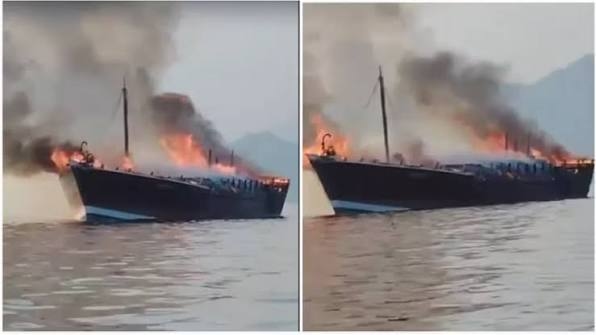


Muscat: One Indian seafarer was killed and 13 others were rescued after an Indian-flagged cargo vessel was struck by an unidentified aerial object near the coast of Oman on November 2. The vessel, identified as MSV AL JUSUFI, was carrying 14 Indian crew members when the incident occurred near Limah, Oman.
Union Minister for Ports, Shipping and Waterways Sarbananda Sonowal confirmed the incident in a post on X. He identified the deceased seafarer as Gandhar Nahim Ajij from Gujarat and said the remaining crew members had been safely evacuated and rescued by the Omani Coast Guard.
The attack comes amid heightened tensions in the Middle East, where the ongoing conflict involving the United States and Iran has raised concerns about the safety of commercial shipping routes. The Strait of Hormuz and surrounding waters remain strategically important for international trade and energy supplies.
Sarbananda Sonowal confirms death of Indian seafarer
In his statement on X, Sonowal said the Indian-flagged vessel was struck by an unidentified aerial object while navigating near the coast of Oman on November 2.
The minister said 13 of the 14 Indian crew members managed to evacuate safely and were rescued by the Omani Coast Guard. However, one seafarer sustained fatal injuries in the incident.
Expressing grief over the death, Sonowal said, “I am deeply saddened to report that one of our seafarers, Gandhar Nahim Ajij from Gujarat, tragically succumbed to his injuries. My heartfelt condolences go out to his family and loved ones during this hour of immense grief.”
The minister also said that the Ministry of Ports, Shipping and Waterways and the Indian Embassy in Oman were coordinating with local authorities to provide assistance to the rescued crew members.
The government is working to facilitate the early repatriation of the 13 survivors and the mortal remains of the deceased seafarer. The coordination with Omani authorities is intended to ensure that the crew receives the necessary support following the incident.
MEA condemns attack on commercial vessel
The Ministry of External Affairs (MEA) also issued a statement condemning the attack on MSV AL JUSUFI near Limah in Oman.
The ministry confirmed that 13 Indian nationals had been rescued, while one Indian citizen lost his life after sustaining injuries. It conveyed condolences to the family of the deceased and said the Indian Embassy in Oman was closely monitoring the situation.
According to the MEA, the embassy is coordinating with Omani authorities to arrange the early repatriation of the rescued Indian nationals and the mortal remains of the seafarer who died.
The ministry also expressed concern over repeated attacks on commercial shipping in the region. It called for an immediate reduction in tensions and urged the parties involved to conclude ongoing negotiations towards a diplomatic solution.
The MEA said the targeting of commercial vessels and civilian infrastructure must end. It also stressed the importance of restoring free and uninterrupted navigation and trade through international waterways in accordance with international law.
The statement underlined India’s concern about the wider implications of maritime attacks, particularly for civilian crews and international commerce. Commercial shipping routes in the region are vital for the movement of energy supplies and other goods, making their security an important international concern.
IRGC claims two oil tankers exploded in Strait of Hormuz
Separately, Iran’s Islamic Revolutionary Guard Corps (IRGC) Navy claimed that two oil tankers, including a supertanker, exploded after allegedly striking naval mines while attempting to navigate an unauthorised route through the Strait of Hormuz.
According to a report by Press TV, which cited a statement from the IRGC Navy’s Public Relations Office, one of the tankers was engulfed in flames following a powerful explosion.
The Iranian naval force alleged that both vessels had switched off their navigation and identification systems. It further claimed that the tankers had ignored repeated warnings against using restricted maritime routes.
The claims were made by the IRGC Navy, and the available information did not independently establish the circumstances surrounding the reported explosions.
The Strait of Hormuz is one of the world’s most important maritime passages. It connects the Persian Gulf with the Gulf of Oman and the Arabian Sea, serving as a major route for international oil and gas shipments.
Any disruption to navigation through the waterway can have consequences for shipping operators, energy markets and countries dependent on supplies passing through the region.
UKMTO reports incident involving merchant vessel
The United Kingdom Maritime Trade Operations (UKMTO) also reported an incident involving a merchant vessel in the Strait of Hormuz.
In a warning issued on November 1, the UKMTO said it had received a report of an incident within the strategic waterway at approximately 1509 UTC.
The report added to concerns about the security of commercial vessels operating in the region. However, the information provided in the warning did not establish whether the reported incident was connected to the tanker explosions claimed by the IRGC Navy.
The separate reports underline the risks facing merchant shipping as tensions continue across the Middle East. Seafarers operating in the region may face threats from aerial attacks, maritime mines and other security incidents, while shipping companies must also consider restrictions and warnings issued for particular routes.
India calls for de-escalation and safe maritime passage
The death of Gandhar Nahim Ajij has brought renewed attention to the safety of Indian seafarers working on commercial vessels in conflict-affected waters.
India has called for an immediate de-escalation of tensions and a diplomatic resolution to the ongoing regional crisis. The MEA’s statement also emphasised that commercial shipping and civilian infrastructure must not be targeted.
For now, the Indian government is coordinating with Omani authorities to support the 13 rescued crew members and arrange their return home. It is also working to facilitate the repatriation of the deceased seafarer’s mortal remains.
The incident highlights the human cost of growing insecurity along vital maritime routes. While diplomatic efforts continue, ensuring the safety of civilian vessels and restoring uninterrupted navigation through international waterways remain key concerns for India and the wider international community.