







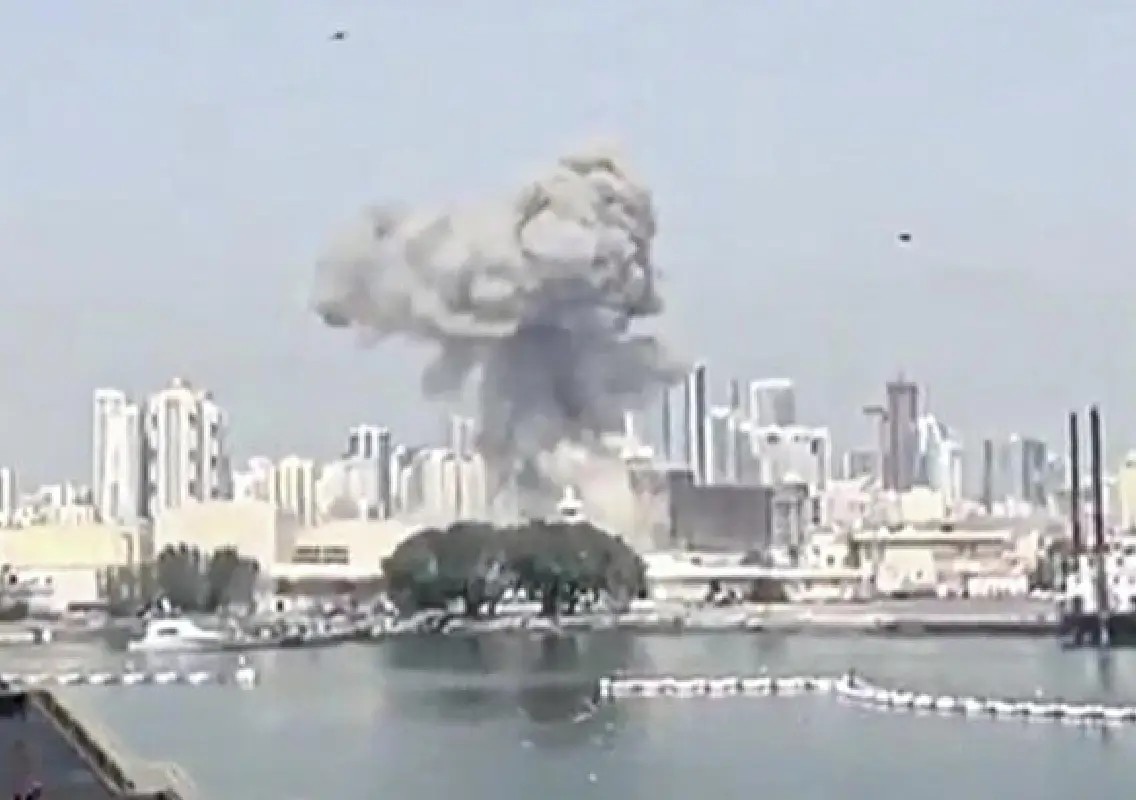


Tehran : Iran has claimed that its forces launched attacks on US military targets in the United Arab Emirates, Kuwait, Bahrain and other parts of the region, marking a sharp escalation in the renewed confrontation between Tehran and Washington.
The Iranian Army said dozens of attack drones targeted radar systems and positions used by US forces at the Al Dhafra and Al Minhad bases in the UAE, while the Islamic Revolutionary Guard Corps (IRGC) said it also targeted American forces in Kuwait, Jordan, Bahrain and Erbil in Iraq’s Kurdistan region.
The claims came after the US military carried out fresh strikes against Iranian military infrastructure, including air-defence systems, radar facilities and other assets near the strategically important Strait of Hormuz.
Iran says US bases were targeted
In a statement reported by Iranian authorities, the Iranian Army said drones had been launched against US military positions at Al Dhafra and Al Minhad in the UAE.
The statement said radar systems and positions where US forces were stationed had been targeted.
Iran also said its forces attacked the Sheikh Isa Air Base in Bahrain, where US military assets are present. The IRGC separately claimed operations against US forces in Kuwait, Jordan and Erbil.
The claims could not immediately be independently verified in their entirety.
Kuwait attack adds to regional tension
The IRGC said its ground forces carried out a combined missile and drone attack against Ali Al Salem Air Base in Kuwait, targeting facilities associated with US forces.
Iranian authorities claimed that the operation targeted the accommodation of a US commander and drone facilities at the base.
The IRGC also claimed that the attack damaged a drone hangar and destroyed several drones. However, claims about US casualties have been disputed. Reuters reported that US officials said initial assessments showed no American casualties, despite Iranian claims of deaths.
Kuwaiti authorities have also reported responding to Iranian attacks and intercepting incoming threats.
Fresh strikes follow US military operation
The latest escalation followed a renewed US military campaign against Iranian targets.
US Central Command said it had carried out strikes against Islamic Revolutionary Guard Corps assets, including air-defence systems, radar installations, maritime capabilities, mine-laying equipment and communications sites.
The strikes marked a significant escalation after a period of relative calm between Washington and Tehran.
Iran has described its attacks as retaliation for American military action, while the United States has accused Tehran of threatening American personnel and commercial shipping in the region.
UAE and Gulf states face growing risks
The involvement of the UAE, Kuwait, Bahrain and other countries has increased concerns that the confrontation could spread beyond direct US-Iranian military exchanges.
Several Gulf countries host American military personnel and facilities, making them potential flashpoints if Tehran continues targeting US assets.
The UAE has called for an immediate de-escalation of the conflict and warned that continued military action could push the region towards deeper instability.
Airspace and aviation operations have also been affected by the heightened tensions. Airlines operating in the Gulf have faced cancellations and disruptions as authorities assess security conditions.
Strait of Hormuz remains major flashpoint
The latest military confrontation is closely linked to the Strait of Hormuz, a vital global shipping route through which a significant share of the world’s oil supplies passes.
The waterway has become a central point of confrontation between Iran and the United States. Tehran has threatened restrictions on shipping, while Washington has sought to maintain access to the strategic route.
Any prolonged disruption could have consequences far beyond the Middle East, potentially affecting oil prices, shipping costs and global supply chains.
Recent reports indicate that the renewed fighting has already pushed oil prices higher and created fresh uncertainty in international markets.
Wider regional conflict feared
The latest exchange of attacks has raised concerns that the conflict could widen further.
Iran has claimed attacks on US-linked military facilities in several countries, while Gulf states have activated air-defence systems to intercept missiles and drones.
Jordan has reported intercepting ballistic missiles entering its airspace, while Bahrain has also reported intercepting Iranian drones.
The United States, meanwhile, has warned of further military action if Iran continues its attacks.
The developments have placed regional governments in a difficult position as they seek to protect their territories while avoiding becoming directly involved in the wider conflict.
Diplomatic efforts face fresh pressure
The renewed military exchanges have also complicated diplomatic efforts aimed at containing the confrontation.
Qatar, which has previously played a role in mediation between the parties, has warned that Iran’s attacks could make efforts to reduce tensions more difficult.
The latest developments demonstrate how fragile any period of calm between Washington and Tehran remains.
With both sides continuing to exchange threats and military strikes, the immediate priority for regional governments is preventing further escalation and protecting civilians.
For the Gulf region and the wider global economy, much will depend on whether the latest exchange remains limited or develops into a broader military confrontation.