







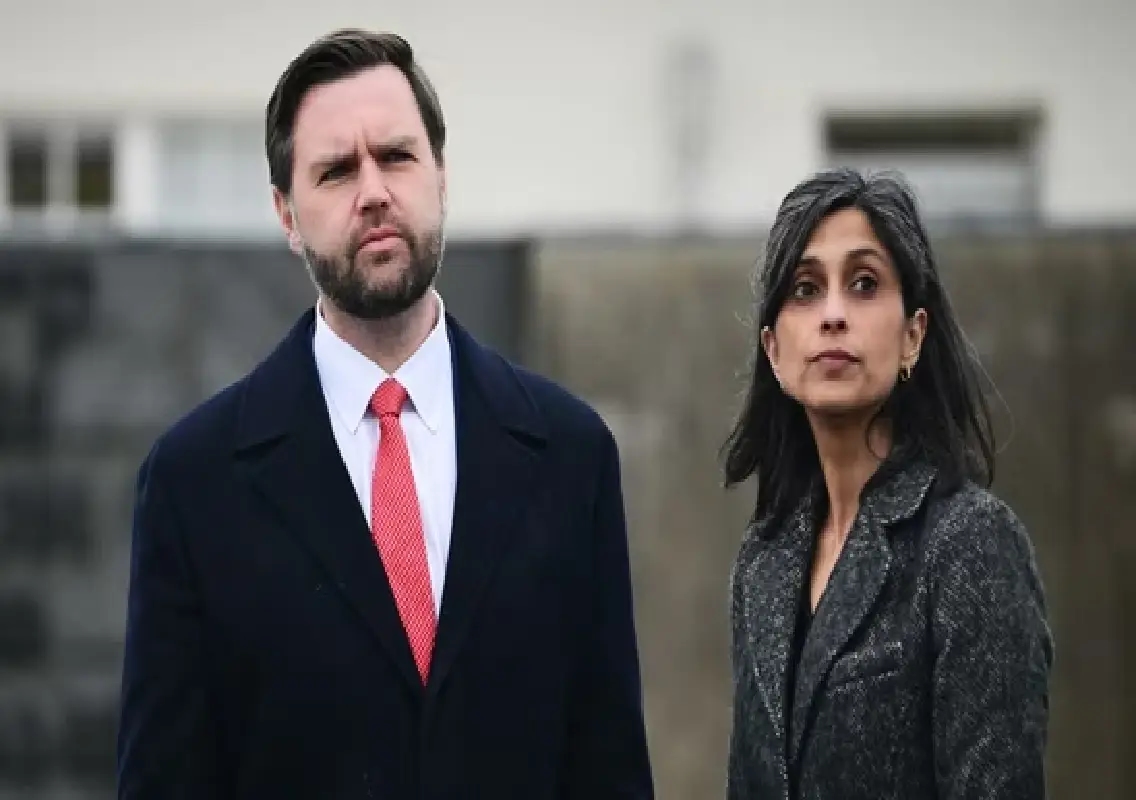


United States Vice President JD Vance has found himself at the centre of social media speculation following his appearance at a Turning Point USA (TPUSA) student event in Oxford, Mississippi earlier this week. Photos of Vance sharing a brief, emotional hug with Erika Kirk, widow of late conservative activist Charlie Kirk, quickly went viral, sparking rumours about his personal life and marriage. At the same time, comments Vance made about his interfaith marriage during the event added fuel to a wave of unfounded online claims about a supposed “religious rift” in the Vance household.
The viral hug that sparked rumours
The Vice President attended the TPUSA gathering on Wednesday at the Sandy and John Black Pavilion on the University of Mississippi campus, an event that drew nearly 10,000 attendees, according to Mississippi Public Broadcasting.
During the programme, Erika Kirk introduced Vance on stage, where the two exchanged a brief hug before he began his remarks. The gesture, captured by photographers, was widely circulated online within hours. Several social media posts insinuated that there was “more” to the moment, despite no factual basis for such speculation.
Photographs from Getty Images and Reuters show the hug was a short, public greeting in front of thousands. Fact-checkers and journalists later confirmed that the claim of an “affair” between Vance and Kirk was entirely unsubstantiated. The event, held in memory of Charlie Kirk, featured multiple conservative speakers, including student leaders, activists, and elected officials.
Comments on interfaith marriage go viral
Following his speech, Vance participated in a Q&A session, where an audience member asked about his interfaith marriage, noting that his wife, Usha Chilukuri Vance, is not Christian. Vance, who converted to Catholicism in 2019, explained that Usha was raised Hindu but “was never particularly religious.” The couple met while studying at Yale Law School, at a time when both identified as atheist or agnostic.
He elaborated that the couple is raising their three children Catholic and that Usha often accompanies them to church. “Do I hope eventually that she is somehow moved by the same thing I was moved by in church? Yeah, honestly, I do wish that,” Vance said, drawing applause from parts of the audience.
Social media misinterpretations
Soon after the event, snippets of Vance’s remarks circulated without context, fuelling misleading claims that his wife’s differing faith had led to a “rift” or even a “potential separation.” Several viral posts distorted his comments, alleging that his faith journey had “strained his marriage.”
In response, Vance posted a clarification on X (formerly Twitter), reaffirming his commitment to his wife. “My wife—as I said at the TPUSA—is the most amazing blessing I have in my life,” he wrote. “She herself encouraged me to reengage with my faith many years ago. She is not a Christian and has no plans to convert, but like many in an interfaith marriage, I hope she may one day see things as I do. Regardless, I’ll continue to love and support her because she’s my wife.”
Vance directly addresses speculation
Later, responding to a now-deleted post spreading rumours, Vance said, “First off, the question was from a person seemingly to my left, about my interfaith marriage. I’m a public figure, and people are curious, and I wasn’t going to avoid the question.”
He continued, “My Christian faith tells me the Gospel is true and is good for human beings. My wife is the most amazing blessing I have in my life. She herself encouraged me to reengage with my faith. She’s not converting, but that doesn’t change our love and our marriage.”
Political and public reaction
Political commentators from both sides of the aisle largely dismissed the online chatter as baseless gossip, urging restraint in amplifying personal matters unrelated to governance. Supporters of Vance emphasised that his comments reflected a common interfaith dynamic, not marital discord. Conservative groups defended both Vance and Erika Kirk, describing the speculation as “unfounded attacks on private individuals.”
Meanwhile, Erika Kirk herself has not publicly commented on the controversy. TPUSA representatives told local media that the event was “entirely focused on honouring the legacy of Charlie Kirk and inspiring young conservatives,” dismissing any personal insinuations.
Conclusion
Despite the viral storm, there is no credible evidence suggesting any separation or conflict between JD Vance and his wife Usha. The controversy appears to be the result of misinterpreted remarks and out-of-context images amplified on social media. As of now, both Vance and the White House have moved past the incident, focusing instead on the administration’s upcoming policy events and travel schedule.