


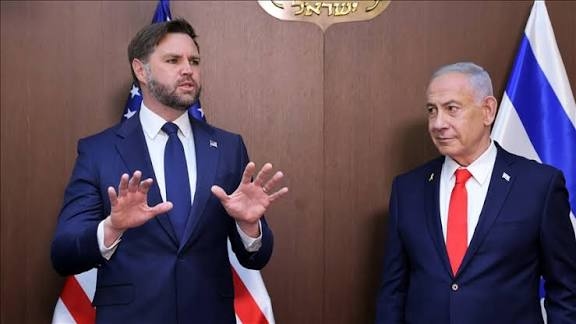


United State: US Vice President JD Vance has declined to endorse Israeli Prime Minister Benjamin Netanyahu for re-election, saying he is focused on American candidates and the upcoming US midterm elections. His remarks came a day after President Donald Trump publicly backed Netanyahu, highlighting a difference in their approaches to Israel’s electoral politics.
Speaking to journalist Mark Halperin on Monday, Vance acknowledged the influence of Trump’s endorsement but said he would not involve himself in Israel’s election campaign.
“The president has the most influential endorsement in American or international political history,” Vance said. “I endorse American candidates, and that’s where I’m focused on the midterms.”
Vance made the comments while travelling to North Carolina to campaign for Republican Senate nominee Michael Whatley. He added that he was not getting involved in Israeli elections.
The remarks come at a sensitive time for US-Israel relations, with disagreements over the conflict involving Iran and growing political debate in the United States about Israel and antisemitism.
Trump backs Netanyahu as Israeli election approaches
Vance’s position followed Trump’s public endorsement of Netanyahu on Sunday. The US president’s support placed the Israeli leader’s re-election campaign in the spotlight, given Washington’s longstanding political and strategic relationship with Israel.
Trump has frequently expressed support for Netanyahu, and his endorsement could carry significance among voters and political observers who closely follow the US-Israel alliance. However, Vance’s comments indicated that he did not intend to use his position as vice president to publicly intervene in Israel’s electoral contest.
By emphasising his focus on American candidates, Vance sought to draw a distinction between his political priorities and Trump’s decision to back the Israeli prime minister.
The difference is notable because the US administration’s position on Israel has been a prominent issue in American politics. Support for Israel, disagreements over its government’s policies and concerns about antisemitism have featured in debates among Republicans and Democrats ahead of the midterm elections.
Vance’s refusal to endorse Netanyahu does not, by itself, establish a broader policy shift in Washington’s relationship with Israel. His remarks were specifically about electoral endorsements, while disagreements over military action and diplomatic negotiations have formed a separate part of the relationship.
Vance previously campaigned for Viktor Orban
Although Vance said he endorses American candidates, he has previously travelled abroad to support a foreign political leader.
Last spring, the vice president visited Hungary to campaign for then-prime minister Viktor Orban, whose right-wing political movement subsequently lost the country’s parliamentary election.
That earlier intervention provides a contrast with Vance’s stated position on Israel. While he has previously supported a foreign leader on the campaign trail, he has now said he will not get involved in Netanyahu’s re-election bid.
Orban and his political movement were closely associated with right-wing nationalism and conservative politics. His government also maintained a prominent relationship with the Trump administration and other conservative political figures in the United States.
Vance’s decision to stay out of Israel’s election campaign could reflect a desire to keep his public focus on domestic political contests, particularly as Republicans prepare to defend their position in Congress.
The vice president’s comments also leave open the distinction between supporting a foreign government’s policies and endorsing a particular leader in an election. Vance has criticised members of Netanyahu’s government over the Iran conflict, even as Trump has continued to publicly back the Israeli prime minister.
Questions over Israel and antisemitism in US politics
Vance’s remarks come amid heightened political debate over antisemitism, US support for Israel and divisions within conservative political circles.
Republicans have sought to portray some Democratic candidates as hostile towards Jewish people and Israel. Among those facing criticism is Abdul El-Sayed, the Democratic Senate nominee in Michigan.
At the same time, disagreements over Israel and antisemitism have also emerged within conservative ranks, placing Republican leaders under scrutiny over their relationships with controversial media personalities and political commentators.
Vance has faced questions from Jewish Republicans about his commitment to Jewish Americans and the US alliance with Israel. These concerns were discussed during a private meeting with the Republican Jewish Coalition (RJC) in Las Vegas last month.
The RJC is a prominent Republican organisation that advocates strong ties between the United States and Israel and opposes antisemitism. Vance reportedly left a positive impression on participants at the meeting, although he stopped short of disavowing conservative podcast host Tucker Carlson.
Carlson, a former Fox News presenter, faced criticism after interviewing Nick Fuentes, a white nationalist known for his antisemitic views. Vance’s association with Carlson has consequently become a subject of discussion among some Republican and Jewish political circles.
The debate illustrates the challenge facing Republican leaders as they seek to maintain support for Israel while addressing concerns about antisemitism and political extremism within their broader coalition.
Disagreements over Iran add to US-Israel tensions
Vance’s refusal to endorse Netanyahu also comes against the backdrop of disagreements over the Israeli government’s position on the Trump administration’s efforts to resolve the conflict with Iran.
In June, Vance sharply criticised members of Netanyahu’s government for opposing Trump’s efforts to end the war with Iran. The following month, he accused some Israeli government figures of attempting to influence American public opinion in ways that could undermine negotiations.
“There are some people within their system that we know beyond a shadow of a doubt are manipulating and trying to change American public opinion to keep the war going on indefinitely,” Vance said during an appearance on Joe Rogan’s podcast.
His comments reflected concerns within the US administration about the direction of the conflict and the prospects for diplomatic efforts. They also highlighted the possibility of differences between Washington and Israeli officials over how to pursue their shared security interests.
While the United States and Israel maintain close strategic ties, the two governments can differ over military decisions, negotiations and the timing or terms of efforts to end hostilities.
Trump’s public endorsement of Netanyahu and Vance’s criticism of some Israeli officials demonstrate that support for the US-Israel relationship does not necessarily mean agreement on every policy or political decision.
Midterm elections remain Vance’s stated priority
Vance’s latest comments place the focus back on American electoral politics as Republicans prepare for the midterm elections. His appearance in North Carolina to campaign for Michael Whatley reflects the administration’s attention to contests that could shape the balance of power in Congress.
By declining to endorse Netanyahu, Vance has avoided publicly taking a position on the Israeli election while reiterating his commitment to campaigning for American candidates.
His previous support for Orban, however, shows that he has not always avoided foreign election campaigns. The contrast may fuel further discussion about how senior American officials decide when to intervene in another country’s political contest.
For now, Vance has made his position on Netanyahu clear: despite Trump’s endorsement of the Israeli leader, he says his attention is on the United States and its midterm elections. The broader US-Israel relationship, meanwhile, continues to face scrutiny over Iran policy, political endorsements and debates about antisemitism.