







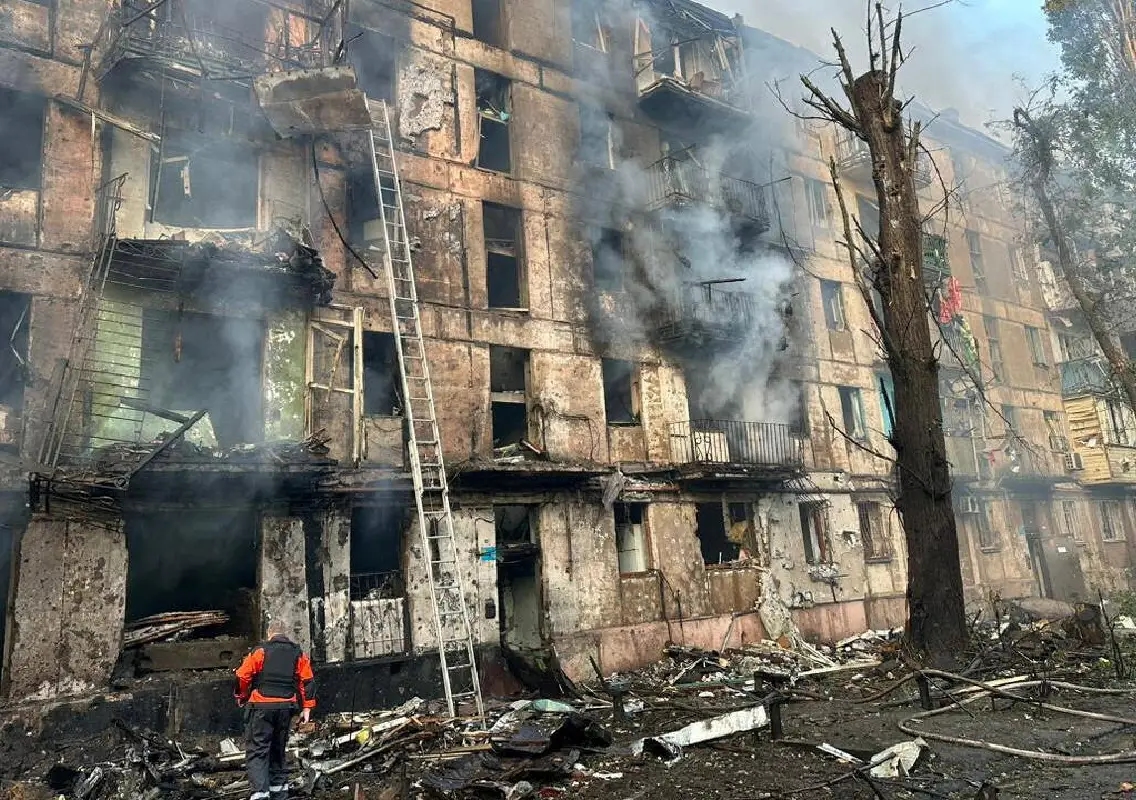


Almost every district in Ukraine’s capital came under a “massive” Russian attack on Friday morning, escalating months of intensified strikes aimed at crippling the country’s infrastructure. At least 11 people were injured, five of whom were hospitalised — including a pregnant woman and a man in critical condition — as missiles and drones pounded residential and energy facilities across the city.
The large-scale assault marks another phase in Russia’s ongoing military campaign that began with its full-scale invasion in 2022, with energy plants, rail systems, heating networks and homes increasingly becoming targets as winter approaches.
Residential areas and heating networks hit
Kyiv Mayor Vitaly Klitschko confirmed that almost all districts in the capital had been struck. He described the assault as a “massive enemy attack”, adding that air defence units were actively intercepting incoming missiles and drones.
Mykola Kalashnyk, head of the Kyiv regional military administration, said that Russian forces specifically targeted critical infrastructure, including key heating systems. Sections of the city’s heating network were damaged, leaving parts of the Desnyansky district temporarily without heat. Kalashnyk also warned of possible disruptions to electricity and water supply in the coming hours.
Tymur Tkachenko, head of the city’s military administration, said that “a lot of high-rise buildings across Kyiv” were damaged. In the Solomyansky district — a major transport hub near Kyiv’s international airport — a fire broke out on the roof of a five-storey residential building following the strikes.
Emergency responders were deployed across eight of the city’s ten districts, with fire crews and ambulances working through the morning to rescue civilians and douse fires.
Russia intensifies winter offensive
Friday’s attack is part of a broader Russian strategy aimed at weakening Ukraine’s energy resilience ahead of winter. Experts say the targeting of heating and power infrastructure is designed to leave civilians vulnerable, strain the grid and hamper military logistics.
In recent months, Russia has focused on Ukrainian energy facilities, railway systems and dense residential areas. Reports from Russian defence officials also claimed that a Ukrainian drone regiment in Donetsk was “wiped out” in a missile strike earlier this week, signalling continued fighting along the eastern front.
Russia recently claimed control of three more villages in the Donetsk and Lugansk sectors — regions it has been attempting to capture for months. Analysts say Moscow is leveraging its advantage in manpower and weapon supplies to advance slowly but steadily across the eastern battlefront.
International reaction and rising global pressure
The attack on Kyiv comes at a time when Western allies have increased diplomatic and economic pressure on Moscow.
On Wednesday, Canada announced fresh sanctions targeting Russia’s drone production, energy sector and cyberattack infrastructure. The G7 foreign ministers also issued a joint statement calling for an immediate ceasefire, reiterating their “unwavering support” for Ukraine’s territorial integrity.
The European Commission is considering a proposal to use part of Russia’s frozen assets — seized after the invasion — to provide Ukraine with a substantial loan for budgetary and military support over the next two years.
However, despite rising global pressure, Moscow has rejected calls for a ceasefire, including diplomatic efforts made by US President Donald Trump to revive stalled peace negotiations. After nearly four years of conflict, both sides remain entrenched, with no clear signs of de-escalation.
Kyiv braces for winter amid deepening crisis
Experts warn that with temperatures set to drop significantly in the coming weeks, Ukraine’s energy grid could face severe strain. The latest attacks highlight Kyiv’s vulnerability, as repeated strikes reduce the capacity to restore power and heating quickly.
For residents of the capital, winter now looms with renewed uncertainty. Emergency teams continue working to restore services, but repeated bombardments make long-term stability difficult.
Conclusion
As Kyiv faces yet another wave of intense Russian strikes, the humanitarian and infrastructural challenges are growing rapidly. With international pressure on Moscow increasing — but little indication of compromise — Ukraine prepares for a difficult winter, both on the battlefield and at home. Friday’s attack underscores the continuing volatility of a war that has shown no sign of abating after nearly four years.