







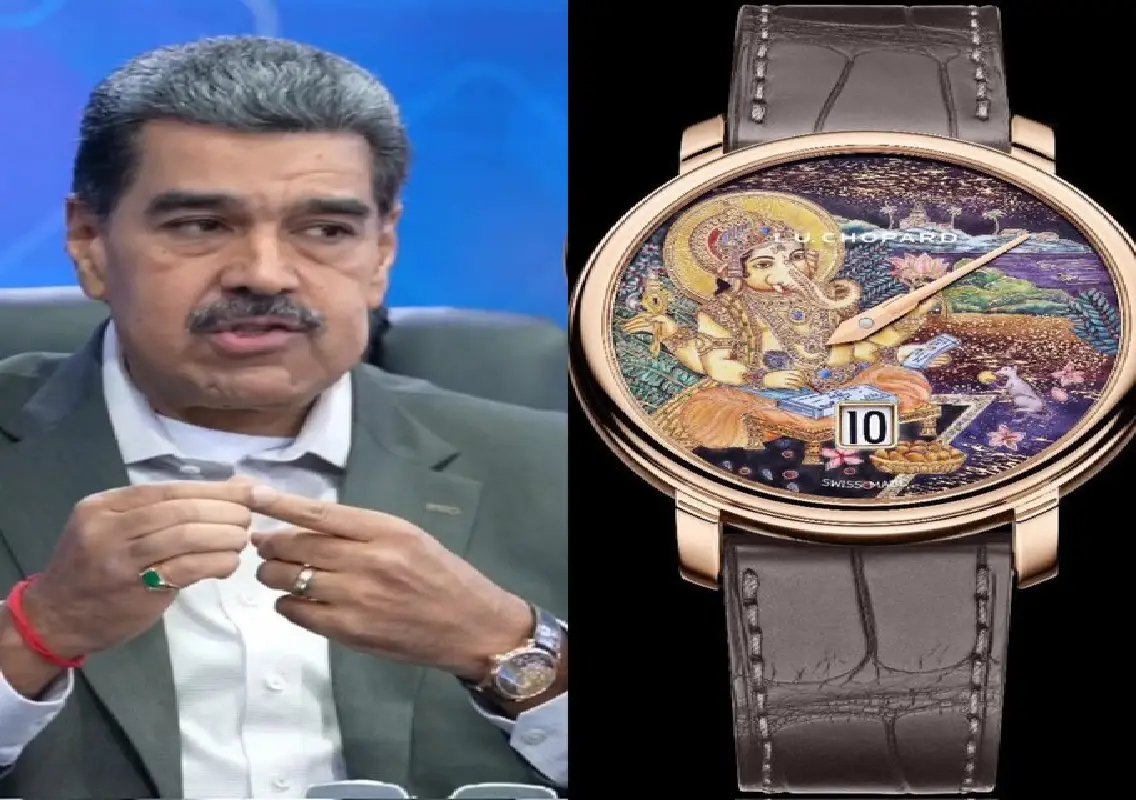


Venezuelan President Nicolás Maduro has once again grabbed global attention — this time not for geopolitics or sanctions but for his personal association with Hindu symbolism after images surfaced showing him wearing a luxury wristwatch featuring Lord Ganesha, a revered deity in Hinduism. The striking visuals quickly went viral on social media, reigniting discussions about Maduro’s longstanding spiritual connect with India and Indian spiritual thought.
The unusual intersection of Indian religious imagery and the personal life of a foreign head of state has intrigued millions online, with commentators and analysts exploring why Hindu symbols such as the Ganesha watch resonate with Maduro’s broader spiritual leanings. Observers note that this is not an isolated instance but part of a pattern in his public appearances that suggests a nuanced personal affinity for elements of Indian spirituality.
Maduro’s known spiritual influences
Pictures from that visit — circulated widely online — show Maduro and his wife seated beside Sai Baba, underscoring the personal nature of their engagement. Over the years, this connection manifested in symbolic ways: at one point, a large portrait of Sathya Sai Baba was reportedly displayed in Maduro’s private office at the Miraflores Palace in Caracas, alongside national icons such as Simón Bolívar and Hugo Chávez.
Hindu symbols in Venezuelan state imagery
The presence of Hindu symbols in Venezuela during Maduro’s tenure went beyond personal accessories. In 2024, government-issued National Day invitations featured the Hindu sacred symbol “Om (ॐ)”, a widely recognised and ancient Vedic emblem representing spiritual sound and cosmic essence. This choice sparked international curiosity and highlighted how Indian spirituality had found an unlikely cultural imprint in Venezuelan state symbolism.
Maduro’s personal outward expressions — from wearing a Ganesha-emblazoned watch to previously wearing a kalawa (sacred thread) — point to a spiritual narrative that blends traditional Venezuelan Catholic upbringing with Indian spiritual influences introduced through his wife.
Social media buzz and interpretations
The viral image of the Lord Ganesha watch caught the attention of social media users across India and beyond. Many interpreted it as a symbolic expression of faith or spiritual openness. Lord Ganesha is venerated in Hinduism as the remover of obstacles and a harbinger of auspicious beginnings, making his depiction on personal accessories a common choice among devotees seeking blessings for success and protection.
Users on platforms such as X (formerly Twitter) and Instagram commented on the surreal visual of a South American leader adorned with Indian spiritual imagery, with some praising the cross-cultural spiritual embrace and others viewing it as a curiosity in contrast to Maduro’s political controversies.
Maduro, who has been a controversial figure in global politics, is known not just for his leadership in Venezuela but also for his personal spiritual journey. Multiple reports highlight his devotion to Indian spiritual guru Sathya Sai Baba, a revered figure in India known for his teachings on love, peace and service. Maduro’s spiritual connection with Sai Baba dates back to at least 2005, when he and his wife Cilia Flores travelled to the Prasanthi Nilayam ashram in Puttaparthi, Andhra Pradesh for a private meeting with the spiritual leader.
Broader India–Venezuela cultural connection
Maduro’s association with Indian spirituality is part of a broader cultural link between India and Venezuela in recent decades. Reports suggest that Venezuela hosts one of the largest Sathya Sai Baba devotee communities in Latin America, established in the 1970s, long before Maduro entered politics. This community has played a role in sustaining interest in Indian spiritual teachings among Venezuelans of diverse backgrounds.
Despite controversies surrounding his political career and current legal challenges in the United States, Maduro’s personal embrace of Indian spiritual motifs continues to fascinate observers. The ongoing discourse around the Ganesha-themed watch underscores how spiritual symbolism can transcend cultural and national boundaries, becoming a topic of global conversation even amidst intense geopolitical developments.
Conclusion
Nicolás Maduro’s Ganesha watch has reignited curiosity over his spiritual ties with India, drawing attention to a personal journey that intersects with Hindu symbolism and Indian spiritual teachers such as Sathya Sai Baba. Whether viewed as cultural curiosity or a deeper statement of spiritual affinity, the episode highlights how icons like Lord Ganesha continue to resonate far beyond India’s borders. As social media buzz spreads, the unusual blend of faith, symbolism and international politics offers a fresh lens on how spiritual narratives can shape global public perceptions.