


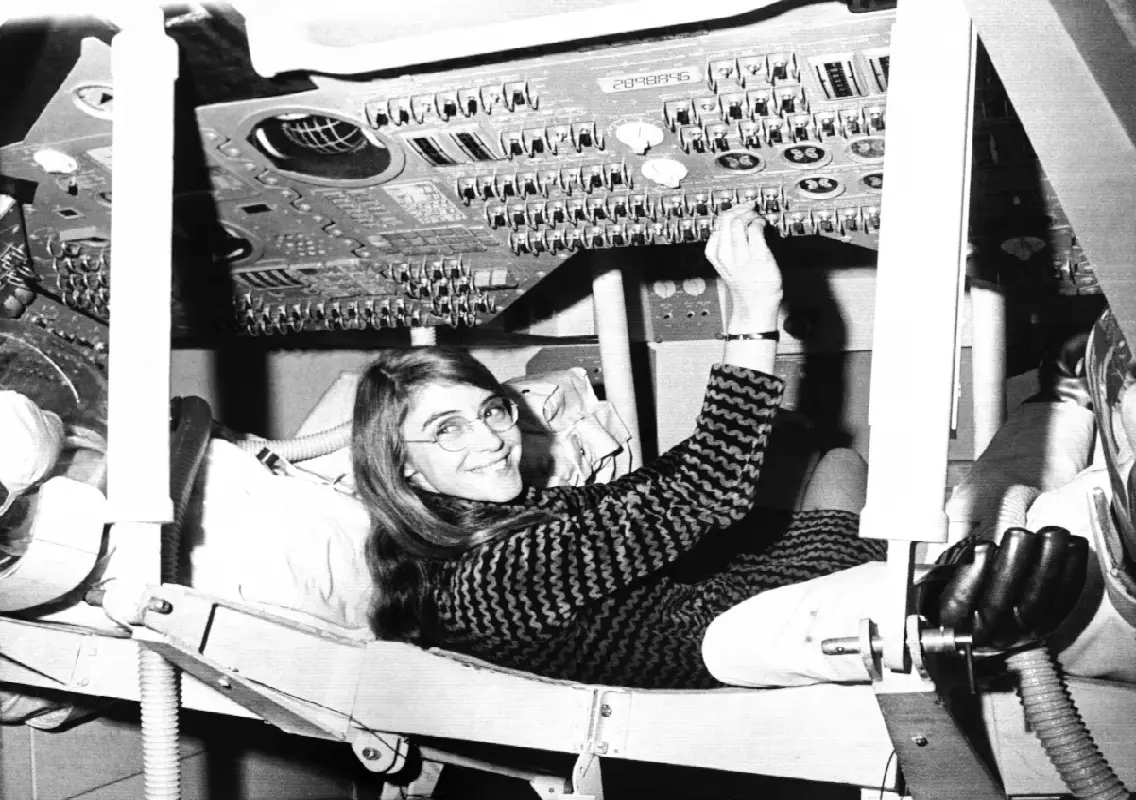


Margaret Hamilton, the pioneering computer scientist whose software helped guide NASA’s Apollo missions to the Moon and whose work helped establish software engineering as a profession, has died at the age of 90.
The Massachusetts Institute of Technology (MIT), where Hamilton worked for nearly two decades, confirmed her death in an announcement by its Department of Aeronautics and Astronautics. She died on September 30, 2026. The cause of death was not disclosed.
Hamilton led a team of around 100 engineers responsible for developing critical software for NASA’s Apollo missions. Her work helped make the spacecraft’s onboard systems more reliable and resilient, contributing to the success of the historic lunar programme that culminated in the first crewed Moon landing in 1969.
Hamilton helped establish software engineering as a profession
Hamilton joined MIT in 1959 while her husband was studying law at Harvard University. She later managed the Software Engineering Division at the MIT Instrumentation Laboratory, which secured a NASA contract in 1961 to develop software for the Apollo programme.
Her team designed software for the Apollo command modules and lunar modules, systems that were essential to navigating spacecraft, managing onboard operations and supporting astronauts during their missions.
At a time when computer programming was still an emerging discipline, Hamilton helped establish rigorous methods for designing, testing and maintaining complex software. She is widely credited with popularising the term “software engineering” to describe the systematic work required to build dependable computer systems.
Olivier de Weck, the Apollo Program Professor and interim head of MIT’s Department of Aeronautics and Astronautics, described Hamilton as a pioneer who worked ahead of her time.
He noted that she developed advanced code while leading a team that used emerging computing technology to build one of the most complex systems humanity had attempted.
Software helped save Apollo 11’s Moon landing
One of Hamilton’s most significant contributions became evident during NASA’s Apollo 11 mission in July 1969, when astronauts Neil Armstrong and Buzz Aldrin descended towards the lunar surface.
Shortly before the landing, the spacecraft’s guidance computer began displaying alarms as it faced an overload of tasks. The software had been designed to prioritise critical operations and prevent less important activities from interfering with essential flight functions.
The system recognised that the computer was under pressure and continued prioritising the tasks necessary for the landing.
According to NASA’s historical account, the software’s response allowed the mission to continue safely. Armstrong and Aldrin landed on the Moon, achieving a milestone in the United States’ space programme.
Hamilton’s work demonstrated the importance of software capable of detecting errors, managing competing demands and preserving critical functions under pressure. These principles remain central to the development of reliable systems used in aerospace and other safety-critical industries.
A lesson in error prevention inspired by her daughter
Hamilton’s approach to software reliability was also shaped by an unexpected incident involving her young daughter, Lauren.
While Hamilton was working on Apollo software, Lauren played with an Apollo command module simulator during a hardware simulation exercise. Her actions inadvertently caused the simulation to crash.
Hamilton recognised that a similar error during an actual mission could have serious consequences. She subsequently worked to introduce safeguards to prevent astronauts from triggering the same problem in flight.
The incident became an example of her emphasis on anticipating human error and designing systems capable of preventing it.
Her approach extended beyond writing code that performed as intended. She advocated building software that could respond appropriately when users made mistakes or when unexpected conditions arose.
From MIT to her own software company
Hamilton remained at MIT until the mid-1970s. After the Apollo programme, the institution’s Instrumentation Laboratory became the Charles Stark Draper Laboratory, now known as Draper.
She did not join the new organisation, choosing instead to establish her own software company.
Her work left a lasting influence on engineers associated with the Apollo programme. Draper chief executive Jerry Wohletz said Hamilton’s leadership and contributions helped ensure that astronauts landed safely on the lunar surface and returned home.
The organisation also acknowledged her enduring legacy in software development and space exploration.
Hamilton’s career helped demonstrate that software was not merely an accessory to hardware but a critical component of complex engineering systems.
Presidential Medal of Freedom and NASA recognition
Hamilton received several honours for her contributions to computing and space exploration.
In 2003, NASA presented her with the Exceptional Space Act Award in recognition of her work on the Apollo programme.
Paul Curto, the technologist who nominated her for the honour, highlighted her contributions to dependable software design, including asynchronous software, priority scheduling, end-to-end testing and systems that allowed human operators to make informed decisions.
In 2016, then-US President Barack Obama awarded Hamilton the Presidential Medal of Freedom, the country’s highest civilian honour, recognising her contribution to science and space travel.
The award brought renewed attention to her role in the Apollo programme and to the contributions of software engineers whose work often took place behind the scenes.
A lasting legacy in computing and space exploration
Born in Paoli, Indiana, in 1936, Hamilton studied at the University of Michigan before earning a degree in mathematics from Earlham College in Indiana.
She entered the computing field at a time when software development was still taking shape as a distinct profession. Through her technical work and leadership, she helped establish practices that became fundamental to the design of complex and reliable computer systems.
Her contributions extended beyond the Apollo missions, influencing how engineers approach testing, error prevention, system reliability and the interaction between humans and computers.
Hamilton’s death marks the loss of a pioneering figure in computing history. The software developed under her leadership helped support one of humanity’s defining scientific achievements, while her insistence on reliability and rigorous engineering continues to influence the technology used in critical systems today.