







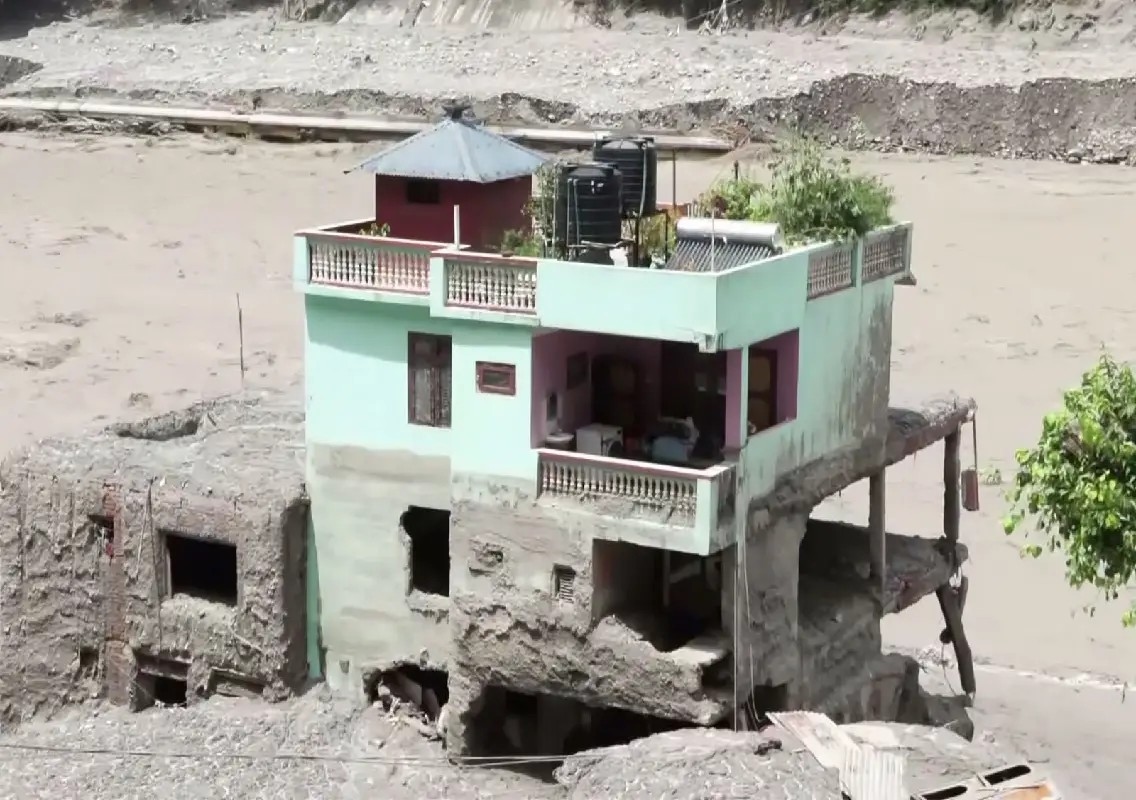


Trishuli, Nepal: A mint-green, two-storey house standing almost untouched amid widespread destruction in Nepal‘s flood-hit Trishuli region has emerged as a striking symbol of the scale of the disaster, with homes, shops, vehicles and bridges around it swept away by powerful floodwaters.
The house has gone viral on social media as survivors struggle to comprehend the devastation left behind by the floods. While the building remains largely intact, the surrounding landscape has been dramatically transformed, with families displaced and livelihoods destroyed.
The disaster unfolded rapidly after warnings were issued about a glacial lake outburst and rising floodwaters, leaving residents with little time to evacuate.
Residents recall terrifying moments
Local resident Phulmaya Lama told ANI that people initially found it difficult to believe that flooding of such magnitude could reach their area.
Lama said she had opened and cleaned her clothing shop and was sitting there when residents began receiving warnings about the glacial lake in Tibet bursting.
According to her, warnings also came after reports that Timure village and Syabrubesi had been affected. Police used loudspeakers to alert people and urge them to evacuate.
“When we looked, we saw the flood coming, as high as the mountain itself,” Lama recalled.
She said residents immediately began running towards safer areas. Elderly people, schoolchildren, school buses and police personnel were among those attempting to escape.
Lama said even the police vehicle being used to warn residents was swept away by the floodwaters.
Families lose homes and livelihoods
Lama said her own house was destroyed in the disaster and that her family has been staying in another person’s home for the past six days.
“Our house was also destroyed. Nothing is left,” she said, describing the uncertainty faced by displaced families over food, drinking water and shelter.
She also said several people from around her home remain missing.
According to Lama, a woman and her son living next to her house disappeared. A brother and sister who were at a nearby hotel were also reported missing, while an elderly man who had been sitting in the area could not be found.
She said five people from around her home remained unaccounted for.
Survivor returns to destroyed shop
Another survivor described the devastation after returning to the affected area.
“Everything is gone, sir, nothing is left,” the resident said, recalling how the area had been transformed by the floods.
The survivor said a helicopter had brought them back the previous day and that the money saved for an operation had also been lost in the disaster.
“There is no shop, no room, nothing left,” the survivor said, recalling the shop that had once stood at the location.
The loss of commercial establishments has compounded the difficulties facing families who have already lost their homes and personal belongings.
Father recalls narrow escape of children
For Prakash Tamang, the devastation was accompanied by relief that his children had narrowly escaped the disaster.
Tamang said his house once stood in the area but was completely washed away by the flood.
He recalled that he had taken his two children to school in his car on the day of the disaster instead of allowing them to travel by school bus.
“By God’s grace, they survived. Beyond that, everything is gone,” he said.
After taking his family to Kathmandu and arranging accommodation with relatives, Tamang returned to the affected area to inspect the damage.
He said he also wanted to check whether officials were documenting the losses suffered by residents.
Death toll rises to 903
Nepal continues to grapple with one of its worst recent flood disasters.
According to the National Disaster Risk Reduction and Management Authority (NDRRMA), the death toll rose to 903 on Monday, while around 4,247 people remained missing.
A total of 10,451 people have been rescued so far.
Chitwan has recorded the highest number of casualties at 272, followed by Nawalparasi East with 207, Nawalparasi West with 151, Nuwakot with 95, Gorkha with 62, Dhading with 55, Tanahun with 37 and Rasuwa with 24.
The missing include security personnel, government employees, hydropower workers and foreign nationals.
District Emergency Operations Centre data showed Nuwakot reporting 1,548 missing people, while Rasuwa had reported 865 missing persons.
Rescue operations continue by land and air
Rescue and relief operations are continuing across the affected areas, with security forces using both ground teams and helicopters to reach stranded residents.
The Nepal Army has conducted aerial rescues involving 252 foreign nationals and 3,344 Nepali nationals. A total of 411 flights have been conducted as part of rescue and relief operations.
On August 30, 15 people from a hydropower site were rescued, including five Chinese and seven Indian nationals.
The disaster has severely affected hydropower infrastructure, with workers among those reported missing or trapped in some locations.
Nearly 20,000 security personnel have been deployed for rescue operations.
Ground teams have carried out 8,730 rescues, while helicopter operations have continued to evacuate people from areas cut off by floodwaters and debris.
Recovery expected to be long and difficult
The images emerging from the Trishuli region underline the scale of the challenge facing Nepal as rescue operations gradually transition towards recovery.
For families such as Lama’s and Tamang’s, the disaster has meant the loss of homes, shops, savings and livelihoods. Many are now dependent on temporary shelter and assistance while authorities assess the damage.
The survival of the mint-green house amid the destruction has attracted attention because of the stark contrast between the building and the devastation surrounding it. However, for residents living through the disaster, the focus remains on finding missing family members, securing shelter and rebuilding their lives.
With thousands still reported missing and rescue teams continuing operations across difficult terrain, authorities face a massive task in locating survivors, identifying casualties, restoring connectivity and providing sustained assistance to displaced communities.