







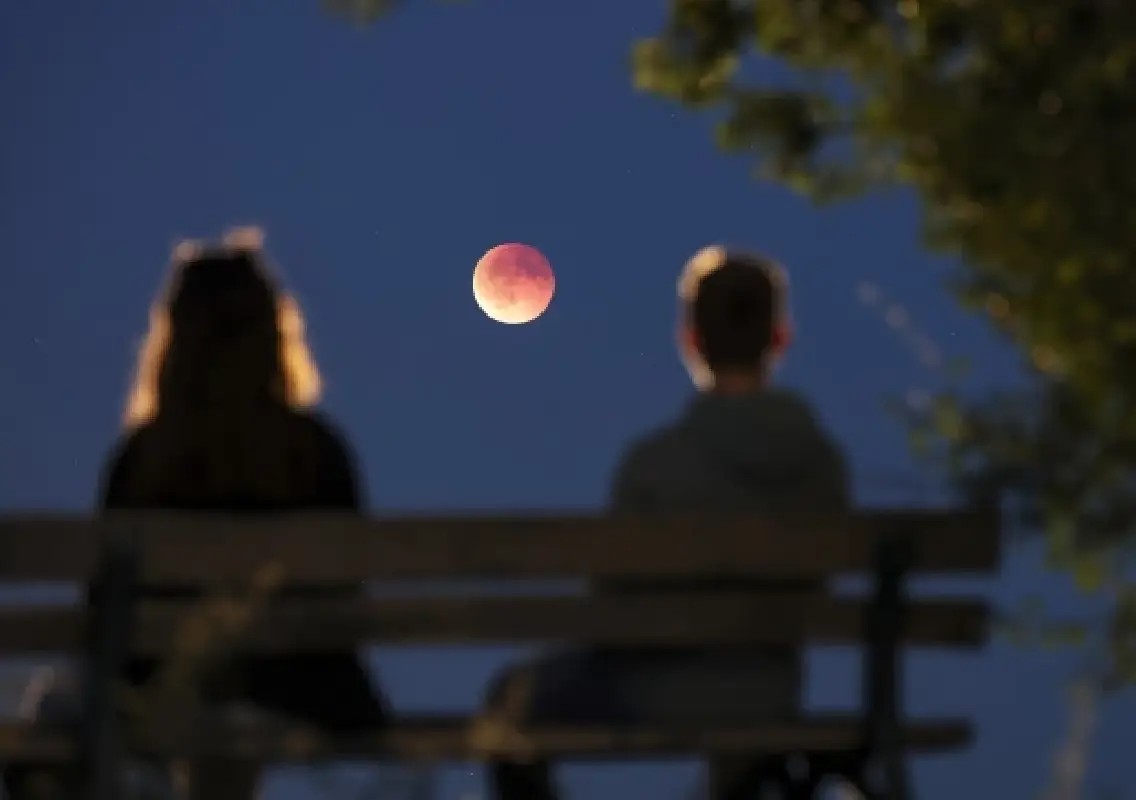


Skywatchers across the Americas are preparing for a spectacular celestial event as the Moon passes deep into Earth’s shadow on Thursday night, creating a partial lunar eclipse that will leave about 96.3% of the lunar disc within the darkest part of the shadow.
NASA classifies the event as a deep partial lunar eclipse, rather than a total eclipse. It will be visible across much of North and South America, as well as parts of Europe and Africa.
Moon will appear dramatically darkened
A lunar eclipse occurs when Earth moves between the Sun and the Moon, causing the Moon to pass through Earth’s shadow.
During Thursday’s event, the Moon will move deeply into the umbra, the central and darkest portion of Earth’s shadow. At maximum eclipse, about 96.3% of the Moon’s disc will be inside the umbra.
The covered portion may take on a striking coppery or reddish appearance. This happens because some sunlight passes through Earth’s atmosphere before reaching the Moon, with red and orange wavelengths travelling through the atmosphere more effectively than shorter blue wavelengths.
Eclipse begins Thursday night
For observers in the eastern United States, the penumbral phase begins at around 9:23 pm, with the more noticeable partial phase starting at about 10:33 pm.
The eclipse will reach its maximum at approximately 12:13 am Eastern Time on Friday, when almost the entire lunar disc will be within Earth’s umbra. The Moon will then gradually emerge from the shadow.
Exact timings vary by location. For example, NASA’s Oklahoma City event information places the partial phase between 9:33 pm and 12:51 am local time, with the penumbral phase ending at 2:01 am.
Millions can watch without special equipment
Unlike a solar eclipse, a lunar eclipse is safe to observe with the naked eye. Skywatchers can also use binoculars or telescopes to see the advancing shadow and changing colour of the Moon more clearly.
The eclipse is expected to be particularly well placed for observers across much of North and South America. Parts of Europe and Africa will also see portions of the event, although the Moon will set while the eclipse is still underway in some locations.
Solar and lunar eclipses arrive in pairs
The lunar eclipse comes roughly two weeks after the August 12 total solar eclipse, which was visible across parts of northern Spain, Portugal, Iceland, Greenland and northern Russia.
Solar and lunar eclipses frequently occur close together because they take place during the same eclipse season. A solar eclipse occurs around a new Moon, while a lunar eclipse occurs around a full Moon when Earth comes between the Sun and Moon.
NASA says the next lunar eclipse will take place on February 20-21, 2027, while the next solar eclipse will occur on February 6, 2027.
For skywatchers, Thursday night offers a rare opportunity to watch Earth’s shadow sweep visibly across the full Moon — without needing special protective equipment or sophisticated astronomical instruments.