







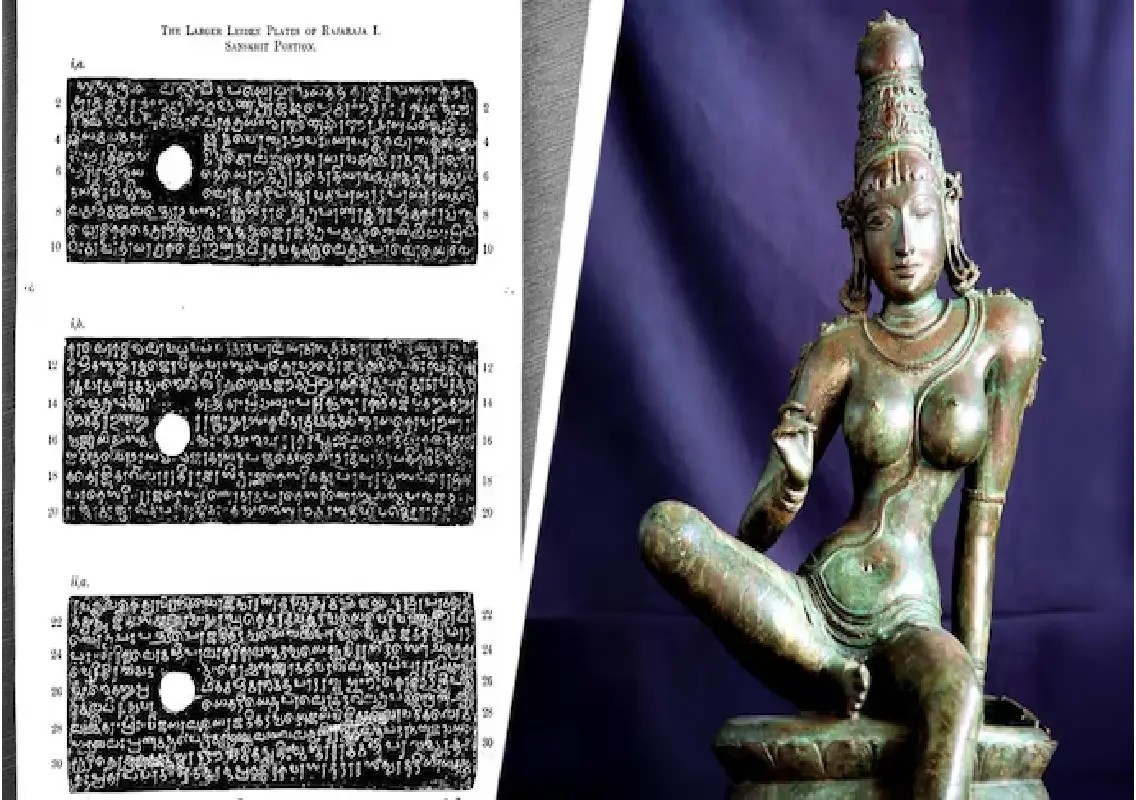


The Netherlands is set to formally return the 11th-century Anaimangalam copper plates, among the most significant surviving records of the Chola dynasty, to India in a major cultural restitution linked to artefacts taken during the colonial period. The development coincides with Prime Minister Narendra Modi visiting the country as part of his five-nation tour.
The return of the Chola-period inscriptions, popularly known as the Leiden Plates, follows years of diplomatic engagement involving India, the Dutch government and academic institutions.
The repatriation is being viewed as an important step in cultural cooperation and restoration of historical heritage.
Ancient inscriptions hold major historical value
Known in the Netherlands as the Leiden Plates, the inscriptions date to the reign of Rajaraja Chola I between 985 CE and 1014 CE.
Historians regard the copper plates as one of the most important surviving records of Tamil history preserved outside India.
The inscriptions document grants of land revenue and taxes to the Chudamani Vihara, a Buddhist monastery in Nagapattinam built by Sri Mara Vijayotunga Varman, ruler of the Srivijaya kingdom in present-day Indonesia.
Scholars state that the records provide valuable insight into maritime links, trade networks and religious interactions between South India and Southeast Asia during the Chola era.
Copper plates reveal cultural and religious exchanges
Historians have noted that the inscriptions reflect the broader cultural exchanges that existed across regions during the period.
The records highlight how rulers supported institutions beyond their own faith traditions and demonstrate interactions between South Asia and Southeast Asia.
Experts also state that the inscriptions provide a deeper understanding of medieval India’s trade routes, cultural influence and patterns of coexistence.
The copper plates are considered important historical documents that illustrate the cosmopolitan character of the Chola period.
Artefacts remained in Netherlands for over a century
The Anaimangalam copper plates consist of 21 large and three small copper sheets weighing nearly 30 kilograms and are bound by a copper ring carrying the Chola royal seal.
While Rajaraja Chola I originally issued the grant, his son Rajendra Chola I later ordered the contents to be permanently engraved on copper plates.
The artefacts were taken to the Netherlands during Dutch colonial rule along the Coromandel Coast in the 18th century.
Historical accounts suggest they eventually entered the collection of Leiden University in 1862 and remained within its Asian collections.
Return follows years of diplomatic efforts
India had pursued the return of the copper plates through sustained engagement with Dutch authorities and academic institutions.
The process gained momentum after the Netherlands introduced a restitution policy for colonial-era artefacts in 2022.
Detailed provenance studies reportedly concluded that the inscriptions should be returned to India.
The return of the Anaimangalam copper plates is being regarded as an important moment in cultural relations and a significant restoration of a valuable chapter of India’s historical heritage.