







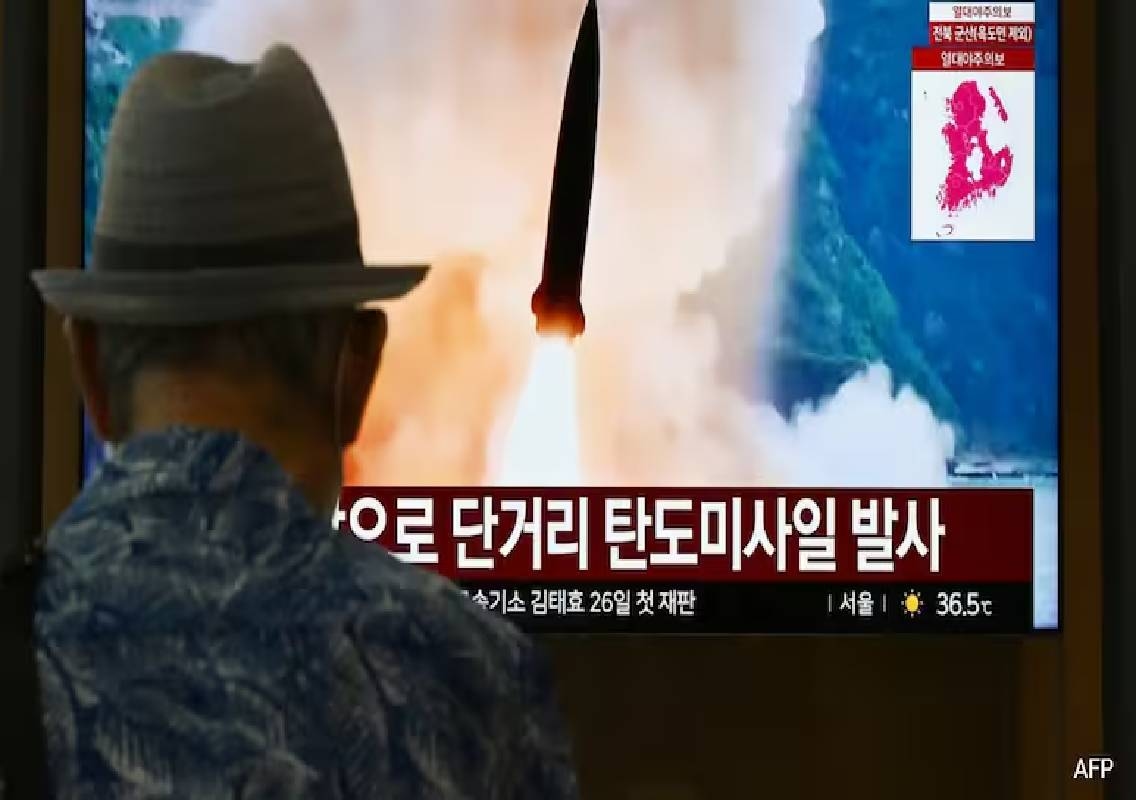


Tokyo: North Korea launched a suspected ballistic missile towards the sea on Wednesday, August 12, prompting Japan to monitor the projectile and assess its trajectory. Japan’s Defence Ministry said the missile was detected after the launch, but there was no indication that it reached Japan’s exclusive economic zone (EEZ).
The latest launch comes amid heightened tensions on the Korean Peninsula, just days before the United States and South Korea are scheduled to begin their annual large-scale military exercises. The joint drills, known as Ulchi Freedom Shield, are scheduled to begin on August 17.
The missile launch is the latest in a series of weapons tests by Pyongyang and comes less than a week after another suspected ballistic missile launch. The repeated tests have raised concerns in Tokyo and Seoul about North Korea’s continued development of its missile capabilities.
Japan detects North Korean missile launch
Japan’s Defence Ministry said it detected a suspected ballistic missile launched by North Korea on Wednesday. Japanese authorities assessed that the projectile did not enter Japan’s EEZ, indicating that it is believed to have fallen farther away from the Japanese coast.
No immediate damage or casualties have been reported in connection with the launch.
The Japanese government has continued to monitor developments through its defence and surveillance systems. The country’s missile-defence network is designed to detect and track ballistic missile launches that could threaten Japanese territory.
Japan’s Defence Ministry has previously highlighted the growing sophistication of North Korea’s missile programme, including developments involving short-range ballistic missiles, hypersonic weapons and longer-range systems.
Missile launched towards the Sea of Japan
The projectile was launched from North Korea’s eastern side and travelled towards waters off the Korean Peninsula.
South Korea’s military also detected the launch and was analysing the missile’s characteristics and flight path. Reports said the projectile travelled approximately 700 kilometres before falling into waters outside Japan’s EEZ.
The exact type of missile has not immediately been confirmed.
That uncertainty is significant because North Korea has developed and tested a wide range of ballistic missile systems, from short-range weapons designed to target South Korea and nearby areas to longer-range missiles intended to strengthen its strategic deterrence against the United States.
Second missile test in less than a week
The latest launch follows another North Korean missile test earlier this month.
North Korea launched a suspected ballistic missile on August 6, according to Japanese and South Korean authorities. That projectile was also launched from the country’s eastern coastal region and travelled over the Sea of Japan.
The August 6 launch came shortly after Pyongyang criticised Japan’s defence policies and military build-up.
The repeated launches indicate that North Korea continues to conduct weapons tests despite international pressure and longstanding United Nations restrictions on its ballistic missile activities.
The latest test is therefore being closely watched by Japan, South Korea and the United States.
US-South Korea military drills add to tensions
The timing of Wednesday’s launch is particularly important.
The United States and South Korea have announced that they will conduct their annual Ulchi Freedom Shield military exercises from August 17 to August 27. The drills are designed to strengthen the allies’ readiness to respond to security threats on the Korean Peninsula.
North Korea has traditionally viewed large-scale US-South Korean military exercises as rehearsals for an invasion.
Pyongyang has frequently responded to such exercises with missile tests, military demonstrations and warnings against Seoul and Washington.
Analysts therefore see the latest launch as potentially connected to the upcoming exercises, although North Korea has not publicly confirmed that the missile test was specifically conducted in response to the drills.
Seoul condemns the launch
South Korean authorities have condemned North Korea’s repeated weapons tests as provocative actions.
Seoul’s military has maintained a heightened surveillance posture and is working with the United States and Japan to analyse North Korea’s missile activity.
The latest launch has also reinforced concerns about Pyongyang’s continued expansion of its missile arsenal.
North Korea has increasingly focused on developing weapons that can evade or challenge existing missile-defence systems. Japan’s Defence Ministry has said the country’s ballistic missile development is making Japan’s missile-defence environment increasingly difficult.
Why Japan is concerned
Japan remains particularly sensitive to North Korean missile launches because of its geographical proximity to the Korean Peninsula.
Previous North Korean launches have passed over or landed near waters surrounding Japan, prompting Tokyo to strengthen its missile-warning and defence capabilities.
Japan’s Defence Ministry has identified several categories of North Korean ballistic missiles, including short-range ballistic missiles and longer-range systems. It has also noted North Korea’s efforts to develop hypersonic weapons and solid-fuel intercontinental ballistic missiles.
Solid-fuel missiles are particularly concerning to defence planners because they can generally be prepared for launch more quickly than liquid-fuel systems, potentially making them harder to detect before launch.
No immediate threat to Japan reported
Despite the launch, there was no immediate indication that the projectile posed a direct threat to Japan.
The missile was believed to have fallen outside Japan’s EEZ, and authorities did not report damage.
The distinction between territorial waters and an EEZ is important. Japan’s EEZ extends up to 200 nautical miles from its coast, but an EEZ does not carry the same legal status as territorial waters.
A missile falling outside the EEZ can nevertheless raise significant security concerns because of the potential risk to shipping and aviation and because of what the test reveals about North Korea’s military capabilities.
North Korea’s growing missile capabilities
North Korea has spent years developing a diverse missile arsenal.
Japan’s defence assessments have identified short-range systems with ranges of hundreds of kilometres, intermediate-range missiles capable of reaching much farther and intercontinental ballistic missiles designed to threaten targets far beyond the Korean Peninsula.
The country has also pursued hypersonic missile technology.
Japan’s Defence Ministry said North Korea is seeking to develop weapons capable of penetrating missile-defence networks through manoeuvrable or unusual flight trajectories.
These developments have made missile tracking and interception increasingly challenging for regional powers.
What the launch means for regional security
The latest test adds another layer of uncertainty to an already tense security environment in Northeast Asia.
Japan, South Korea and the United States have been strengthening cooperation on missile warning and defence in response to North Korea’s weapons programme.
At the same time, North Korea has continued to improve its missile technology and conduct regular tests.
The combination of weapons development and military exercises creates a cycle in which actions by one side are often viewed as provocative by another.
The upcoming US-South Korea exercises could therefore lead to additional military activity or rhetoric from Pyongyang.
North Korea has not immediately acknowledged the launch
North Korean state media had not immediately claimed responsibility for the latest launch at the time of reporting.
This is not unusual. Pyongyang does not necessarily acknowledge every weapons test immediately, particularly when the test outcome or weapon type requires further assessment.
In previous instances, North Korean state media have released details and photographs of missile tests days after they occurred.
South Korea and Japan are continuing to analyse the latest projectile to determine its precise characteristics.
Japan and South Korea maintain close surveillance
The latest launch also highlights the growing importance of trilateral security cooperation among Japan, South Korea and the United States.
The three countries have improved the sharing of missile-warning information in recent years as North Korea has increased the frequency and sophistication of its weapons tests.
Real-time detection and information sharing can help the countries determine the missile’s launch location, trajectory and potential impact area more quickly.
For Japan, the priority remains ensuring that any missile capable of threatening its territory or surrounding waters is detected as early as possible.
What happens next?
The immediate focus will be on identifying the missile.
South Korean and US military authorities are expected to analyse its speed, altitude, range and flight characteristics. Those details could help determine whether it was a conventional short-range ballistic missile or another system.
Japan is also expected to continue monitoring North Korean military activity.
The timing of the launch means attention will now turn towards the US-South Korea military exercises scheduled to begin on August 17.
If Pyongyang conducts additional weapons tests around the drills, regional tensions could rise further.
A continuing pattern of missile tests
The latest launch is not an isolated event.
North Korea has continued to test different types of missiles as it seeks to improve its ability to strike regional and distant targets.
Japan’s recent defence assessment says Pyongyang continues to advance its nuclear and missile programmes and that its missile development includes efforts to improve operational capabilities and overcome missile-defence systems.
The latest test therefore carries significance beyond the projectile itself.
It demonstrates that North Korea remains committed to expanding its weapons capabilities despite diplomatic pressure and international sanctions.
Conclusion
North Korea’s suspected ballistic missile launch on August 12 has heightened security concerns in Northeast Asia, although Japan said the projectile was not detected entering its exclusive economic zone.
The missile reportedly travelled around 700 kilometres before falling into waters outside Japan’s EEZ. Its precise type and capabilities are still being assessed.
The launch is particularly significant because it comes just days before the United States and South Korea are due to begin their annual Ulchi Freedom Shield military exercises on August 17. North Korea has historically opposed such drills and has frequently responded with weapons tests.
For Japan and South Korea, the latest test underlines the continuing challenge posed by North Korea’s expanding missile programme. With Pyongyang continuing to develop short-range, hypersonic and long-range systems, regional governments are expected to maintain heightened surveillance as the upcoming military exercises approach.