







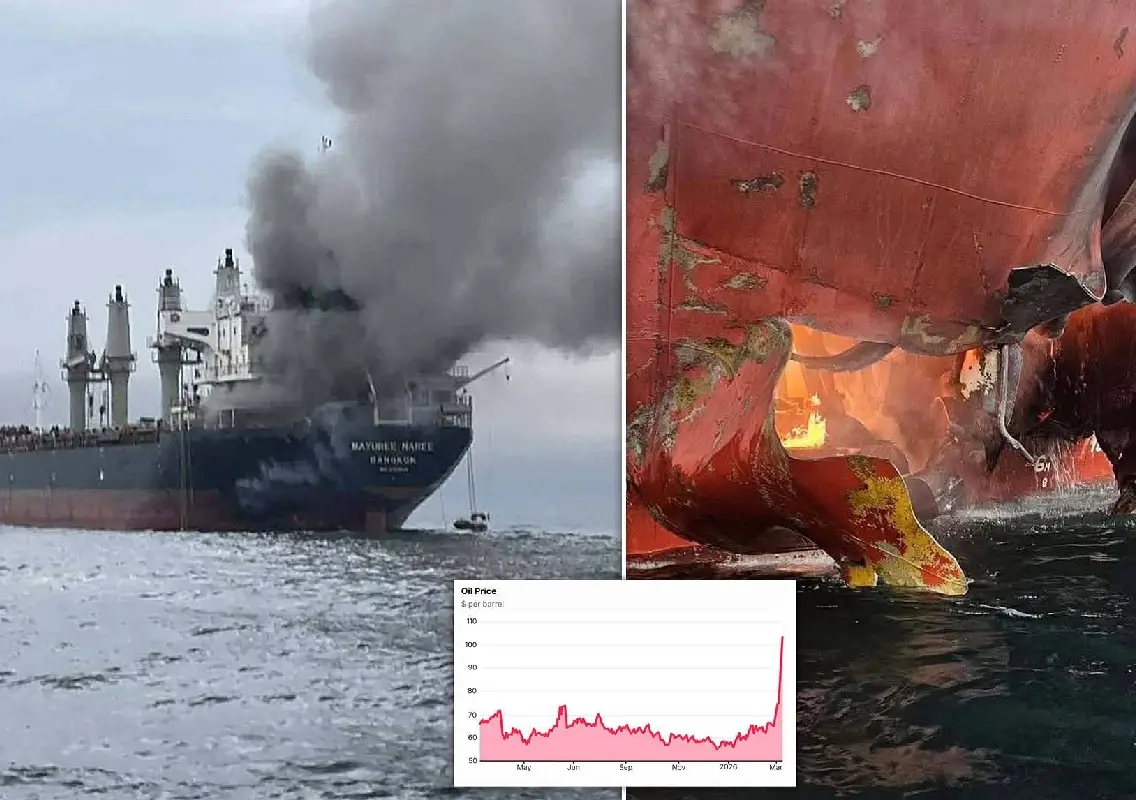


Two oil tankers were struck in the Persian Gulf, leaving one person dead and several crew members rescued, as the ongoing conflict involving Iran, the United States, and Israel intensified across the region.
Authorities said the tankers were hit near Iraq on Thursday, triggering fires and halting operations at several oil terminals. Iraq’s government described the incident as an act of sabotage, while Iran reportedly claimed responsibility for striking one of the vessels.
Tanker attacks disrupt Gulf shipping
Footage circulating online showed both ships engulfed in flames and leaking burning oil. Iraqi officials confirmed that one crew member was killed, while 38 others were rescued. Search operations were underway for additional crew members.
The attacks forced authorities to suspend operations at Iraq’s oil export terminals, though commercial ports remained open.
In a related incident, drones struck fuel tanks at the port of Salalah in Oman, prompting the temporary suspension of operations.
Shipping routes near the Strait of Hormuz also came under renewed threat. A container ship near the United Arab Emirates was hit by an unidentified projectile, causing a small fire but no casualties.
Israel claims strike on Iranian nuclear facility
Meanwhile, the Israel Defense Forces (IDF) said it carried out strikes on a “critical” nuclear facility near Tehran, identified as the Taleghan compound.
The Israeli military claimed the facility had been used for the development of advanced explosives linked to Iran’s alleged nuclear weapons programme.
Iran has consistently denied pursuing nuclear weapons, although it has enriched uranium to high levels and restricted inspections of some nuclear facilities.
Regional attacks and missile strikes continue
Iran continued launching missile attacks toward Israel, firing multiple salvos during the day. No injuries were reported from the latest strikes.
Elsewhere in the Gulf, authorities reported Iranian projectiles and drone incidents across several countries:
- Bahrain reported fires at fuel storage tanks on Muharraq Island
- Kuwait reported injuries after a drone struck a residential building
- Explosions were heard in Dubai, where air defences intercepted missile threats
Saudi Arabia also said it intercepted drones headed toward the Shaybah oil field.
Oil prices surge amid global supply disruption
The escalating conflict has severely disrupted global energy markets. According to the International Energy Agency, the crisis has triggered the largest oil supply disruption in history, surpassing shocks seen during the 1970s energy crisis.
Oil prices surged above $100 per barrel, while governments began releasing strategic reserves to stabilise markets.
The IEA said Gulf oil output had dropped by at least 10 million barrels per day, with no immediate signs of de-escalation.
As the war entered its 13th day, analysts warned that continued attacks on energy infrastructure and shipping lanes could further destabilise global markets and deepen the regional conflict.