







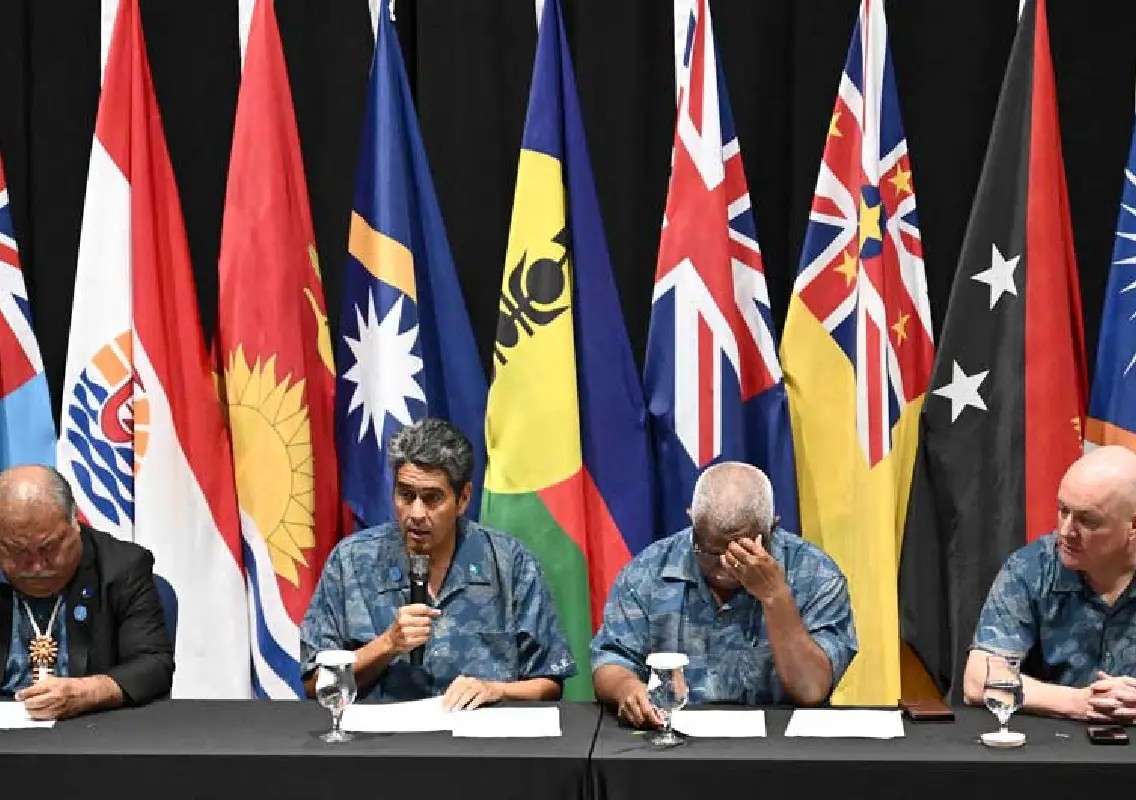


Koror: Pacific island leaders have expressed concern over China’s recent intercontinental ballistic missile (ICBM) test and called for countries conducting such launches to provide adequate advance warning, highlighting growing unease over military activity in the Pacific.
The issue was discussed at the 2026 Pacific Islands Forum in Palau, where leaders considered the implications of China’s July missile launch. The missile travelled over several Pacific island nations without what regional leaders considered sufficient prior notification.
The Forum’s final position called for at least 24 hours’ advance notice for future missile tests, reflecting concerns about safety, sovereignty and transparency.
Concerns over missile launch
China conducted a long-range ballistic missile test into the Pacific in July. Beijing described the exercise as safe and routine, but several Pacific governments questioned the limited warning they received before the launch.
For countries located across the vast Pacific region, missile tests can raise concerns not only about military security but also about the safety of civilian populations and aircraft and maritime traffic.
Palau President Surangel Whipps Jr., who hosted this year’s Pacific Islands Forum, pushed for a stronger regional position. He argued that countries carrying out such tests should respect the sovereignty of Pacific nations and provide sufficient information beforehand.
The final Forum position stopped short of directly naming China. Instead, leaders called on all countries conducting missile tests to provide advance notification, framing the issue as a broader regional principle rather than an explicit condemnation of one country.
Nauru breaks ranks
The effort to present a united Pacific position was complicated by disagreement among member states.
Nauru did not support the collective position on the missile test, reflecting the Pacific nation’s closer relationship with Beijing since switching diplomatic recognition from Taiwan to China in 2024.
Despite the disagreement, the majority of Forum members supported the call for advance notification. Australian Energy Minister Chris Bowen said unanimity was not necessary for Pacific countries to express a strong collective position on an issue affecting regional security.
The disagreement illustrates the increasingly complex diplomatic environment in the Pacific, where China, the United States, Australia, New Zealand and Taiwan are competing for influence while island nations seek to maintain their own priorities and strategic independence.
Debate over transparency
The demand for advance warning is closely connected to broader concerns about transparency in military activity.
Pacific nations have increasingly called for the region to remain peaceful and for major powers to consult island countries before conducting activities that could affect their security or environment.
The July missile test was particularly sensitive because the weapon travelled thousands of kilometres across the Pacific. Although China said the launch was conducted safely, governments in the region questioned whether the notification provided was adequate.
Pacific leaders’ concerns are also taking place against the backdrop of China’s expanding military capabilities and growing engagement with island nations.
The Pacific Islands Forum has traditionally focused heavily on issues such as climate change, economic development and environmental protection. However, regional security is becoming an increasingly important part of its discussions.
China rejects criticism
Beijing has rejected suggestions that its missile test represented military expansion in the Pacific.
Chinese officials have maintained that the test was conducted safely and in accordance with international practice. Beijing has also criticised what it sees as attempts to portray its military activities as a threat to the region.
Before the Forum concluded, China accused Palau of creating unnecessary “hype” around the missile test after President Whipps called for a unified Pacific response. Chinese officials reiterated that the test was safe and denied engaging in military expansion.
The contrasting positions highlight the diplomatic challenge facing Pacific governments as they attempt to maintain relationships with major powers while asserting their own interests.
Taiwan issue adds to tensions
The missile dispute was not the only major geopolitical issue at the Pacific Islands Forum.
The participation of Taiwan also became a source of tension after China objected to Taiwan’s presence at the gathering. Taiwan is a development partner of the Forum, while China is a dialogue partner.
Taiwan’s Foreign Minister Lin Chia-lung accused Beijing of using increasingly aggressive diplomacy and attempting to disrupt the regional gathering. The dispute added another layer to the wider strategic competition playing out across the Pacific.
Palau, which hosted the Forum, maintains diplomatic relations with Taiwan and has strongly defended its right to participate in regional discussions.
The disagreements over both the missile test and Taiwan demonstrate how wider China-Taiwan and China-West tensions are increasingly affecting Pacific diplomacy.
Pacific nations seek stronger regional voice
Despite divisions, Pacific leaders have continued to emphasise the importance of regional unity and the right of island nations to determine their own priorities.
The call for 24 hours’ advance notice represents an attempt to establish a basic regional expectation for missile-testing countries.
For many Pacific island states, the issue is not simply about China. Leaders have also pointed to the need for consistent standards for all countries conducting missile tests in or over the Pacific.
The debate has therefore raised broader questions about how major military powers should communicate with smaller island nations whose territories and surrounding waters may be affected by strategic weapons testing.
A changing security environment
The latest developments underscore how the Pacific is becoming an increasingly important arena in global strategic competition.
China has expanded its economic and diplomatic engagement with Pacific island countries, while Australia, New Zealand and the United States have sought to strengthen their own relationships in the region.
For Pacific governments, balancing these competing interests can be difficult. They must address immediate concerns over security and sovereignty while also dealing with climate change, economic development and other issues that remain central to their national priorities.
The missile test debate has consequently become a symbol of a wider challenge: how can Pacific nations preserve their independence and regional voice as major powers expand their presence?
The Forum’s call for advance notification does not resolve those broader tensions. However, it sends a clear message that Pacific nations expect greater transparency and consultation when military activities have the potential to affect the region.
As strategic competition continues to grow, the demand for prior warning could become an increasingly important part of discussions over security, sovereignty and peace across the Pacific.