







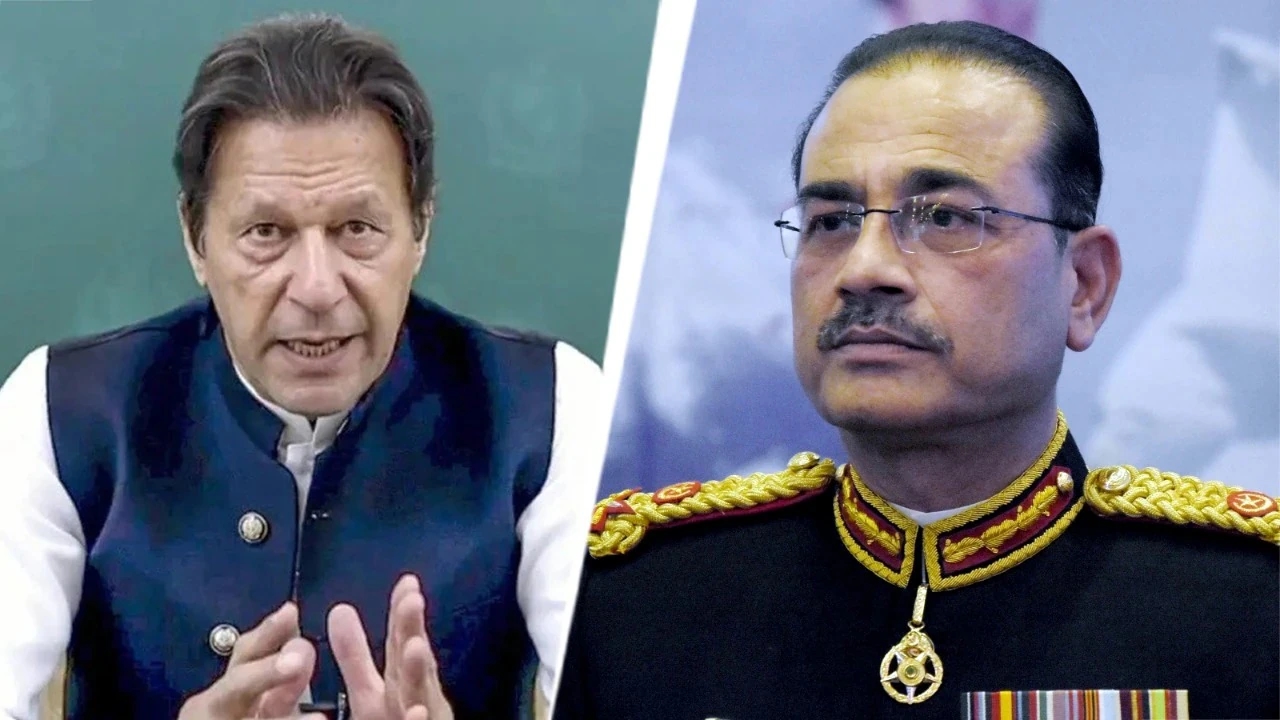


A week after a fierce confrontation between Pakistan’s military establishment and supporters of jailed former Prime Minister Imran Khan, the civilian government led by PM Shehbaz Sharif has issued its strongest warning yet. Senior PML(N) leader and government adviser Rana Sanaullah said on Monday that a treason case against Imran Khan “cannot be ruled out”, deepening the already volatile political climate in the country
Government’s warning escalates political crisis
Speaking to a media outlet, Sanaullah said that the message delivered last week by Inter-Services Public Relations (ISPR) chief Lt Gen Ahmed Sharif Chaudhry had been “clear” and was “fully endorsed” by the Sharif government.
(See also: NK report on regional political developments | Treason – Wikipedia)
“We cannot rule out a treason case being lodged against the PTI founder,” Sanaullah said, adding that Pakistan Tehreek-e-Insaf (PTI) leaders should not take this warning lightly. He cautioned that any continued defiance could lead to “serious consequences”.
The warning comes days after the ISPR chief accused Imran Khan of spreading an “anti-army” narrative that he described as a “creeping national security threat”. The confrontation intensified further after a video surfaced showing Chaudhry winking at a journalist during a press briefing, triggering public criticism online.
(See related: NK analysis on civil-military relations)
Tensions erupt over prison visit
The political standoff worsened on Tuesday when police blocked the roads leading to Rawalpindi’s Adiala Jail, preventing Khan’s sisters from meeting him on the court-mandated visitation day. The move sparked anger among PTI supporters, who accused the government of violating judicial orders.
Pakistani columnist Zahid Hussain, writing in Dawn, noted that calling political leaders “traitors” has long been part of Pakistan’s power struggles, with nearly every major politician experiencing such accusations at some point. Imran Khan, he observed, is simply the latest to be branded a “security threat” and dismissed as having a “delusional mindset”.
Treason law and its implications
Treason in Pakistan refers to “abrogating, subverting, suspending or holding the Constitution in abeyance”. Former military ruler Pervez Musharraf was convicted of treason in 2019 for imposing emergency rule in 2007 and suspending the Constitution.
Under Pakistani law, treason carries a punishment of death or life imprisonment.
Sanaullah also alleged that the narrative used by terrorists in the March hijacking of the Jaffer Express was amplified by “Indian, Afghan and PTI-linked media”, accusing Imran Khan’s party of contributing to national instability.
Munir–Imran standoff deepens
The crisis unfolds as Field Marshal Asim Munir — now constitutionally elevated as the combined chief of all defence forces with lifetime immunity — consolidates unprecedented power under the controversial 27th Amendment, passed in November. Critics describe the move as a “constitutional coup” that entrenches military dominance by limiting judicial oversight and codifying control previously exercised informally.
From Adiala Jail, Imran Khan has fiercely criticised Munir, calling him “mentally unstable” and accusing him of orchestrating a campaign of repression. He has refused any negotiation with what he calls the “Asim Law regime”.
The military, in turn, labelled Khan “mentally ill” and warned that no one would be allowed to incite public sentiment against the armed forces.
Pakistan enters a period of severe instability
Pakistan’s internal security situation has deteriorated further in recent months, with separatist and militant violence rising sharply in Balochistan and Khyber Pakhtunkhwa. Armed groups have intensified their attacks on military and police targets, adding to the strain on the Sharif–Munir administration.
Imran Khan has been held at Adiala Jail since August 2023 after his arrest in multiple graft cases. He received a 14-year sentence in January 2025 in the Al-Qadir Trust case and faces additional charges in the Cipher case concerning leaked state secrets.
Khan’s conflict with Asim Munir dates back to 2019, when he removed Munir as ISI director after just eight months, sowing the seeds of a personal and political feud that now defines Pakistan’s national crisis.
As military power consolidates, political polarisation widens, and insurgencies rise, Pakistan appears to be entering one of its most volatile phases in recent history.