


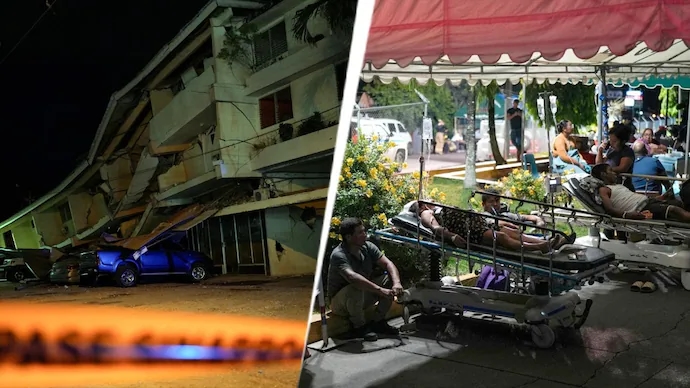


Panama City: Two powerful earthquakes measuring 7.7 and 6.6 struck Panama on Friday, damaging buildings, disrupting electricity and transport services, and prompting evacuations across affected areas. More than 40 aftershocks followed the initial tremor, adding to concerns about the stability of damaged structures.
The first earthquake struck southern Panama at a depth of 12.6 km, with its epicentre about 200 km from Panama City near Pitaloza Arriba in Herrera province, according to the US Geological Survey (USGS). A second major tremor measuring 6.6 struck later in the day.
The earthquakes were felt across much of the country and in neighbouring countries, including Costa Rica and Colombia. Residents reported prolonged shaking, while emergency services and authorities began assessing damage across several provinces.
Although no fatalities had been officially confirmed in the initial reports, injuries were reported as authorities continued their assessments. The full extent of the damage remained uncertain. Reuters reported that the earthquakes caused structural damage and widespread disruption but spared Panama from large-scale devastation.
Buildings damaged as residents flee
The first earthquake caused panic in communities near its epicentre, where residents rushed outside as buildings shook. Some structures were damaged or collapsed, raising concerns about further failures during the aftershocks.
The epicentre was near La Pitaloza, a rural community in Herrera province close to Panama’s Pacific coast. Damage was reported in several areas, including Penonomé, a city between the epicentre and Panama City.
Footage verified by Reuters showed damage to a church and nearby buildings in Penonomé. President José Raúl Mulino travelled to the area after the earthquake to assess the situation.
Omar Smith, head of Panama’s civil protection agency, said damage had also been reported in Chitré, the capital of Herrera province, and in coastal areas of Los Santos province.
In Herrera, residents feared that cracks in homes and other structures could cause further collapses. Ricardo Brown, a 74-year-old resident of Las Minas, told Reuters that he and his companion were frightened by the condition of their house.
“We’re scared. It’s just the two of us old folks here. The house has cracked, and we’re afraid it could fall on us,” Brown said.
Authorities continued checking buildings and infrastructure as aftershocks rattled the affected regions.
Power cuts and transport disruption
Electricity supplies were disrupted across six provinces, utility provider Naturgy said. The outages added to the difficulties faced by residents and businesses as authorities worked to assess damage and restore services.
Tocumen International Airport, Panama’s main international aviation hub, temporarily suspended flights following the earthquake. The suspension was later lifted, allowing operations to resume.
The disruption caused concern for passengers travelling through the airport, although the Panama Canal remained operational. Authorities continued monitoring infrastructure for possible damage.
In Panama City, office buildings were evacuated as a precaution, with some employers releasing workers early. The resulting movement of people contributed to traffic congestion across parts of the capital.
The city’s Metro system also suspended services temporarily, while schools in the capital sent students home early. Classes were suspended nationwide as officials assessed the situation and considered the safety of educational facilities.
Juan Sanchez, a 37-year-old employee of the economy ministry, told Reuters he was waiting for a bus after buildings were evacuated but was unsure whether transport would arrive.
“They evacuated all of these buildings. Everyone is outside. Now the problem is, how do we get home?” Sanchez said.
The disruption highlighted the challenges of moving large numbers of people through the capital when offices, transport systems and public facilities are affected simultaneously.
Azuero-Sona Fault System identified as source
Nestor Luque, director of Panama’s geosciences institute, attributed the earthquake to the Azuero-Sona Fault System, where stress had accumulated over time.
“It’s a system of active faults that occasionally, due to the accumulation of stress, release this amount of energy,” Luque told Reuters.
He said seismic waves had travelled across the country, explaining why the tremors were felt in distant areas.
The shaking reportedly lasted around 40 seconds in Panama City, although its duration varied across the affected regions.
Residents described the first earthquake as unusually strong and prolonged. Sabina Rios, who was on the sixth floor of an older building in the capital, told Reuters that the tremor lasted longer than others she had experienced in recent years.
Victor Pinzon, a 48-year-old maintenance worker, described watching window cleaners sway as high-rise buildings shook.
“It’s a miracle they didn’t get killed,” he told Reuters, comparing their movement to people swinging in a hammock.
The USGS estimated that approximately 43,000 people lived in areas exposed to severe shaking. Its preliminary assessment also indicated that economic losses could be substantial, potentially ranging from 1% to 10% of Panama’s gross domestic product. Such estimates are early projections, not a final calculation of damage.
More than 40 aftershocks follow major tremors
The initial magnitude 7.7 earthquake was followed by a series of aftershocks, including the magnitude 6.6 tremor later in the day.
The continued seismic activity complicated damage assessments because buildings weakened by the first earthquake could face additional stress from subsequent shaking.
Residents in affected provinces remained concerned about damaged homes, churches and public buildings. Authorities were assessing structures and infrastructure while emergency teams responded to reports from communities across the country.
The earthquakes were also felt beyond Panama’s borders. Reports indicated that tremors reached neighbouring Costa Rica and Colombia, demonstrating the wide area affected by the seismic activity.
The USGS recorded the main earthquake near Pitaloza Arriba at a depth of 12.6 km. The relatively shallow depth contributed to the intensity of the shaking experienced near the epicentre.
Tsunami warning lifted
The US Tsunami Warning System initially warned that hazardous tsunami waves could reach parts of the coasts of Panama, Colombia, Costa Rica, Ecuador, Peru, Nicaragua, Guatemala, El Salvador and Mexico following the first earthquake.
The warning was later lifted after authorities determined that the tsunami threat had passed.
The initial alert prompted concern among coastal communities, although the subsequent cancellation meant that the warning was no longer in effect. Authorities continued monitoring the situation as they assessed the wider consequences of the earthquakes.
Panama was also scheduled to conduct a nationwide evacuation drill the following Monday. The exercise was intended to test emergency response arrangements, including preparedness for earthquakes.
The timing of the disaster added significance to the planned drill, as officials faced the immediate task of assessing damage and reviewing the response to a major seismic event.
Regional bank offers financial assistance
The Development Bank of Latin America and the Caribbean announced a credit line of up to $50 million for Panama following the magnitude 7.7 earthquake.
The institution also announced a donation of $250,000 to support the country, according to a statement shared on social media.
The financing could help the government address urgent needs and support recovery efforts as the scale of the damage becomes clearer. The final requirements will depend on assessments of affected buildings, public infrastructure and essential services.
The announcement added a regional financial response to the emergency measures already under way in Panama.
Authorities continue damage assessments
The two earthquakes caused widespread alarm, structural damage and disruption to daily life, particularly in the central provinces of Herrera, Los Santos and Coclé.
Electricity interruptions, temporary airport and Metro suspensions, school closures and traffic congestion affected residents far beyond the immediate epicentral area.
Although the country avoided the widespread devastation initially feared, the damage to buildings and the continuing aftershocks left authorities facing a challenging assessment and recovery process.
Officials will need to establish the condition of affected structures, restore disrupted services and determine the full economic impact. The number of injuries and the extent of property damage may also become clearer as emergency teams complete their work.
For now, the priority remains public safety, the inspection of damaged buildings and the restoration of normal services while Panama continues to monitor aftershocks following one of the strongest earthquakes to hit the country in recent years.