







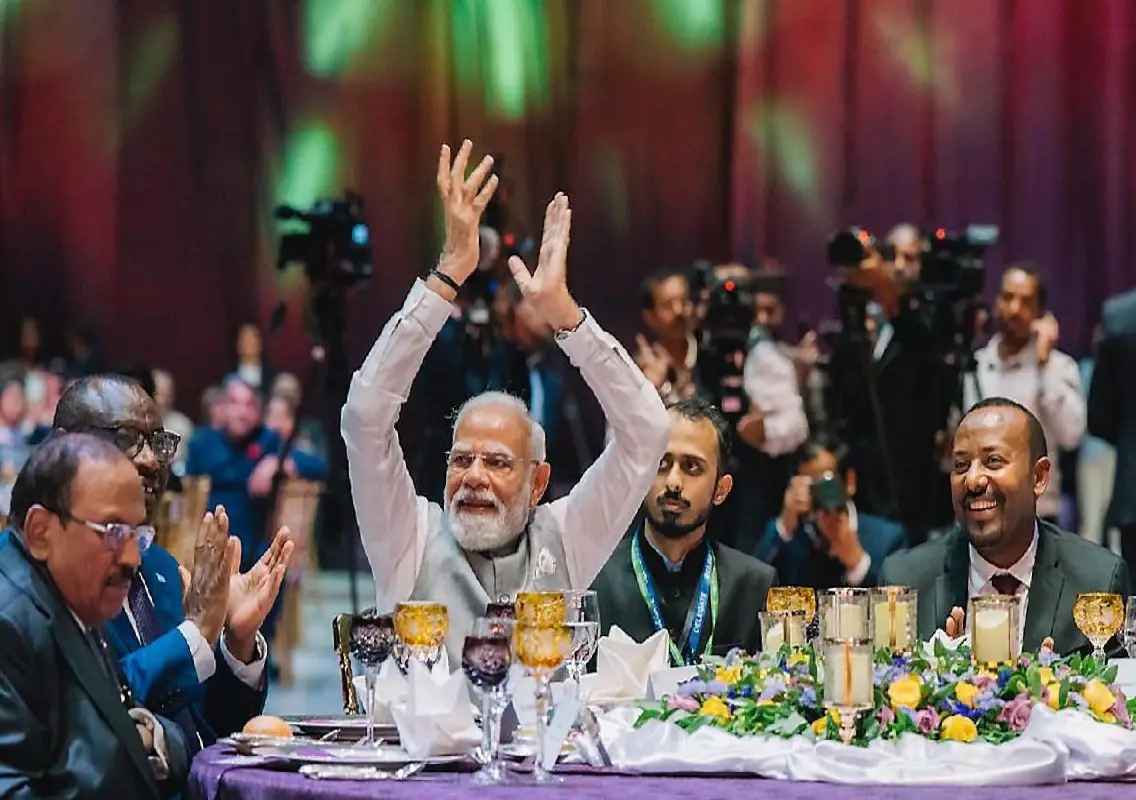


Prime Minister Narendra Modi on Wednesday described as “deeply moving” a soulful rendition of Vande Mataram performed by Ethiopian singers at a banquet hosted in his honour by Ethiopian Prime Minister Abiy Ahmed Ali. The cultural moment, marked by warmth and symbolism, highlighted the growing people-to-people connect between India and Ethiopia during the Prime Minister’s maiden visit to the African nation.
The performance took place at a formal banquet hosted by Prime Minister Abiy Ahmed Ali as part of PM Modi’s ongoing four-day, three-nation tour. A short video clip shared by PM Modi on social media platform X showed three Ethiopian singers rendering India’s national song with emotion and grace, drawing enthusiastic applause from the Indian delegation.
In the video, the Prime Minister and members of the Indian delegation are seen clapping with their hands raised overhead, visibly moved by the tribute. The moment resonated strongly, especially as India is marking the 150th anniversary of Vande Mataram this year.
PM Modi shares moment on social media
Sharing the video on X, PM Modi expressed his appreciation for the gesture and the sentiments behind it.
“At yesterday’s banquet dinner hosted by Prime Minister Abiy Ahmed Ali, a wonderful rendition of Vande Mataram was sung by Ethiopian singers. It was a deeply moving moment, that too at a time when we are marking 150 years of Vande Mataram,” the Prime Minister said in his post.
The message quickly drew widespread attention, with several users praising the cultural exchange and the respect shown by the Ethiopian hosts towards India’s heritage and national symbols.
Symbol of cultural and emotional connect
Officials said the performance symbolised the deep cultural respect and goodwill between the two countries. Vande Mataram, composed by Bankim Chandra Chattopadhyay, occupies a special place in India’s freedom movement and national consciousness, and its rendition by Ethiopian artistes was seen as a meaningful acknowledgement of India’s history and values.
Observers noted that such cultural gestures often play a powerful role in diplomacy, reinforcing bonds beyond formal agreements and political dialogue. The choice of Vande Mataram was particularly significant given the shared emphasis both India and Ethiopia place on national pride, independence and civilisational heritage.
Part of a landmark diplomatic visit
The banquet and the cultural performance came amid a series of high-profile engagements during PM Modi’s visit to Ethiopia, his first to the country as Prime Minister. He arrived in Addis Ababa on Tuesday from Jordan and is scheduled to depart for Oman later as part of his four-day, three-nation tour.
During the visit, PM Modi held wide-ranging talks with Prime Minister Abiy Ahmed Ali, following which India and Ethiopia elevated their bilateral relationship to a Strategic Partnership. Discussions focused on cooperation in areas such as food and health security, capacity building, Digital Public Infrastructure, pharmaceuticals, medical tourism, energy and critical minerals.
Address to Ethiopian Parliament
Earlier on Wednesday, PM Modi addressed a joint session of the Ethiopian Parliament, becoming the 18th parliament in the world to be addressed by him. In his speech, he highlighted shared civilisational values and described Ethiopia as the “land of lions,” drawing a parallel with Gujarat, his home state, which is also known for its lions.
He also spoke about people-centric governance and the importance of aligning state policies with public aspirations, underlining common democratic values shared by the two nations.
Highest civilian honour conferred
Adding to the significance of the visit, PM Modi was conferred the Grand Honour Nishan of Ethiopia, the country’s highest civilian award, by Prime Minister Abiy Ahmed Ali. Accepting the honour, PM Modi said he did so with humility on behalf of the people of India, describing it as a recognition of the enduring friendship between the two nations.
Cultural diplomacy in focus
The rendition of Vande Mataram by Ethiopian singers stood out as a highlight of the visit, showcasing the role of cultural diplomacy in strengthening international relations. Diplomats said such moments leave a lasting impression and help build emotional bridges between countries.
India and Ethiopia share a long history of friendly ties, rooted in mutual respect and support, particularly during anti-colonial struggles. Cultural exchanges, including music and art, have increasingly become a key component of their engagement.
Conclusion
The moving rendition of Vande Mataram at the banquet in Addis Ababa underscored the warmth and depth of India–Ethiopia relations. As India commemorates 150 years of its national song, the tribute by Ethiopian singers added a global dimension to the celebration. Combined with the elevation of bilateral ties to a Strategic Partnership, the cultural moment reflected not just diplomatic success, but a shared sense of respect, history and friendship between the two nations.