







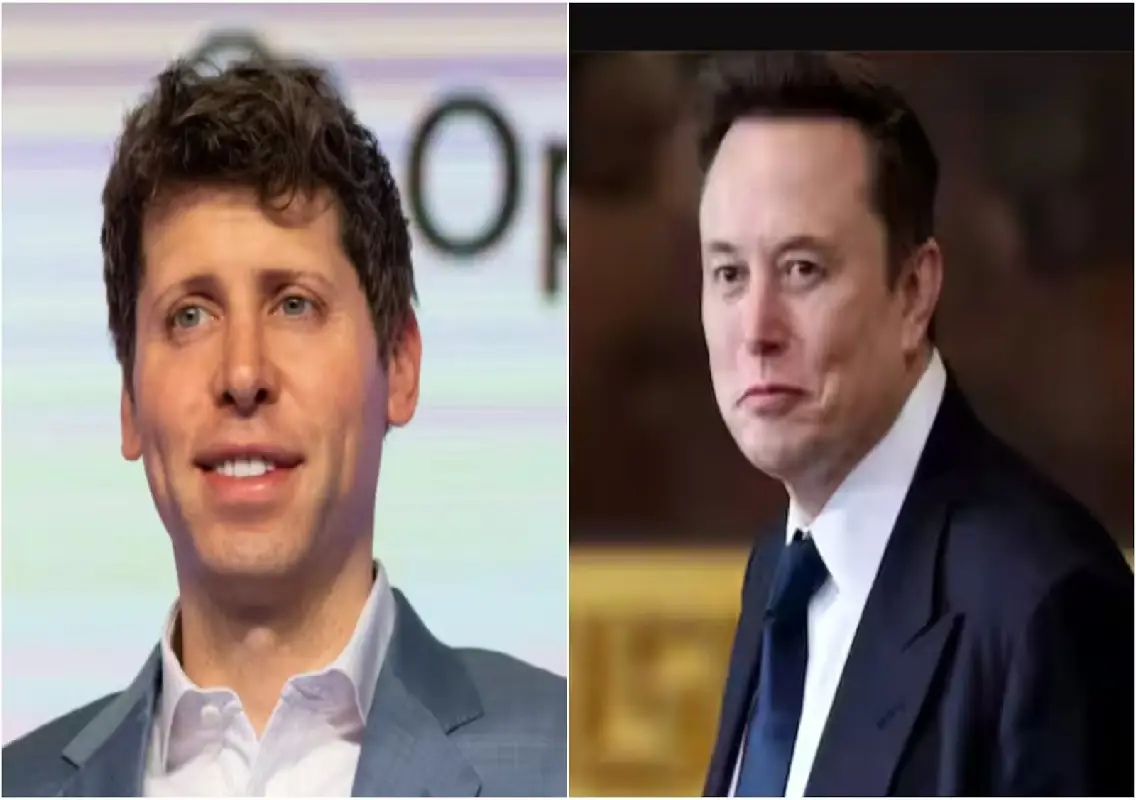


San Francisco: A renewed friendship between OpenAI CEO Sam Altman and tech billionaire Elon Musk appears improbable, according to Altman, who remarked that the prospect of reconciliation is “less likely” amid an escalating legal and ideological battle between the two Silicon Valley figures.
Speaking during an interaction with The Indian Express, Altman was asked which scenario seemed more unlikely: Taiwan Semiconductor Manufacturing Company losing its dominance in the global chip market, or he and Musk becoming friends again. Without hesitation, Altman responded that the latter was less likely, drawing laughter from the audience.
His remark comes at a time when tensions between the two have intensified over OpenAI’s structural transition and long-term direction.
Legal battle intensifies
Musk, who co-founded OpenAI in 2015, later parted ways with the organisation and has since emerged as one of its most outspoken critics. He alleges that Altman and OpenAI have deviated from their original nonprofit mission of developing artificial intelligence for the benefit of humanity.
According to Musk, the company’s increasing commercial partnerships — particularly its deep ties with Microsoft — signal a shift towards a profit-driven model that undermines its founding principles. Musk has sought to block OpenAI’s transition to a for-profit structure and is reportedly pursuing damages estimated between $79 billion and $134 billion (approximately ₹6.5 lakh crore to ₹11 lakh crore).
A jury trial in the matter is scheduled to begin on April 27, setting the stage for what could become one of the most closely watched corporate disputes in the global technology sector.
The dispute highlights broader questions about governance, transparency and the ethical development of advanced AI systems.
AI’s rapid evolution
During the event, Altman also reflected on the extraordinary pace at which artificial intelligence has evolved over the past year. He noted that just over a year ago, AI systems were only beginning to handle high school-level mathematics reliably — a milestone that had impressed many observers at the time.
“Only a couple of years before that, AI couldn’t really do grade school math,” he recalled, emphasising how quickly benchmarks have shifted.
By last summer, according to Altman, AI systems were competing in some of the world’s most challenging mathematics competitions and performing respectably. He referred to a recent “first proof” benchmark in which mathematicians released ten unsolved research problems. Altman claimed that OpenAI’s latest system successfully solved seven of them.
He described this leap as transformative, noting that AI has moved from solving standard academic problems to contributing at the frontier of research, including in physics. “We’ve gone from AI that could do what we expected a very smart high school student to do, to pushing the edge of human knowledge,” he said.
Beyond mathematics: reshaping programming
Altman stressed that the transformation is not limited to mathematics. He pointed out that AI’s role in software development has dramatically expanded.
He observed that tools which once functioned as simple autocomplete systems for code have evolved into platforms capable of generating entire applications based on a user’s idea. Referring to OpenAI’s code-generation tools, he noted that developers can now type in a concept and receive a working application, fundamentally altering what it means to be a computer programmer.
This shift, he suggested, represents a structural change in how software is created and how technical skills are deployed in the workplace.
What should children study?
Addressing one of the most common questions he encounters socially — what children should study in an AI-driven future — Altman acknowledged the difficulty of predicting specific career paths.
Drawing parallels with the Industrial Revolution, he noted that historical predictions about future jobs were often dramatically wrong. New professions that now seem obvious — such as social media influencers or AI company executives — would have been unimaginable decades ago.
Instead of recommending particular job titles, Altman emphasised foundational and adaptable skills. He said fluency with AI tools, resilience, adaptability, and the ability to identify and meet people’s needs will remain valuable regardless of technological shifts. Collaborative skills and the capacity to work effectively with others will also be critical.
The broader tech landscape
Altman’s comments come against the backdrop of intensifying global competition in semiconductor manufacturing and AI infrastructure. Taiwan Semiconductor Manufacturing Company (TSMC), which controls about 65 per cent of the global chip foundry market and produces over 90 per cent of advanced logic chips critical for AI systems, recently announced an additional $100 billion investment in US manufacturing over five years.
As geopolitical and corporate rivalries reshape the technology landscape, the public rift between Altman and Musk underscores deeper tensions about control, commercialisation and the future direction of artificial intelligence.
While reconciliation between the two former collaborators appears unlikely for now, the legal and strategic outcomes of their dispute could significantly influence how AI companies operate in the coming years.
In an industry defined by rapid change, their fractured partnership stands as a reminder that technological revolutions are often accompanied by equally dramatic personal and institutional conflicts.