







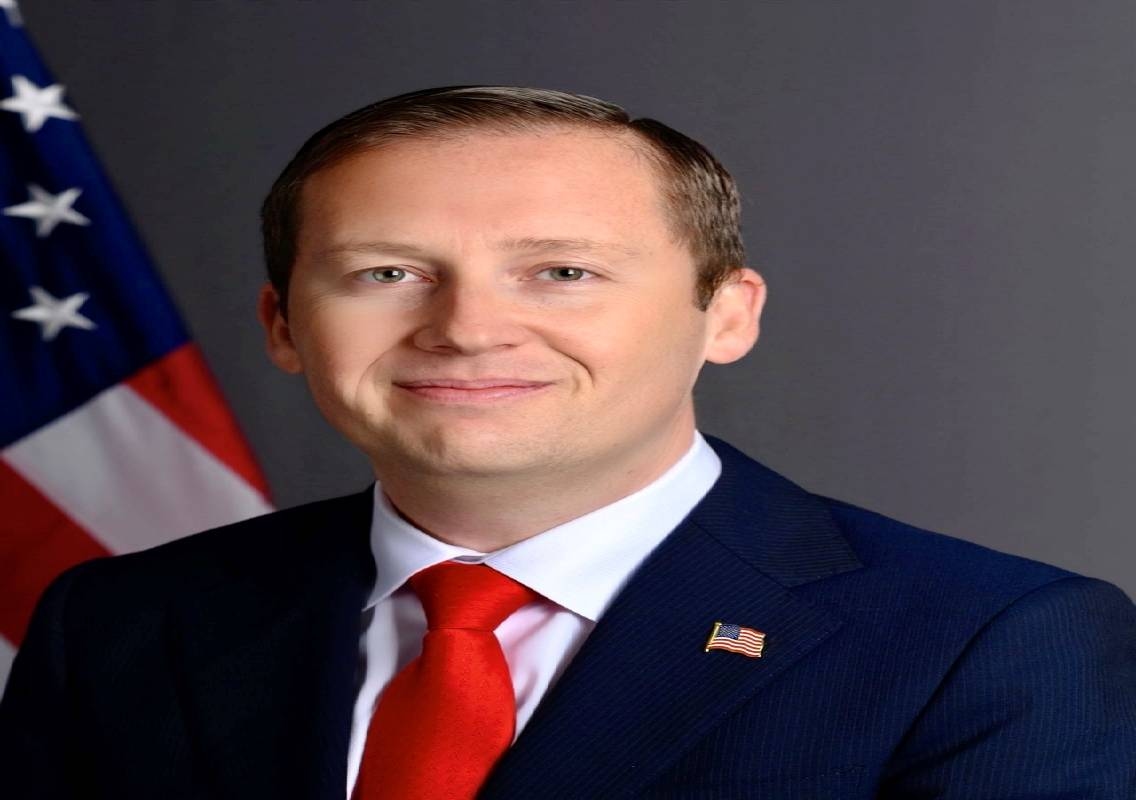


New Delhi: US Ambassador to India Sergio Gor has backed President Donald Trump’s push for a nationwide voter identification requirement in the United States, citing India’s electoral system as an example. Gor said the US should introduce a voter ID requirement and described the issue as one that should not be viewed through a partisan lens.
Gor’s comments came as the Trump administration renewed its push for the Safeguard American Voter Eligibility (SAVE) America Act, a proposed law that seeks stricter requirements around voter identification and proof of citizenship in US federal elections.
Sergio Gor backs Trump’s voter ID push
Speaking on the sidelines of his special address at the Indo-American Chamber of Commerce National Convention 2026, Gor said Trump had been clear about the need for voter identification in America.
He pointed to India’s voter ID framework as an example of a system that could be adopted in the US.
Gor said the US should have a requirement for voters to present identification when casting their ballots and argued that voter ID should not be treated as a partisan issue.
Gor points to India’s massive electorate
Gor highlighted the scale of India’s elections while making his case.
He referred to more than 660 million people voting in India’s latest general election and noted that less than 1% of voters used mail-in voting.
He argued that India’s experience demonstrates that voter identification can be implemented even when elections involve hundreds of millions of people.
In a separate post on X, Gor said Trump was “absolutely correct” in pointing to India’s system and urged Congress to pass the SAVE America Act.
Trump had cited India’s election system
Gor’s remarks came shortly after Trump invoked India’s electoral system in his own campaign for stricter voting rules.
Trump said India’s Chief Election Commissioner Gyanesh Kumar had questioned how elections could be conducted in the US without valid photo identification.
Trump also cited India’s latest general election, saying around 646 million people voted and that every voter had to have a valid photo identity document. He used the comparison to call for the passage of the SAVE America Act.
However, the specific conversation Trump attributed to Kumar has not been independently corroborated through a confirmed public record.
What is the SAVE America Act?
The Safeguard American Voter Eligibility Act is aimed at introducing stricter voter eligibility and identification requirements for US federal elections.
Among the proposed measures are requirements for documentary proof of US citizenship and government-issued identification. The legislation is part of Trump’s wider campaign to change federal election rules and strengthen voter-eligibility verification.
Trump has made the legislation a major part of his election policy agenda, arguing that stricter identification requirements would strengthen election security.
How India’s voter ID system works
India uses the Electors Photo Identity Card (EPIC) as an important form of voter identification.
At elections, registered voters can use their EPIC or another identification document approved by the Election Commission of India to establish their identity at polling stations.
Identification is only one part of the process. A person must also be registered on the electoral roll and meet the legal requirements to vote.
India’s system therefore combines voter registration records with identification procedures at polling stations.
US election rules are different
The comparison between India and the US comes against significantly different election structures.
India’s elections are administered through a national constitutional framework overseen by the Election Commission of India. In the US, elections are largely administered by individual states and local authorities.
As a result, voter identification requirements already vary across the US.
Some states require voters to present photo identification, while others use different methods to verify a voter’s identity.
Trump’s proposal would seek to establish much stricter and more uniform requirements for federal elections.
Voter ID remains politically contentious in America
The question of mandatory voter identification has long been politically divisive in the US.
Supporters argue that requiring identification can strengthen public confidence in elections and provide additional safeguards against voter impersonation and other forms of fraud.
Opponents have raised concerns about potential barriers for eligible voters who may not possess the required documents or find it difficult to obtain them.
The debate consequently involves both election security and voting access.
Gor says voter ID is not partisan
Gor specifically rejected the idea that voter identification should be viewed as a partisan issue.
He said identification is important when people turn up to vote and backed Trump’s argument that the US should introduce such a requirement.
His comments are significant because they come from the US ambassador to India and directly reference India’s election infrastructure while the administration is seeking support for changes to US voting rules.
India becomes a reference point for US election reforms
The remarks have placed India’s election system at the centre of an American political discussion.
India conducts elections involving hundreds of millions of voters across thousands of constituencies, making voter identification and electoral-roll management a major logistical exercise.
Trump and Gor are now using that scale to argue that the US could similarly implement stronger identification requirements.
However, the differences between the two countries’ constitutional and election-administration systems remain important when making such comparisons.
SAVE America Act faces political divisions
The legislation backed by Trump and Gor has encountered political divisions in Congress.
The proposal has generated disagreement over the extent of federal control over elections, voter eligibility requirements and the potential consequences for access to the ballot.
Trump has nevertheless continued to press lawmakers to approve the measure, making voter identification a prominent issue ahead of the US midterm elections.
A growing India-US election comparison
Gor’s comments come just as India has received unusual attention in the American debate over election administration.
The discussion does not mean that the US is adopting India’s electoral system wholesale. Instead, Trump and his ambassador are highlighting specific elements — particularly voter identification and the limited use of postal voting — as examples for American policymakers.
The comparison is likely to continue as the administration pushes for changes to federal election rules.
Conclusion
US Ambassador to India Sergio Gor has backed mandatory voter identification in America, saying the US should have a voter ID requirement and pointing to India’s electoral system as an example. He also urged Congress to pass the SAVE America Act, which seeks stricter voter eligibility and identification rules.
Gor’s comments followed Trump’s recent praise of India’s voter ID system. Trump cited India’s huge electorate and use of photo identification while arguing that similar requirements should be introduced in the US.
While voter ID requirements already exist in different forms across several US states, the proposed federal legislation would create more stringent and uniform standards. The debate is expected to remain politically contentious as Washington considers changes to the country’s election rules.