







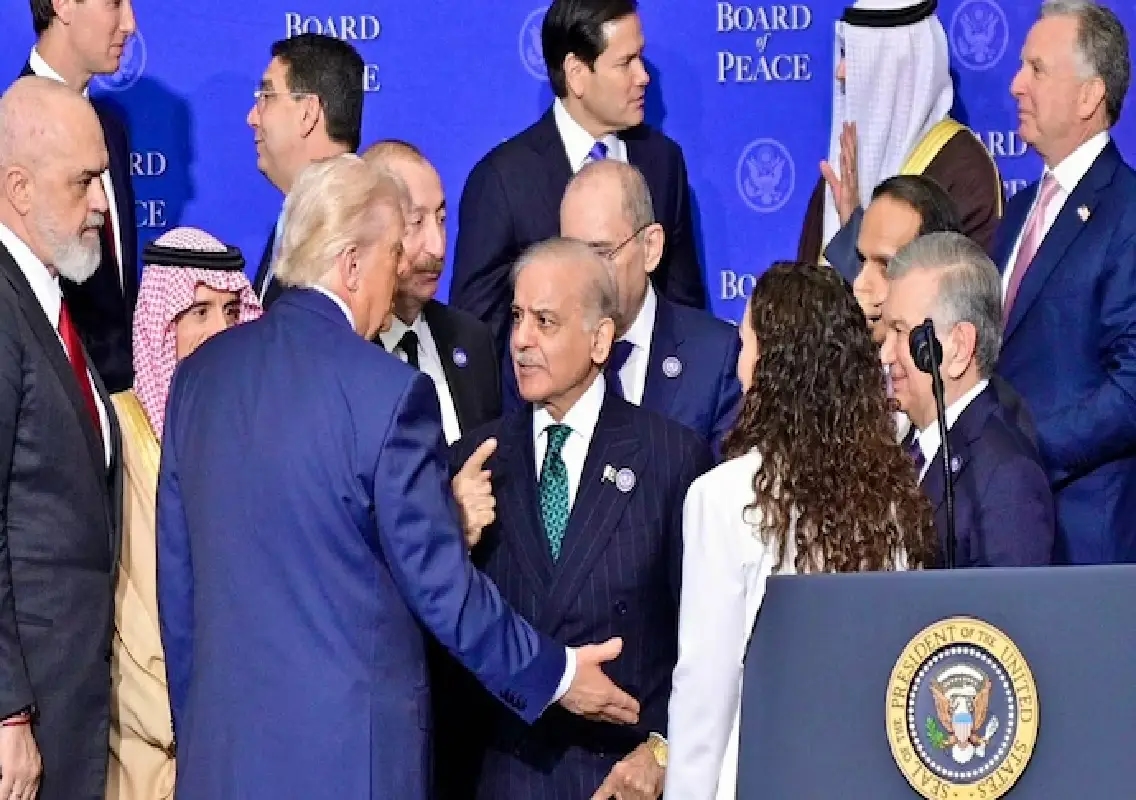


Washington: Pakistan Prime Minister Shehbaz Sharif’s high-profile appearance at US President Donald Trump’s first “Gaza Board of Peace” summit on Thursday drew widespread attention, but much of it centred on awkward optics and diplomatic discomfort rather than substantive outcomes.
Sharif, who in recent months has repeatedly praised Trump as a “man of peace” and even nominated him for the Nobel Peace Prize, appeared marginalised during the high-level meeting attended by representatives from around 40 countries. India participated as an observer at the summit, which is part of Trump’s initiative to oversee reconstruction and stabilisation efforts in war-torn Gaza.
Several videos from the event circulated widely on social media, showing Sharif positioned at the edge of the group during the official photo opportunity. Trump stood prominently in the front row, flanked by Vice President JD Vance and Secretary of State Marco Rubio, while leaders from Saudi Arabia, Indonesia and Qatar were seen directly behind him.
Optics and photo op draw attention
In diplomatic engagements, visual symbolism often carries significant weight. Observers noted that Sharif was barely visible in the official group photograph, standing on the sidelines as Trump addressed the gathering.
At one point during his remarks, Trump gestured towards Sharif and asked him to “stand up”. The Pakistani Prime Minister complied immediately. The moment drew varied reactions online, particularly as Trump went on to praise Indian Prime Minister Narendra Modi as a “great man” and a “very good friend” during the same interaction.
While there was no official indication of any diplomatic slight, the optics triggered debate in political circles in Pakistan and beyond. Analysts pointed out that positioning during such events often reflects protocol decisions based on multiple factors, including order of arrival, bilateral engagements and geopolitical considerations.
Gaffes ahead of visit
Even before Sharif landed in Washington, controversy surrounded his visit. A statement issued by Pakistan’s Foreign Ministry announcing the trip contained typographical errors, including referring to the “United States of America” as the “Unites States of Americas”. The mistake was widely shared on social media and drew criticism domestically.
Social media users also revisited a previous error in which Sharif had mistakenly written “I condom the attack” instead of “I condemn the attack” while reacting to Israeli airstrikes on Iran last year. Though minor in isolation, such gaffes added to the scrutiny around his Washington visit.
Praise for Trump and ceasefire remarks
During his intervention at the summit, Sharif praised Trump for what he described as “timely and effective intervention” in mediating last year’s India-Pakistan ceasefire. India has consistently maintained that the understanding was reached bilaterally between the two countries without third-party mediation.
Sharif said Trump had “proved to be a man of peace” and described him as a “saviour of South Asia”. The remarks were consistent with his earlier statements, including praise expressed at international forums last year.
Trump, in turn, briefly responded by saying, “I like this guy”, and reiterated positive remarks about Pakistan’s Army Chief General Asim Munir.
Troop contributions and policy dilemmas
A key point of discussion at the summit was the proposed multinational stabilisation force for Gaza. Trump announced that countries including Indonesia, Morocco, Albania, Kosovo, Kazakhstan, Egypt and Jordan had agreed to contribute troops for demilitarisation, aid delivery and ground-level security in Gaza following nearly two years of conflict with Israel.
Pakistan was not mentioned among the contributors.
Diplomatic sources suggest that Islamabad faces a complex domestic political calculus. Pakistan does not recognise Israel and travel to Israel on Pakistani passports remains prohibited. The Palestinian issue carries deep emotional resonance in Pakistan, and any direct military coordination involving Israeli forces could trigger political backlash and public protests at home.
This has reportedly led to caution within Islamabad over committing troops, even as it participates in the broader diplomatic initiative.
Strategic recalibration?
For Pakistan, the Washington visit underscored the challenges of navigating a transactional US foreign policy under Trump. While Sharif’s praise for the US President signalled Islamabad’s intent to maintain close ties, concrete commitments—particularly on sensitive issues such as Gaza—appear to weigh more heavily in Washington’s calculations.
The summit’s optics, combined with the absence of any announced Pakistani troop contribution, have prompted debate over Islamabad’s current diplomatic leverage.
As reconstruction and stabilisation efforts in Gaza move forward, Pakistan will have to balance its domestic political realities with its international commitments. Sharif’s appearance at the summit highlighted both the opportunities and constraints shaping Pakistan’s foreign policy at a delicate geopolitical moment.