







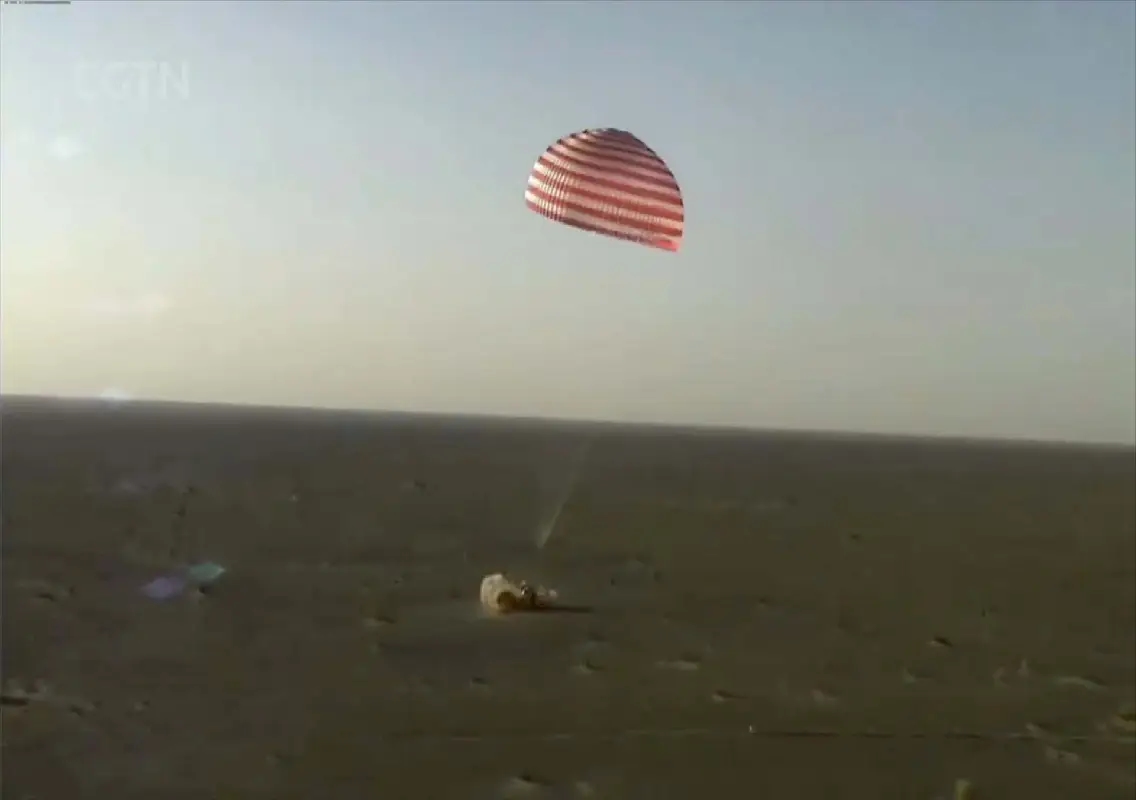


China’s Shenzhou-21 return capsule, carrying three astronauts, safely touched down at the Dongfeng landing site in north China’s Inner Mongolia Autonomous Region on Friday. The landing marked the successful completion of another major crewed mission under China’s expanding space programme. Although the event itself was brief, it represents an important milestone in the country’s broader ambitions in low-Earth orbit and long-duration spaceflight. The Shenzhou-21 astronauts had been part of ongoing operations related to the Tiangong space station, conducting essential experiments, maintenance tasks, and technology validations critical for China’s long-term presence in space.
Safe landing and crew recovery
The return capsule made a precise landing at the Dongfeng site, a location increasingly used by China for crewed spacecraft recovery because of its favourable terrain and vast open spaces. Recovery teams, already stationed in advance, quickly surrounded the capsule after touchdown. According to preliminary information released by Chinese state media, the astronauts were in good physical condition upon extraction. They underwent routine medical checks before being transported for further evaluation. The landing process followed the standard descent procedure: deorbit burn, atmospheric re-entry at high temperatures, parachute deployment, and controlled ground impact. The capsule’s shielding and parachute systems functioned normally, ensuring a smooth return for the crew.
Mission background
The Shenzhou-21 mission was launched to support operations aboard the Tiangong space station, which has been gradually expanding as part of China’s long-term plans for human presence in orbit. While specific mission details remain limited in public reports, the crew’s tasks typically include managing scientific experiments, conducting station upkeep, testing new technologies, and preparing equipment for future missions. Shenzhou missions form the backbone of China’s human spaceflight capability, and each successful mission strengthens the country’s operational expertise.
Growing capabilities of China’s space programme
China has been accelerating crewed space efforts with a clear strategy aimed at long-term self-reliance. The Tiangong space station has become central to these ambitions, especially since China does not participate in the International Space Station. Recent missions have shown improvements in spacecraft reliability, mission safety, and faster crew rotations. With the safe return of Shenzhou-21, China maintains its strong record of successful astronaut retrievals since 2003.
Strategic importance of the Dongfeng landing site
Located in the Gobi Desert region, Dongfeng has become China’s preferred landing zone due to its vast open terrain, sparse population, and predictable weather patterns. These characteristics make it ideal for precision landings and efficient recovery operations. In recent years, China has shifted more landings here to improve safety margins and streamline mission logistics.
What the landing means for future missions
The successful conclusion of Shenzhou-21 paves the way for upcoming missions in China’s expanding space roadmap. Key priorities include increasing crew rotation frequency, enhancing Tiangong’s scientific research output, testing deep-space technologies, and advancing preparations for crewed lunar landings. China aims to send astronauts to the Moon before 2030, and each mission like Shenzhou-21 forms an essential building block toward that objective.
Conclusion
The smooth landing of the Shenzhou-21 capsule reinforces China’s strong momentum in space exploration. While the event was brief, it demonstrates growing confidence in spacecraft reliability, mission execution, and long-term planning. With the crew safely back, China continues progressing steadily towards its broader ambitions in orbit and beyond.