









Western thought has long grappled with the paradoxes of quantum physics—just as it has with ancient spiritual traditions. The notion that a particle can simultaneously be a wave challenges rigid logic, much like the mystical teachings of Vedanta. This may explain why scholars like Oppenheimer turned to Eastern philosophy.
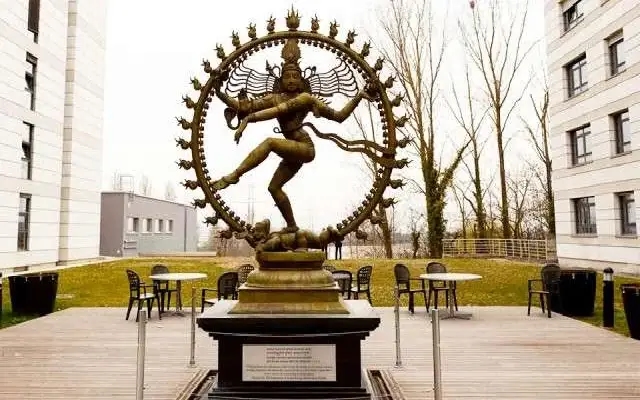
The towering Nataraja statue at CERN, home to the Large Hadron Collider, often bewilders visitors. Some skeptics dismiss it as unscientific, yet it symbolizes the very essence of physics—creation and destruction in perpetual motion. Fritjof Capra, in The Tao of Physics, describes witnessing cosmic energy flows, likening them to Shiva’s divine dance.
This dance, called Tandava, embodies five cosmic processes: creation, preservation, destruction, illusion, and liberation. The concept resonates with modern physics, where particles constantly emerge and vanish, mirroring the rhythm of the universe. French sculptor Auguste Rodin once stood spellbound before a Nataraja bronze, recognizing its unparalleled artistic depth.
CERN’s mission—to decode the universe—confronts an enigma: T = 0, the instant before time began. Science explains what follows but falters at the singularity. At quantum levels, reality defies conventional language; existence itself is a flux of probabilities.
Thus, Shiva’s cosmic dance serves as a profound reminder: the universe is not still but an eternal, dynamic movement. Whether through physics or philosophy, one truth endures—the dance never ceases.
Read Also: