







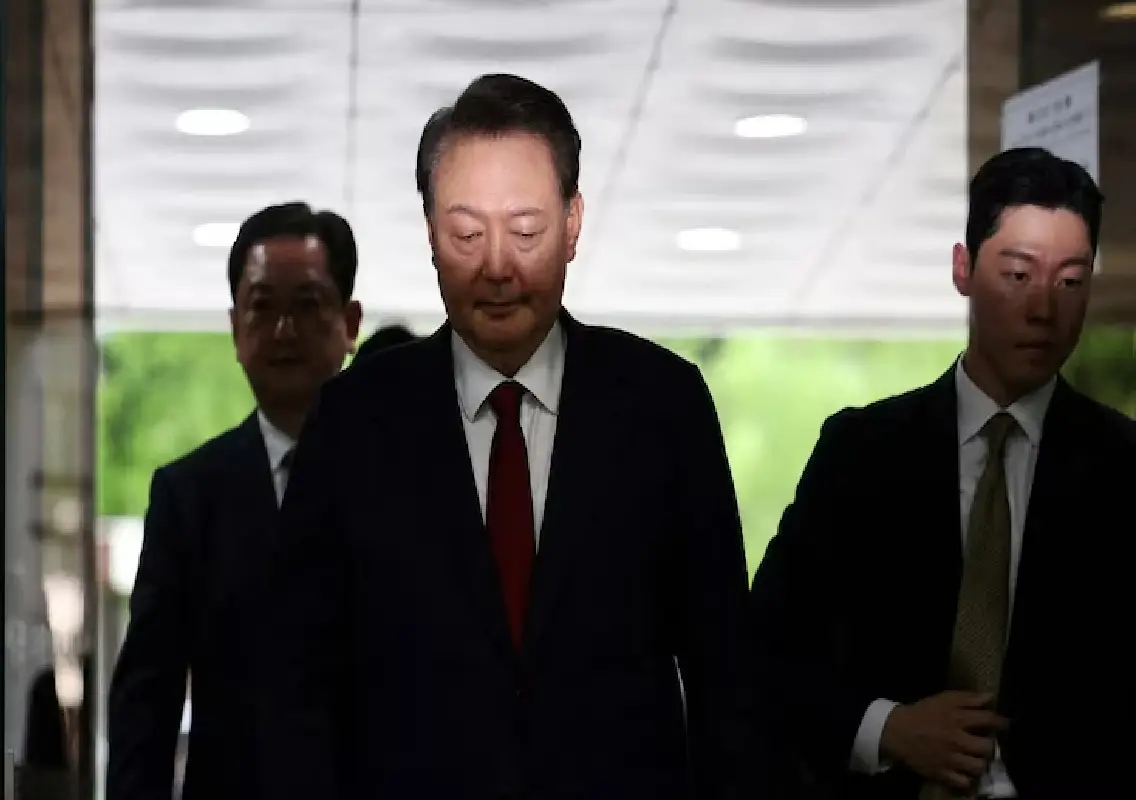


Seoul: Former South Korean president Yoon Suk Yeol could face the death penalty or life imprisonment as prosecutors move closer to seeking a sentence in the high-profile insurrection case linked to his short-lived imposition of martial law in 2024.
The country’s special prosecutor is expected to make a formal sentencing request after the final session of Yoon’s lower court trial convened on Friday at the Seoul Central District Court. Yoon, 65, stands accused of masterminding an insurrection by attempting to suspend democratic institutions and seize legislative authority through martial law.
Under South Korean law, insurrection is one of the gravest offences and carries a maximum punishment of death or life imprisonment. Although the country has maintained an unofficial moratorium on executions for nearly 30 years — with the last execution carried out in 1997 — capital punishment remains on the statute books.
Prosecutors outline alleged plot
During the trial, prosecutors alleged that Yoon, together with then defence minister Kim Yong-hyun, began planning the move as early as October 2023. According to the prosecution, the alleged scheme involved suspending the National Assembly, detaining political opponents and consolidating power within the executive.
Prosecutors claimed Yoon intended to label opposition leaders, including then-opposition chief Lee Jae Myung, as “anti-state forces” in order to justify their detention under emergency powers. They further alleged that Yoon and Kim attempted to manufacture a pretext for declaring martial law by deliberately escalating tensions with North Korea, including through a covert drone operation.
Shockwaves across the economy and democracy
Although the martial law declaration on December 3, 2024, lasted only around six hours, it sent shockwaves through South Korea, Asia’s fourth-largest economy and a key security ally of the United States. The move was widely seen as an unprecedented challenge to the country’s democratic order, which had long been regarded as one of the most resilient in Asia.
Lawmakers famously scaled fences and broke through security cordons around the National Assembly to convene an emergency session and vote down the martial law decree, forcing its swift revocation.
Yoon denies wrongdoing
Yoon has consistently denied all charges, arguing that the declaration of martial law fell within his constitutional powers as president. The conservative leader has maintained that the move was intended to “sound the alarm” over what he described as persistent obstruction of government functioning by opposition parties.
Appearing in court on Friday dressed in a dark suit and white shirt, Yoon looked noticeably thinner than at the start of the trial in February. He sat alongside seven other defendants, including Kim Yong-hyun, as defence lawyers presented their final arguments.
Political fallout and impeachment
The fallout from the crisis proved politically devastating for Yoon. He was impeached by the National Assembly and subsequently removed from office by the Constitutional Court. A snap presidential election held in June last year brought liberal-leaning Lee Jae Myung to power, marking a dramatic shift in South Korea’s political landscape.
The court proceedings on Friday opened earlier than usual to accommodate defence submissions, followed by the prosecution’s final arguments and sentencing requests for each of the defendants.
More charges await
Beyond the insurrection case, Yoon faces a series of additional criminal charges, including obstructing the execution of an arrest warrant and abuse of power while in office. These cases add to the legal peril confronting the former president, even as the country continues to grapple with the aftermath of the 2024 crisis.
The Seoul Central District Court is expected to deliver its verdict in February, bringing to a close more than a year of political turmoil sparked by the failed martial law attempt.
Conclusion
The case against Yoon Suk Yeol represents one of the most consequential legal and political episodes in South Korea’s modern history. As prosecutors prepare to seek the harshest penalties available under law, the trial underscores the enduring strength of South Korea’s democratic institutions — and the severe consequences faced by leaders accused of attempting to undermine them.