


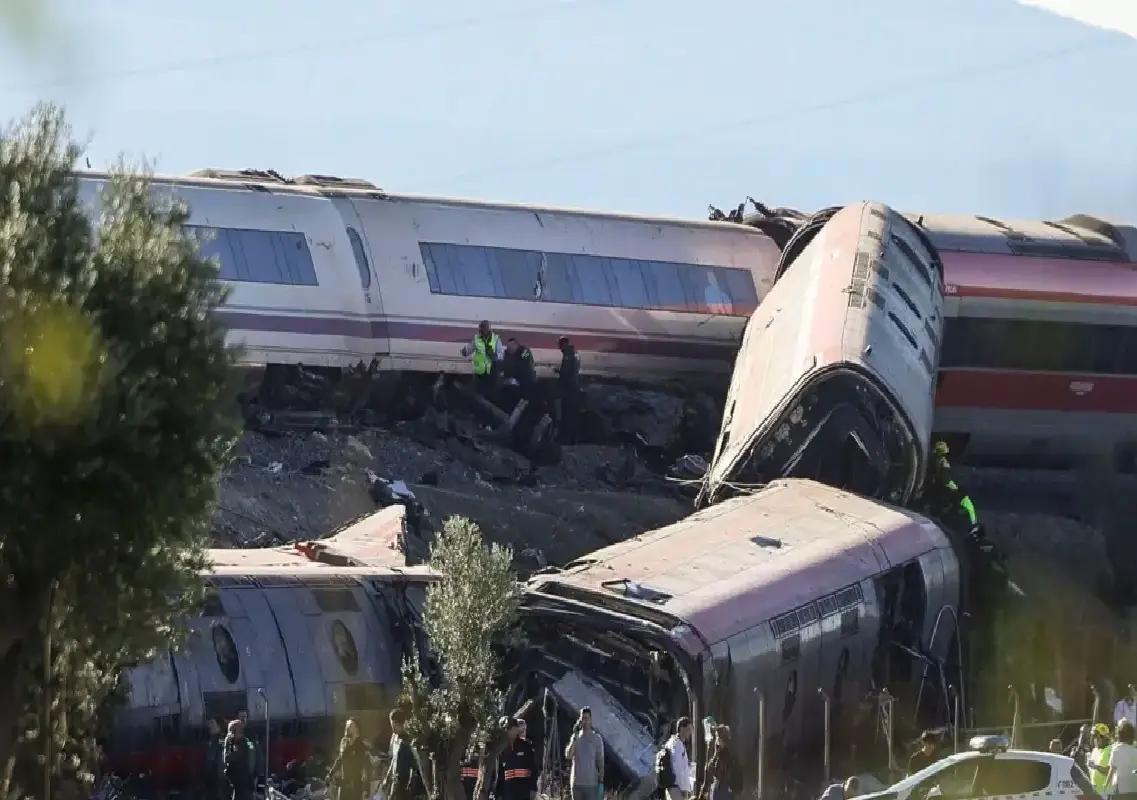


Spain: At least 64 people were killed after two high-speed trains collided in the country’s central province of Toledo on Wednesday morning, according to Spanish local media. Several passengers were also feared injured, with the death toll expected to rise as emergency services continued rescue and relief operations at the accident site.
The collision disrupted rail services connecting Madrid with Ciudad Real and Andalusia, leaving passengers facing delays and cancellations on key routes. Spain’s rail infrastructure operator, ADIF, confirmed the accident and announced the suspension of services on the affected sections as authorities responded to the emergency.
The severity of the crash, reports of injured passengers and the possibility that more people could be trapped or critically hurt raised concerns about the scale of the disaster. Emergency personnel were deployed to assist survivors, while local authorities began preparing facilities to accommodate passengers affected by the collision.
Two high-speed trains collide while travelling in the same direction
According to Spanish state broadcaster TVE, the accident involved two high-speed trains travelling in the same direction. One train reportedly struck the rear of the other, causing two carriages to derail.
The circumstances leading to the collision were not immediately clear. Authorities had yet to establish the precise sequence of events or explain why the trains collided. Further details were expected to emerge as emergency teams assessed the wreckage and investigators began examining the incident.
The collision occurred on a key rail corridor linking the Spanish capital with destinations farther south. High-speed rail services are an important part of the country’s transport network, connecting major cities and carrying large numbers of domestic and international passengers.
The suspension of services was expected to affect travellers using the routes between Madrid, Ciudad Real and Andalusia. Passengers were likely to face disruption while officials assessed the condition of the affected railway section and determined when operations could safely resume.
ADIF’s announcement confirmed that the incident had significantly affected rail operations. The immediate priority for emergency teams was to reach injured passengers, establish the full extent of the damage and ensure that those involved received assistance.
Spanish prime minister expresses solidarity with victims
Spanish Prime Minister Pedro Sánchez expressed shock over what he described as a serious train accident. He said emergency services were working at the scene to help those affected and coordinate the response with the relevant authorities.
“My affection, solidarity, and support to all the victims and their families,” Sánchez said in a statement.
His remarks came as the scale of the tragedy was still being assessed. The high death toll and reports of serious injuries prompted concern across the country, with the authorities facing the immediate challenge of managing rescue operations and supporting affected families.
The prime minister also highlighted the coordination between emergency services and the different administrations involved in responding to the crash. Such coordination is critical in major rail accidents, where rescue teams must work around damaged carriages, disrupted infrastructure and the risk of further injuries.
The authorities were expected to provide additional information as more details became available. The final casualty figures would depend on the outcome of rescue operations and confirmation of the condition of those injured.
Nearby towns prepare to assist affected passengers
Local officials in communities close to the crash site described the incident as serious and said preparations were under way to support passengers.
Manuel Galán, mayor of the nearby town of Urda, told TVE that passengers had sustained injuries. Civil protection officials had asked the town council to prepare a sports pavilion to receive people affected by the collision.
The move was intended to provide a temporary facility for passengers who required assistance or were unable to continue their journeys because of the suspension of rail services. Such arrangements can help emergency services manage the movement of survivors and ensure that affected travellers have access to basic support while transport operations remain disrupted.
Jesús Pérez, mayor of the neighbouring village of Los Yébenes, also described the incident as apparently serious.
Emiliano García-Page, president of the Castilla-La Mancha region, said in a post on X that he was travelling to the crash site. His visit was expected to provide regional officials with a direct assessment of the situation and the needs of emergency teams and affected communities.
The involvement of nearby local administrations reflected the wider impact of the crash beyond the immediate railway site. In addition to treating casualties, authorities had to account for displaced passengers, coordinate information and prepare support facilities while the investigation and rescue efforts continued.
Fresh concerns over Spain’s railway safety
The accident comes months after another deadly train crash in southern Spain raised concerns about railway safety in the country.
In January, 45 people died when a train derailed and collided with an oncoming train. That disaster was reported as Spain’s deadliest rail accident since a crash in 2013 that killed 80 people.
The latest collision is likely to renew scrutiny of the country’s extensive rail network, particularly its high-speed services, which are widely used for travel between major urban centres.
However, the cause of Wednesday’s collision had not been established in the information available at the time of reporting. It would therefore be premature to draw conclusions about whether infrastructure, signalling, operational procedures or other factors contributed to the accident.
A full investigation will be needed to determine how the trains came to collide, what caused the carriages to derail and whether any failures played a role. Investigators will also need to reconstruct the movements of both trains and examine relevant operational records.
The earlier fatal crash in January had already focused attention on the risks associated with major rail accidents. The new incident adds urgency to questions about the safeguards needed to protect passengers, although the two crashes may have different causes.
Rescue operations and service disruption continue
As emergency services continued responding to the collision, the immediate focus remained on helping injured passengers, confirming casualties and supporting those affected.
The suspension of rail services also created a significant challenge for travellers using the Madrid–Ciudad Real–Andalusia corridor. Authorities will need to assess the affected infrastructure before determining when services can resume safely.
With reports indicating that several people were critically injured, the death toll could rise further. Officials were expected to release more details as the rescue operation progressed and the condition of injured passengers became clearer.
The disaster has once again placed Spain’s railway network under scrutiny. The priority now is to establish the full extent of the tragedy, provide assistance to survivors and families, and determine the circumstances that led to the collision.