







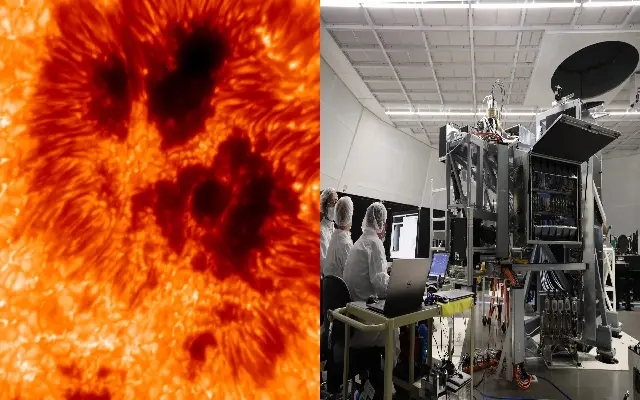


The Daniel K. Inouye Solar Telescope has achieved a major milestone with the first light from its revolutionary Visible Tunable Filter (VTF). Perched atop Maui’s Haleakalā and operated by the National Solar Observatory (NSO) under the U.S. National Science Foundation (NSF), the telescope now boasts the world’s most advanced solar imaging technology.
The VTF, crafted by Germany’s Leibniz Institute for Solar Physics, acts as a cutting-edge imaging spectro-polarimeter, capturing the Sun in exceptional magnetic and spectral clarity. Early images reveal sunspots at a resolution of just 10 kilometers, offering a detailed glimpse into the Sun’s magnetic intricacies and solar flare origins.
Unlike conventional instruments, the VTF uses precisely spaced glass plates, called etalons, to scan different light wavelengths with atomic precision. This method provides a three-dimensional, ultra-detailed view of solar structures. It can record 12 million spectra per session, decoding temperatures, velocities, pressures, and magnetic field strengths across the solar atmosphere.
Light’s polarization is also analyzed, revealing hidden magnetic field details crucial for understanding solar storms. Scientists anticipate that this leap in solar observation will significantly boost space weather forecasting, helping protect satellites, power grids, and communication systems on Earth.
The Inouye Telescope, with its 4-meter primary mirror and now a full suite of first-generation instruments, sets a new benchmark in solar physics, unlocking unprecedented knowledge of our nearest star’s behavior and its effects on our planet.
Read Also: