







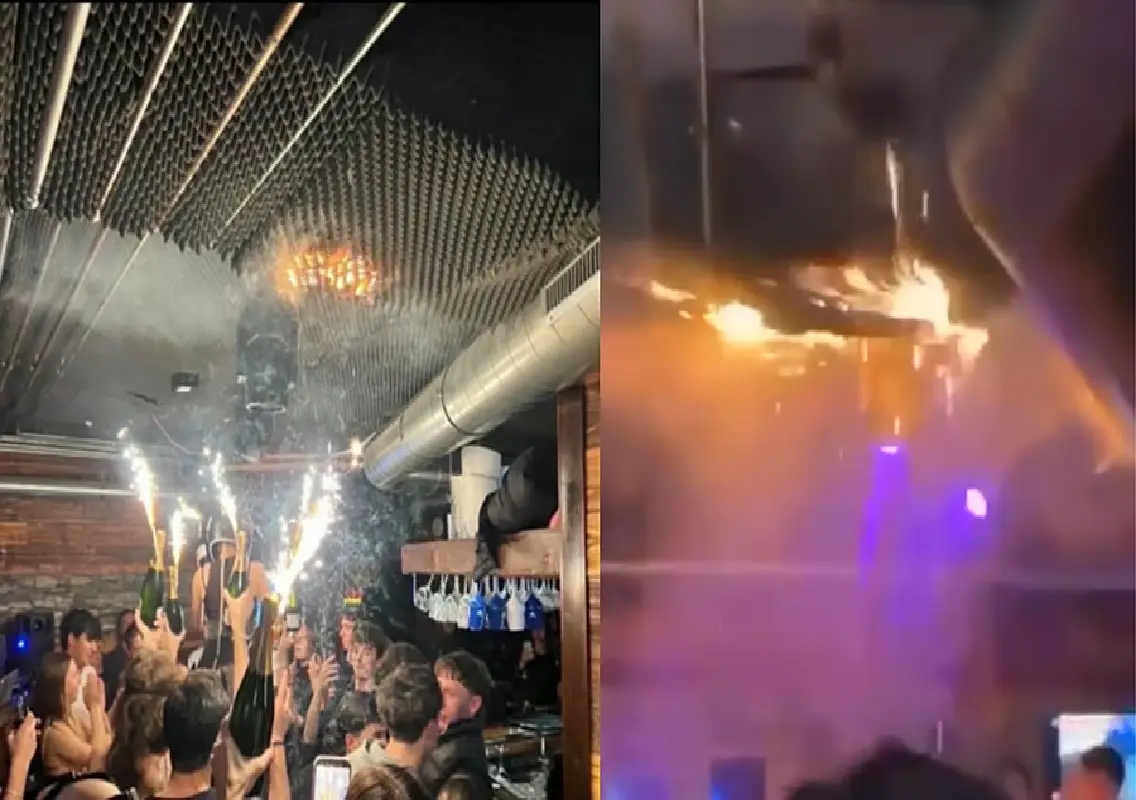


Switzerland: Swiss authorities investigating the deadly fire at a bar in the ski resort town of Crans-Montana have indicated that a phenomenon known as a flashover is the likely cause behind the rapid spread of flames that killed around 40 people in the early hours of Thursday. While the exact cause of the blaze remains under investigation, officials and fire safety experts say preliminary findings strongly point towards this deadly fire behaviour in an enclosed space.
The fire broke out at Le Constellation, a popular bar frequented by tourists and locals alike. Witnesses reported flames engulfing the building within minutes, followed by at least one explosion, leaving little time for those inside to escape. Emergency services rushed to the spot, but by the time firefighters gained control of the blaze, dozens of people had already lost their lives.
What is a flashover?
A flashover is one of the most dangerous phenomena in fire science. According to fire experts, it occurs when a fire in an enclosed space rapidly spreads after temperatures rise to a critical point, causing almost everything in the room to ignite nearly simultaneously.
When a flame is not extinguished quickly, hot gases rise and accumulate near the ceiling, spreading intense heat across the room. As temperatures soar, often reaching as high as 1,000 degrees Fahrenheit (around 540 degrees Celsius), all combustible materials — furniture, wooden fittings, decorations, plastics, and fabrics — reach their ignition temperature and burst into flames almost at once.
Steve Kerber, executive director of the Fire Safety Research Institute in Maryland, explained that flashovers can occur extremely quickly. “All the wood, all the seats, all of the decorations and everything else in the room would be heated to the ignition temperature,” he said. “If you have very combustible materials, like plastics, it happens very fast.”
Initial findings point to sparklers
Beatrice Pilloud, the local attorney general overseeing the investigation, told reporters at a news conference on Friday that early evidence suggests the fire may have started from sparklers attached to bottles of Champagne. These sparklers, commonly used during celebrations, were allegedly held too close to the ceiling, where heat and flammable materials were present.
Investigators believe that the sparks or flames ignited ceiling decorations or other combustible materials, allowing the fire to spread upwards rapidly. Once the ceiling caught fire, the conditions for a flashover were created within minutes.
Fire experts say that in rooms filled with modern furnishings and decorations, flashovers can develop in as little as three to five minutes. “A flame can spread from a candle to a sofa, then to the carpet and the rest of the room very quickly,” Kerber noted.
Deadly and almost unsurvivable
Flashovers are almost always fatal for those caught inside. The intense heat and toxic smoke make survival extremely unlikely. Even trained firefighters wearing full protective gear would struggle to withstand such temperatures, according to the National Fire Protection Association (NFPA).
“Those are temperatures well beyond what you could get away with breathing,” Kerber said, highlighting how quickly people inside would have been incapacitated.
Authorities fear that this explains the high death toll at the Crans-Montana bar, where many victims were found unable to escape despite being close to exits.
Not an isolated phenomenon
While flashovers sound dramatic, experts say they are not rare. “There are flashovers that happen every single day all around the world,” Kerber said. “Every major fire has a room or multiple rooms that transition through flashover.”
One of the most notorious examples was the 2003 nightclub fire in Rhode Island, United States, which killed 100 people. In that incident, pyrotechnics used during a band performance ignited soundproofing foam on the walls and ceiling, leading to a rapid flashover. Fire officials have noted similarities between that tragedy and the Swiss bar fire, particularly the role of celebratory flames and combustible interior materials.
Prevention and safety concerns
Fire safety experts stress that flashovers are largely preventable. Automatic sprinkler systems can significantly slow or stop a fire before temperatures reach flashover levels. Strict adherence to fire safety regulations, including limits on flammable decorations, proper ceiling materials, and clearly accessible exits, also plays a crucial role.
Authorities are now examining whether Le Constellation complied with Swiss fire safety codes, including the presence of sprinklers, fire alarms, and the nature of interior materials used. Questions are also being raised about the use of sparklers and similar open flames in enclosed nightlife venues.
Conclusion
As Switzerland mourns the loss of around 40 lives, investigators continue to piece together the final moments before the blaze engulfed the Crans-Montana bar. While the official cause is yet to be confirmed, authorities believe a flashover triggered by celebratory sparklers is the most likely explanation for the speed and severity of the tragedy. The incident has reignited global discussions on fire safety in enclosed public spaces and the urgent need for stricter enforcement to prevent such catastrophic loss of life in the future.