







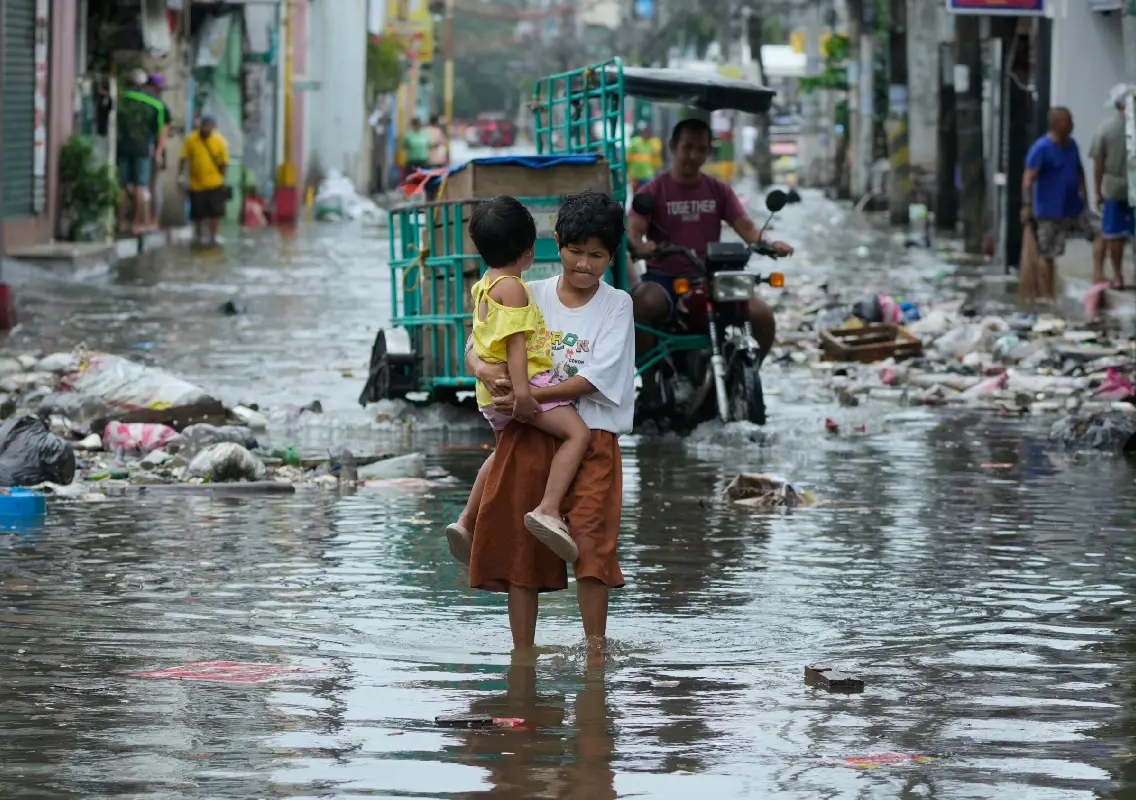


Taiwan evacuated more than 3,000 people from high-risk areas and closed schools and offices on Tuesday as tropical storm Fung-wong approached the island after leaving a trail of destruction in the Philippines, where at least 18 people were killed and over 1.4 million displaced.
Storm weakens but remains a major threat
Fung-wong, which was earlier classified as a typhoon, has weakened while moving towards Taiwan but continues to pose serious risks of heavy rain, flooding, and landslides. The storm is expected to make landfall on Wednesday afternoon or evening near the southwestern port city of Kaohsiung, Taiwan’s Central Weather Administration said.
As of Tuesday morning, the storm had maximum sustained winds of 108 km/h and gusts reaching 137 km/h. Meteorologists expect Fung-wong to sweep across Taiwan and exit from the island’s northeastern coast by Wednesday night or early Thursday.
Evacuations and closures across eastern Taiwan
Authorities said more than 3,300 residents from four counties and cities have been moved to safer areas, including those in Hualien and Guangfu Township, where previous typhoon-triggered floods and landslides have claimed lives.
In September, a barrier lake overflow in the same region had killed 18 people, prompting authorities to take extra precautionary measures this time. Schools and offices have been closed in Hualien and Yilan counties, while a land warning has been issued for Taiwan’s southern and southwestern areas, including Kaohsiung, Pingtung County, Tainan, and Taitung.
Local officials have also urged fishermen and coastal residents to remain alert as the storm’s outer rainbands could trigger flash floods and mudslides in mountainous regions.
China issues typhoon alert for coastal provinces
China’s emergency management ministry said it had activated a Level IV emergency response — the lowest in its four-tier system — for southeastern provinces, including Fujian, Guangdong, Zhejiang, and Hainan, in anticipation of the storm’s potential impact later this week.
Authorities in Fujian have warned of heavy rainfall and rough seas, advising fishing boats to return to port and coastal industries to suspend operations temporarily.
Philippines reels from Fung-wong’s devastation
Before approaching Taiwan, Fung-wong slammed into the Philippines’ northern coast on Sunday as a super typhoon, packing maximum sustained winds of 185 km/h and gusts up to 230 km/h. The 1,800-kilometre-wide storm battered several northern provinces, unleashing flash floods and landslides that killed at least 18 people and left a massive humanitarian crisis in its wake.
More than 1.4 million people were displaced, including about 803,000 taking refuge in over 11,000 evacuation centres across northern Luzon, according to the Philippines Office of Civil Defense.
Among the victims were three children whose homes were buried in separate landslides in Nueva Vizcaya province. Two villagers were killed in nearby Kalinga province, while two others remained missing as of Tuesday.
Officials said dozens of roads and bridges remain impassable due to flooding, while power outages and communication disruptions have affected relief efforts.
Coordinated regional preparedness
Authorities in Taiwan and the Philippines are coordinating with meteorological agencies in China and Japan to track the storm’s shifting trajectory and share real-time updates. Taiwan’s defence ministry has also placed military rescue teams on standby in case of large-scale flooding or landslides.
President Tsai Ing-wen urged citizens to stay indoors and follow evacuation advisories, saying, “Safety must come first. Please cooperate with local authorities and avoid unnecessary travel until the storm passes.”
Fung-wong’s path and expected impact
Although Fung-wong is expected to weaken further into a tropical depression after crossing Taiwan, the storm’s wide diameter and heavy moisture content could still cause widespread rainfall across the island’s southern and central regions.
The Central Weather Administration warned that mountainous areas could receive up to 500 mm of rainfall, increasing the risk of flash floods and soil liquefaction. Coastal regions, especially in southern Taiwan, could also experience storm surges and high tides.
Aftermath and ongoing monitoring
Disaster relief agencies have been instructed to monitor reservoir levels and ensure uninterrupted power and water supply in affected regions. Officials have also dispatched teams to inspect bridges and embankments to prevent structural damage.
While Fung-wong’s intensity is gradually declining, meteorologists cautioned that it could still cause significant agricultural and infrastructural losses before dissipating later this week.