







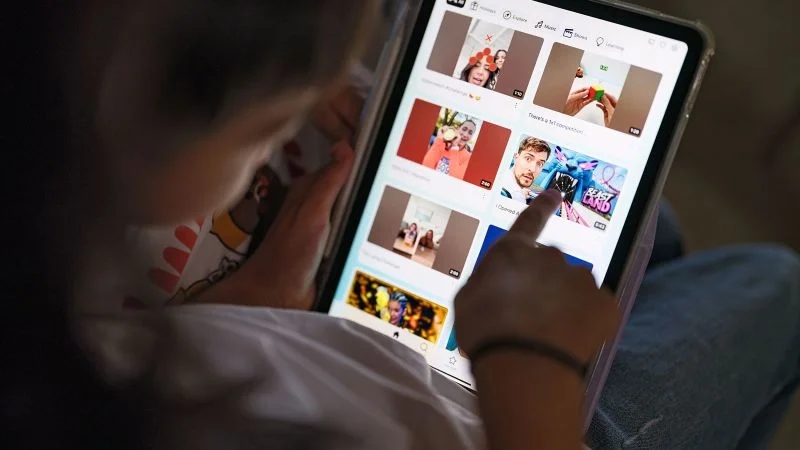


As Australia’s landmark ban on social media use for children under 16 comes into full effect this week, a case involving a 15-year-old Sydney boy has highlighted the practical challenges of enforcing age verification online.
The teenager, referred to as Charlie to protect his identity, successfully passed Snapchat’s visual age estimation check, despite being under the legal age, raising questions about the reliability of facial recognition tools used by platforms to comply with the new law.
How the age check was bypassed
Charlie received a notification from Snapchat last week asking him to verify his age to continue using the app. Although his account date of birth indicated he was over 16, Snapchat required additional verification under Australia’s new rules.
He opted for a facial age estimation test, powered by technology from verification firm k-ID, which involves taking a selfie that is analysed to estimate the user’s age.
Within moments, the system cleared him as being over 16.
“It just said something like, ‘Thank you, we won’t bother you any more,’” Charlie said, adding that he was surprised the process was so quick and simple.
Snapchat flags technical challenges
Responding to the case, a Snapchat spokesperson said the company had long warned about the technical difficulties of accurately enforcing age-based bans on social platforms.
“This is one such challenge,” the spokesperson said, adding that Snapchat believes age verification would be more effective if implemented at operating system, device or app store levels, rather than relying on individual apps.
Snapchat also confirmed that parents can report accounts they believe belong to underage users, triggering further review.
Parents voice frustration
Charlie’s mother, Christine*, said the incident left her frustrated and uncertain about how effective the new law would be.
“If they’re relying on facial recognition and algorithms, is there really a clear difference between a 15-year-old and a 16-year-old?” she asked. “It feels like an uphill battle.”
She said she was now actively looking for ways to report her son’s account to ensure compliance.
Government acknowledges imperfections
Prime Minister Anthony Albanese, writing in a News Corp opinion piece on Sunday, acknowledged that the system would not be flawless.
“We’ve acknowledged this process won’t be 100% perfect,” he wrote. “But the message this law sends will be 100% clear.”
Drawing a parallel with Australia’s legal drinking age, Albanese argued that occasional breaches do not undermine the value of having a clear national standard.
“This law is about making it easier for parents to have conversations with their children about online risks and harms,” he said.
Other platforms under scrutiny
Charlie said he also uses Instagram and TikTok, but has not yet been prompted for age verification on those platforms. Both are included under the ban and have stated they are complying with the legislation.
A TikTok spokesperson said the platform would continue actively identifying underage accounts, even if some initially bypass checks. Meta-owned platforms, including Instagram and Facebook, allow users to report underage accounts directly within the app.
However, it remains unclear whether all platforms will provide parents with simple reporting mechanisms, a concern raised by child safety advocates.
A test case for digital regulation
The incident underscores the complex reality of regulating children’s access to social media, especially as platforms increasingly rely on AI-driven tools for age estimation.
While Australia’s ban aims to support parents and reduce peer pressure, cases like Charlie’s suggest enforcement will depend heavily on technology accuracy, parental involvement and platform accountability.
As the law comes into force nationwide, policymakers and tech companies alike will be closely watching whether safeguards evolve quickly enough to match the intent of the legislation.